Loading...
The National One Health Mission's inaugural executive committee meeting was chaired by Union Health Minister JP Nadda on 10 July 2024. Participants included Dr V K Paul (Member-Health, Niti Aayog) and Dr Ajay Kumar Sood (Principal Scientific Advisor). The mission, emphasizing the "One Health" approach, aims to achieve integrated disease control and pandemic preparedness in India. Minister Nadda stressed leveraging existing programs across ministries for holistic and sustainable health management of humans, animals, plants, and the environment.
Prof. Ajay Kumar Sood, Principal Scientific Adviser to the Government of India wrote about the Holistic Approach to Public Health with the National One Health Mission in an editorial for The Hindu on 11th of April 2024. National One Health Mission, steered by O/o PSA, is a significant step towards a comprehensive approach to public as well as animal health. This mission recognizes the interconnectedness of human, animal, and environmental health, aiming to address disease outbreaks and improve overall health outcomes across all sectors
|The Union Cabinet chaired by Prime Minister Shri Narendra Modi approved the creation of post of Director of National Institute of One Health, Nagpur to spearhead National One Health Mission for integrated disease control and pandemic preparedness on 29 Feb 2024. 13 Departments have worked together to develop the Mission aimed at addressing pressing issues under One Health.
|A workshop on ‘Environmental Surveillance for One Health’ was organised on 9th February 2023 by the Office of PSA in collaboration with ARTPARK at IISc Bengaluru.
|Animal Pandemic Preparedness Initiative and World Bank-funded Animal Health System Support for One Health launched to enhance India's preparedness and response to potential animal pandemics, under the One Health Mission
|Central Zoo Authority hosted the 2nd National Stakeholder Workshop on Wildlife Health and One Health Collaboration. The workshop served as a platform for insightful discussions and a consultative approach towards the development of the National Referral Centre for Wildlife
What is One Health
One Health is a collaborative, multidisciplinary approach that unites human, animal, and environmental health sectors. It recognizes the interconnectedness of these domains, aiming to optimize health outcomes and address challenges across the sectors.
One Health has major implications for India. India with its diverse wildlife, one of the largest livestock populations and high density of human population, carries heightened risks for inter-compartmental spread of diseases. One health approach relies on shared and effective governance, communication, collaboration and coordination. Having the One Health approach in place makes it easier for people to better understand the co-benefits, risks, trade-offs and opportunities to advance equitable and holistic solutions.
The Covid pandemic, outbreaks of Lumpy Skin Disease in cattle and the constant threat of Avian Influenza demonstrate the need to address diseases across all sectors. Livestock, wildlife and plant sectors impact productivity, health and conservation aspects. This also opens opportunities for leveraging the complementarity and strengths that are inherent in each sector and devising integrated, robust and agile response systems.
A collaborative and multidisciplinary approach uniting human, animal and environmental health sectors, recognising that the health of people, animals and our planet are all inextricably linked.
National One Health Mission
There are many One Health efforts underway in various Ministries of the Government of India, in private organizations in addition to a range of activities globally. This presents a prospect to review the areas of focus underlying each effort, identify opportunities for collaboration and work towards filling any remaining gaps. Considering this, The Prime Minister's Science, Technology, and Innovation Advisory Council (PM-STIAC) in its 21st meeting, approved to set up a National One Health Mission with a cross-ministerial effort which will serve to coordinate, support, and integrate all the existing One Health activities in the country and fill gaps where it is appropriate. The Indian Council of Medical Research (ICMR) is the implementing agency for One Health Mission.
The mission received further impetus in February 2024, with the approval of the Director position for National Institute of One Health, Nagpur by the Union Cabinet chaired by Prime Minister Narendra Modi. This institute will be the anchor for the One Health mission and co-ordinate the activities of the mission in the country.
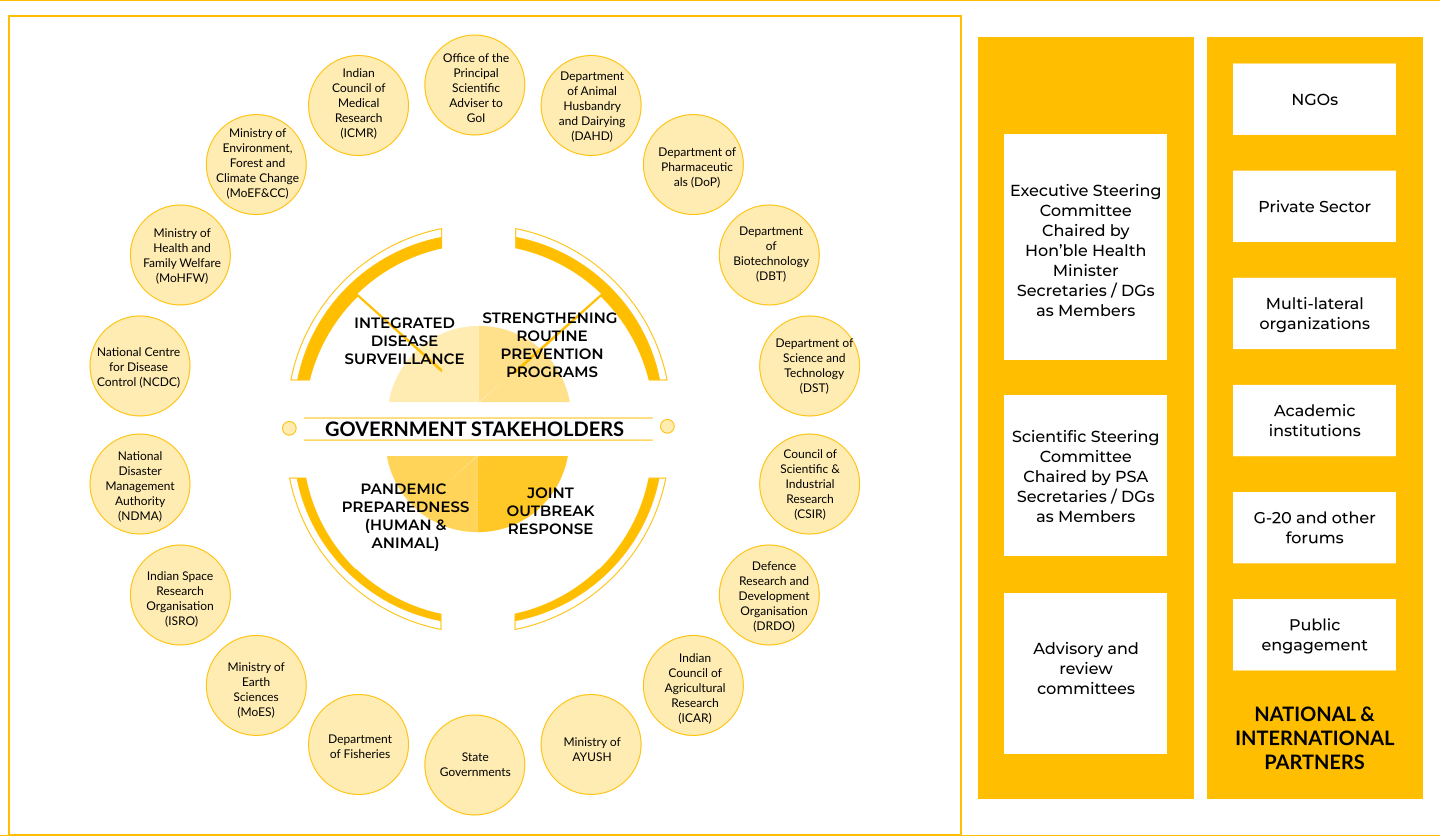
An integrated framework developed collaboratively by over 13 government ministries/ departments guides the mission. This framework facilitates coordination and synergy across sectors for priority activities.
The governance of the National One Health Mission is two tiered:
• Executive Committee: The Executive committee chaired by Hon’ble Minister, MoHFW with PSA as vice chair and Member Health, NITI Aayog is a permanent invitee. Secretaries of various stakeholder departments and two states (on rolling basis) are members. The committee provides overall policy guidance for the progress of the mission and its associated activities.
• Scientific Steering Committee: The committee is chaired by the PSA and has Secretaries/DGs of all stakeholder departments and two states (on rolling basis) as members. It provides overall scientific direction, oversight and guidance to the National One Health Mission.
• Advisory and review committee: Advisory and Review Committees provide thematic expertise to the Mission by bringing together experts from government, academia, research institutions, and partner organizations. They guide the Mission's technical priorities, review progress, and recommend strategies to strengthen One Health implementation.
Goals of the One Health Mission
The Mission aims to coordinate across achieving overall pandemic preparedness and integrated disease control against priority diseases of human, animal and environmental sectors with early warning systems built on integrated surveillance system and response readiness for endemic as well as emerging epidemic or pandemic threat.
The mission will also address critical pillars of preparedness in the form of targeted R&D to develop critical tools such as vaccines, diagnostics and therapeutics, readiness in terms of clinical care, streamline data and information linkages and access across sectors as well as close community participation to keep our readiness to respond.
The following robust efforts are being undertaken to achieve the various goals under the mission:
Preparedness is important not just the human pandemics but also the animal diseases of pandemic potential which have high economic costs to the farmers and can have important implications for wildlife conservation through spread into protected species. Human and animal pandemic preparedness is a key pillar of the One Health Mission, which relies on effective surveillance stategies, developing early warning systems, boostiong research, innovation and manufacturing, infrastructure, community engagement and data integration across sectors.
One of the key initiatives, under this goal is creation of a network of BSL 3/4 labs, within the framework of the One Health Mission. This network will play a critical role in preventing, detecting, and responding promptly and effectively to disease outbreaks across human, livestock and wildlife sectors. Currently there are 22 labs in this Network. This network which is geographically distributed and accessible to all stakeholders (humans, livestock and wildlife) for analysis of disease outbreak samples will enhance India’s preparedness for emergencies.

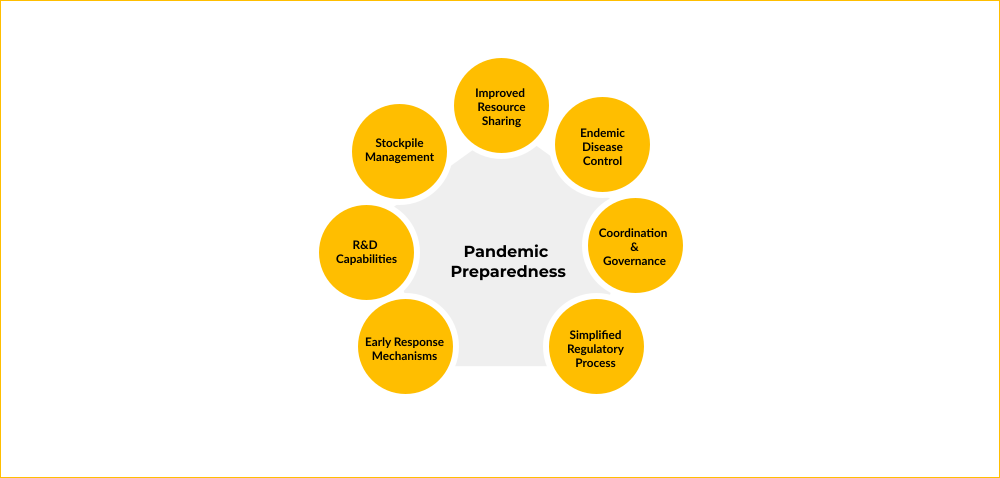
All the aspects of pandemic preparedness will be embedded in the routine prevention programs to ensure sustainability and continued improvement of both aspects.
Enablers of the One Health Mission
These outcomes of the One Health Mission will be supported by critical enabling initiatives. Many of these initiatives are ongoing and will be strengthened under the mission and several new activities that will facilitate the goals of the mission will be undertaken.

Build a Governance Model
One Health mission has a collaborative Governance model with decentralized decision making. To ensure sustainability and continued improvement of all aspects of the mission, integration of the efforts into existing programs will be done.
To effectively address the diverse aspects of the National One Health Mission, four specialized advisory and review committees have been established. These committees focus on the following key themes:
1. National network of BSL 3/ 4 laboratories
2. Technology enhanced integrated surveillance & outbreak investigation
3. Research and Development on medical countermeasures
4. Integration of databases and data sharing.
Targeted R&D
Streamline Regulatory and Approval Process
State Engagement
International Connect
The ability to predict, detect and respond to an infectious disease reflects fundamental capability of a system, and the efforts mentioned above are useful not just for natural origins of the infection but also accidental or intentional spreads. One Health concept is comprehensive and encompasses overall health of all living beings as well as that of the environment. This includes issues such as food security, water quality, antimicrobial resistance, and climate change. These are also being handled globally through quadripartite and G-20 forum. This mission aims to take up the specific issue of integrated disease control and pandemic preparedness within the broader landscape of One Health. Achieving meaningful progress in a focused manner will not only help in addressing this important topic and but also will provide valuable insights and lessons to further take up other issues of One Health.