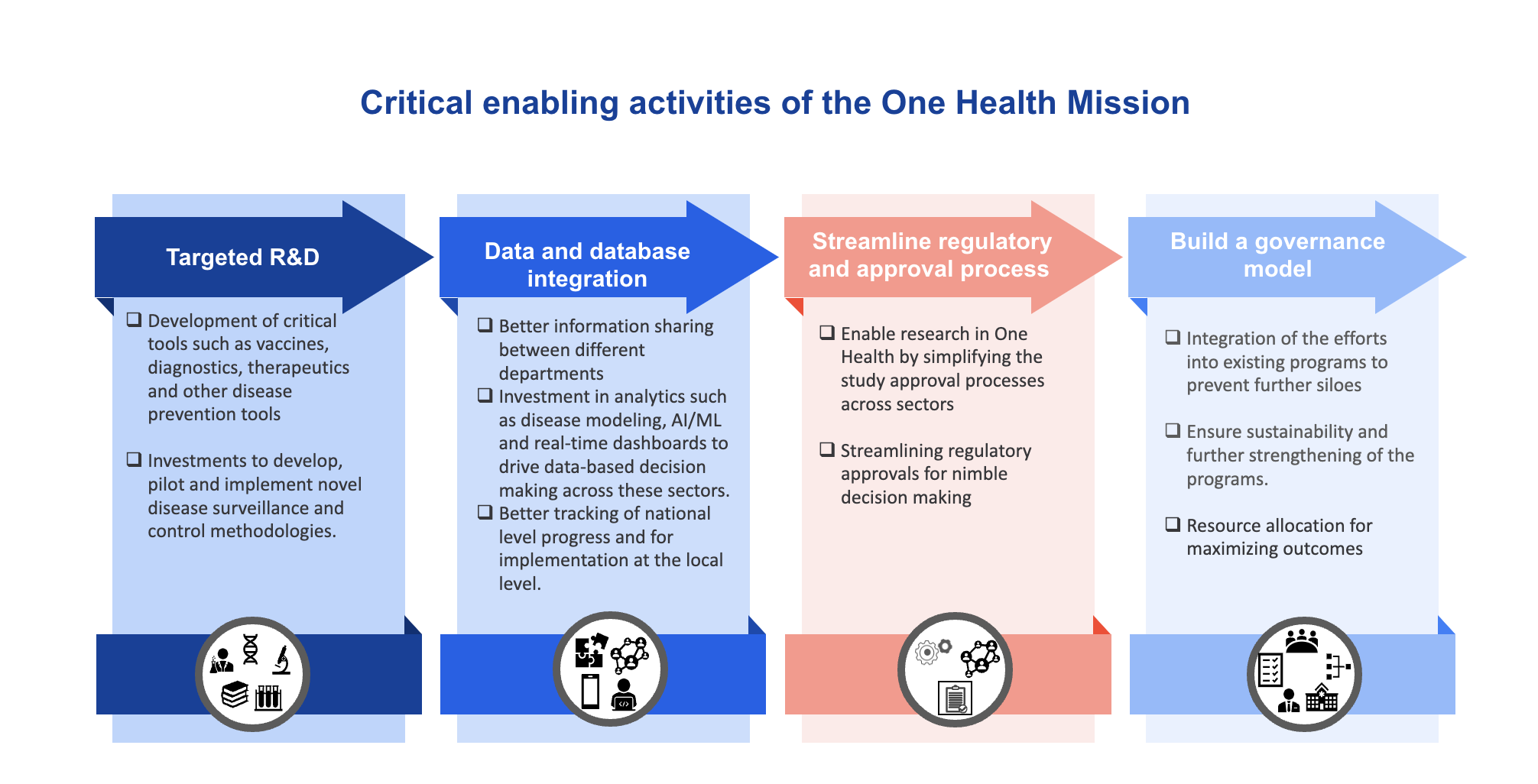
Critical enabling activities are the initiatives undertaken to achieve the goals on the National One Health Mission. Many of these initiatives are ongoing and will be strengthened and several new activities will be added with time.
Critical enabling activities of the One Health Mission
DescLinks
Detail
The National One Health Mission's inaugural executive committee meeting was chaired by Union Health Minister JP Nadda on 10 July 2024. Participants included Dr V K Paul (Member-Health, Niti Aayog) and Dr Ajay Kumar Sood (Principal Scientific Advisor). The mission, emphasizing the "One Health" approach, aims to achieve integrated disease control and pandemic preparedness in India. Minister Nadda stressed leveraging existing programs across ministries for holistic and sustainable health management of humans, animals, plants, and the environment.
Prof. Ajay Kumar Sood, Principal Scientific Adviser to the Government of India wrote about the Holistic Approach to Public Health with the National One Health Mission in an editorial for The Hindu on 11th of April 2024. National One Health Mission, steered by O/o PSA, is a significant step towards a comprehensive approach to public as well as animal health. This mission recognizes the interconnectedness of human, animal, and environmental health, aiming to address disease outbreaks and improve overall health outcomes across all sectors
The Union Cabinet chaired by Prime Minister Shri Narendra Modi approved the creation of post of Director of National Institute of One Health, Nagpur to spearhead National One Health Mission for integrated disease control and pandemic preparedness on 29 Feb 2024. 13 Departments have worked together to develop the Mission aimed at addressing pressing issues under One Health.
A workshop on ‘Environmental Surveillance for One Health’ was organised on 9th February 2023 by the Office of PSA in collaboration with ARTPARK at IISc Bengaluru.
Animal Pandemic Preparedness Initiative and World Bank-funded Animal Health System Support for One Health launched to enhance India's preparedness and response to potential animal pandemics, under the One Health Mission
Central Zoo Authority hosted the 2nd National Stakeholder Workshop on Wildlife Health and One Health Collaboration. The workshop served as a platform for insightful discussions and a consultative approach towards the development of the National Referral Centre for Wildlife
Exercises to strengthen the existing programs and enable their integration in the One Health Mission
State pilots are being developed to better inform the implementation and to ensure that the Mission is grounded and informed by ongoing activities and capabilities. Moreover, following detailed mapping exercises are being conducted. This will ensure continuous strengthening of the existing programs and systems.
Disease gap prioritization exercise: A comprehensive collation of all the diseases of One Health priorities (zoonotic, transboundary animal diseases and diseases of epidemic/pandemic potential) and available interventions (vaccines, therapeutics, and diagnostics) across human, animal husbandry and wildlife sectors has been performed with extensive consultations. Gaps thus identified will be prioritized to serve as a guide for targeted R&D or epidemiological studies. This is envisioned to be a live database that will be continuously updated as the program evolves.
Mapping of existing surveillance programs: Before considering integrating disease surveillance, a comprehensive mapping of all ongoing disease surveillance programs (both active and passive surveillance) across the sectors has been undertaken. Overlaps and potential opportunities for integrating them further will be taken up.
Mapping of laboratory capabilities of existing and upcoming BSL-2, 3 and 4 levels for better understanding of country’s capabilities has been done. This critical lab infrastructure will be better integrated into a national network to achieve effective resource utilization and capacity building both for routine disease control and addressing emerging pandemics.
Mapping institutional capabilities: India has strong capabilities both within and outside government departments. A mapping exercise was undertaken to assess the core capabilities of institutions of the stakeholder departments and highlight where they can contribute towards the Mission. This will further provide a collective understanding of the roles to be played in building a One Health ecosystem.
The ability to predict, detect and respond to an infectious disease reflects fundamental capability of a system, and the efforts mentioned above are useful not just for natural origins of the infection but also accidental or intentional spreads. One Health concept is comprehensive and encompasses overall health of all living beings as well as that of the environment. This includes issues such as food security, water quality, antimicrobial resistance, and climate change. These are also being handled globally through quadripartite and G-20 forum. This mission aims to take up the specific issue of integrated disease control and pandemic preparedness within the broader landscape of One Health. Achieving meaningful progress in a focused manner will not only help in addressing this important topic and but also will provide valuable insights and lessons to further take up other issues of One Health.
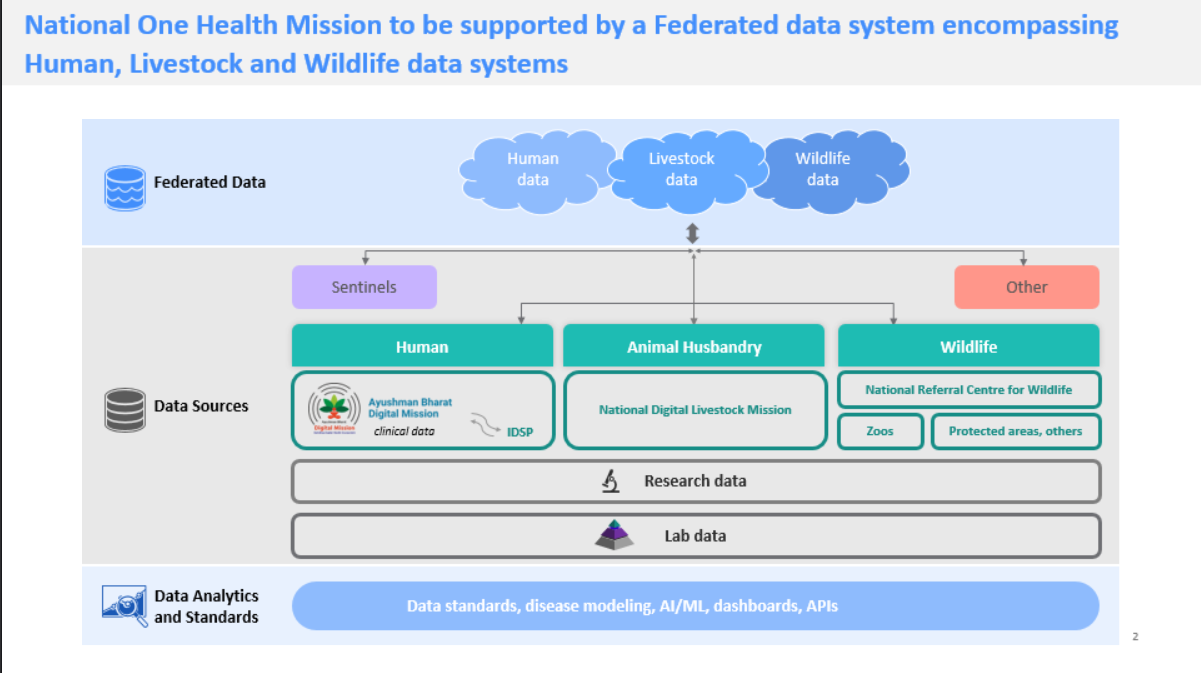
Data related efforts are the most significant backbone of One Health Mission. An integrated data platform will be built to host data on disease spread across all sectors, data to guide R&D and preparedness efforts, data for better public health and other program design and monitoring effectiveness etc.
A Federated model will be followed where-in data will be held in different distributed places and it will be integrated by APIs and other technical means by harmonizing the input, and following the data standards. All the stakeholder departments will be contributors and users of this platform. The data platform will host data related to, but not limited to-
Integrating surveillance and routine care data within sectors and across sectors like integrating across human health sectors (efforts on linking vector born and NCDC data). Integrating information across sectors, such as between IDSP/NDLM/NRC-W and beyond.
Disease incidences and outbreaks across sectors
R&D and preparedness efforts
Various analytics such as disease modeling, epidemiology capabilities etc. for better decision making
A schematic representation of the integrated data ecosystem is mentioned below-
Exercises Details
The ability to predict, detect and respond to an infectious disease reflects fundamental capability of a system, and the efforts mentioned above are useful not just for natural origins of the infection but also accidental or intentional spreads. One Health concept is comprehensive and encompasses overall health of all living beings as well as that of the environment. This includes issues such as food security, water quality, antimicrobial resistance, and climate change. These are also being handled globally through quadripartite and G-20 forum. This mission aims to take up the specific issue of integrated disease control and pandemic preparedness within the broader landscape of One Health. Achieving meaningful progress in a focused manner will not only help in addressing this important topic and but also will provide valuable insights and lessons to further take up other issues of One Health.
Preparedness is important not just the human pandemics but also the animal diseases of pandemic potential which have high economic costs to the farmers and can have important implications for wildlife conservation through spread into protected species. Human and animal pandemic preparedness is a key pillar of the One Health Mission, which relies on effective surveillance stategies, developing early warning systems, boostiong research, innovation and manufacturing, infrastructure, community engagement and data integration across sectors.
One of the key initiatives, under this goal is creation of a network of BSL 3/4 labs, within the framework of the One Health Mission. This network will play a critical role in preventing, detecting, and responding promptly and effectively to disease outbreaks across human, livestock and wildlife sectors. Currently there are 22 labs in this Network. This network which is geographically distributed and accessible to all stakeholders (humans, livestock and wildlife) for analysis of disease outbreak samples will enhance India’s preparedness for emergencies.
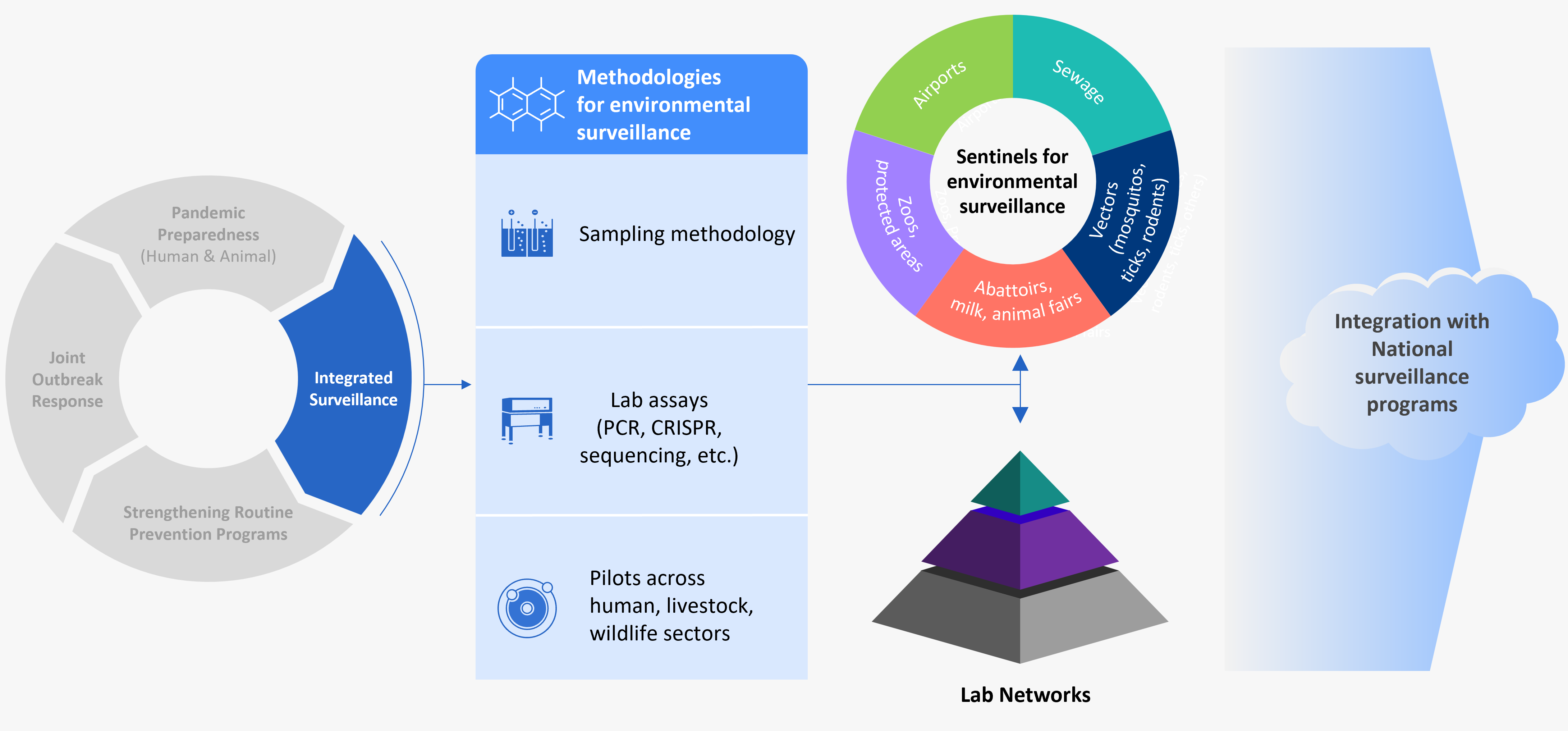
The National One Health Mission prioritizes implementing integrated disease surveillance across human, animal, and environmental sectors to address zoonotic diseases, transboundary animal diseases and diseases of epidemic/pandemic potential. This includes building early warning systems and integrating information from clinical and epidemiological data, information from various surveillance programs and deploying novel approaches such as environmental surveillance for timely and more accurate detection of diseases. Novel approaches such as Environmental surveillance can be deployed for augmenting the robustness of the surveillance systems.
The One Health Mission envisions a sentinel-based surveillance network that provides real-time data on pathogen/disease spread, complementing other information sources. It helps fill a gap in understanding disease transmission dynamics across human, animal, and wildlife populations.
Sentinels can include sewage, vectors (mosquitoes, ticks, rodents), milk, animal trade areas, waterholes, abattoir effluents, and ports of entry. Once established, this system can be expanded to other areas such as Antimicrobial Resistance (AMR) surveillance. Concerted efforts will then be undertaken to implement sentinel-based surveillance for the diseases of One Health importance.
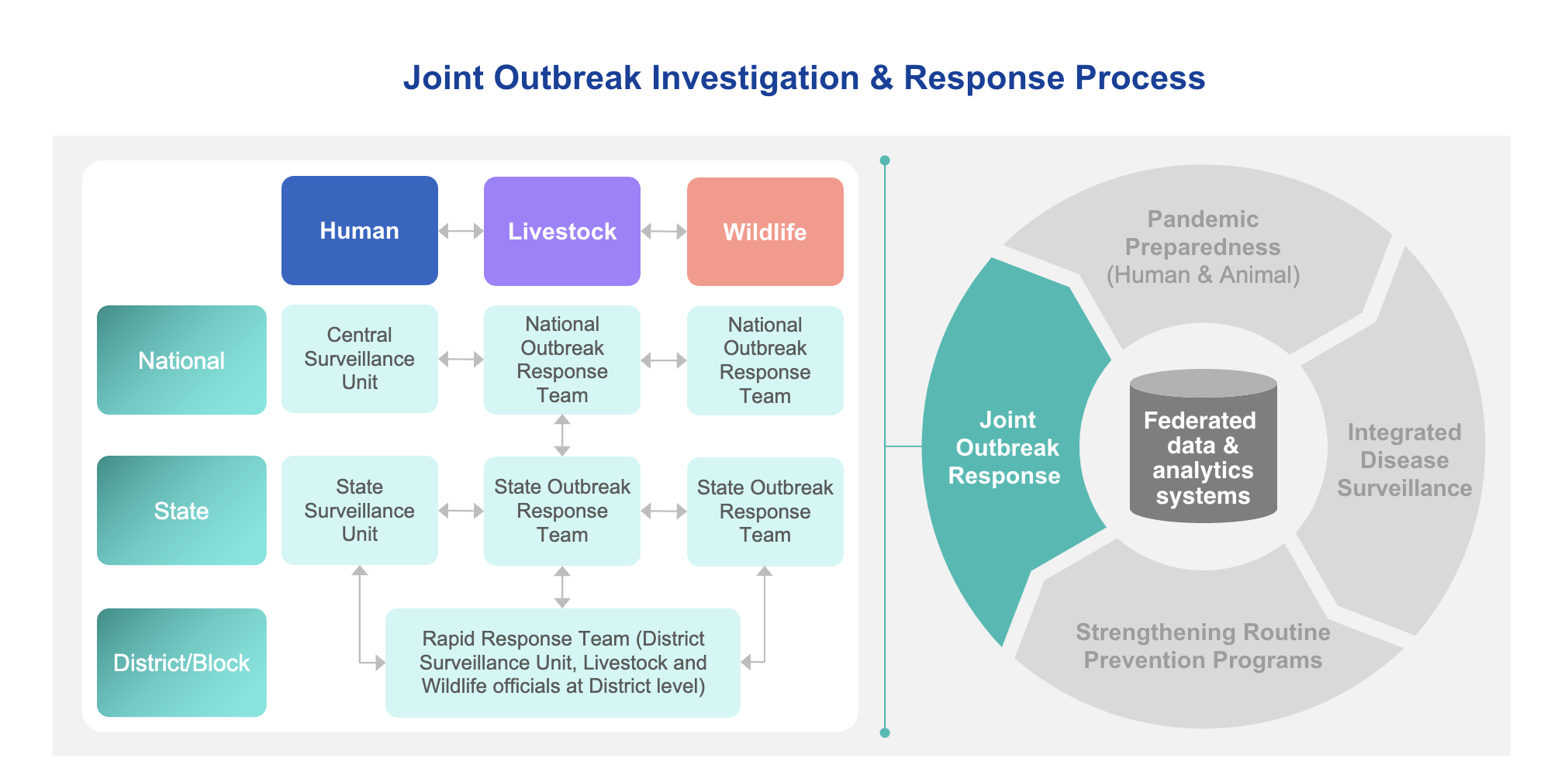
The National One Health Mission prioritizes designing pre-identified processes for coordinating across human, livestock and wildlife sectors so that response to disease outbreaks are done collaboratively for the effective control of diseases that are cross-sectoral in nature. The notification for the National Joint Outbreak Response Team (NJORT) was issued by MoHFW, which has nodal officers from key agencies like: National Centre for Disease Control (NCDC), Indian Council of Medical Research (ICMR), Department of Animal Husbandry and Dairying (DAHD), Indian Council of Agricultural Research (ICAR), Ministry of Environment, Forest and Climate Change (MoEFCC), The Food Safety and Standards Authority of India (FSSAI), Jal Shakti Ministry.
This joint outbreak mechanism will be Pre-notified to the States so that there is effective coordination between the center and the states during outbreaks. States will be encouraged to form similar joint outbreak response mechanisms so that all sectors are engaged in handling the diseases using ‘One Health’ principles.
Federated Data System for the National One Health Mission
Description
Data plays a critical role in the National One Health Mission, serving as the foundation for various activities such as Tracking disease spread for informed decision-making, guiding R&D and preparedness efforts, developing and monitoring effective public health and other programs. The mission aims to develop a federated data model, where necessary integrations can be made across sectors.
The data system will be focused on the following principles:
• Harmonization: Ensuring consistent data formats and definitions across different sources.
• Data Governance: Establishing clear protocols for data access, security, and ownership.
• Technical Integration: Utilizing APIs and other tools to facilitate seamless data exchange.
• Evolving Standards: Adapting data standards as technologies and requirements change.
This comprehensive data strategy ensures the efficient utilization of information across all sectors, fostering a more informed and effective One Health approach.
The mission aims to coordinate across achieving overall pandemic preparedness and integrated disease control against priority diseases of human, animal, and environmental sectors with early warning systems built on integrated surveillance systems and response readiness for endemic as well as emerging epidemic or pandemic threats.
The mission will also address critical pillars of preparedness in the form of targeted R&D to develop critical tools such as vaccines, diagnostics, and therapeutics; readiness in terms of clinical care; streamlined data and information linkages and access across sectors; and close community participation to keep our readiness to respond.
The following robust efforts are being undertaken to achieve the various goals under the mission:
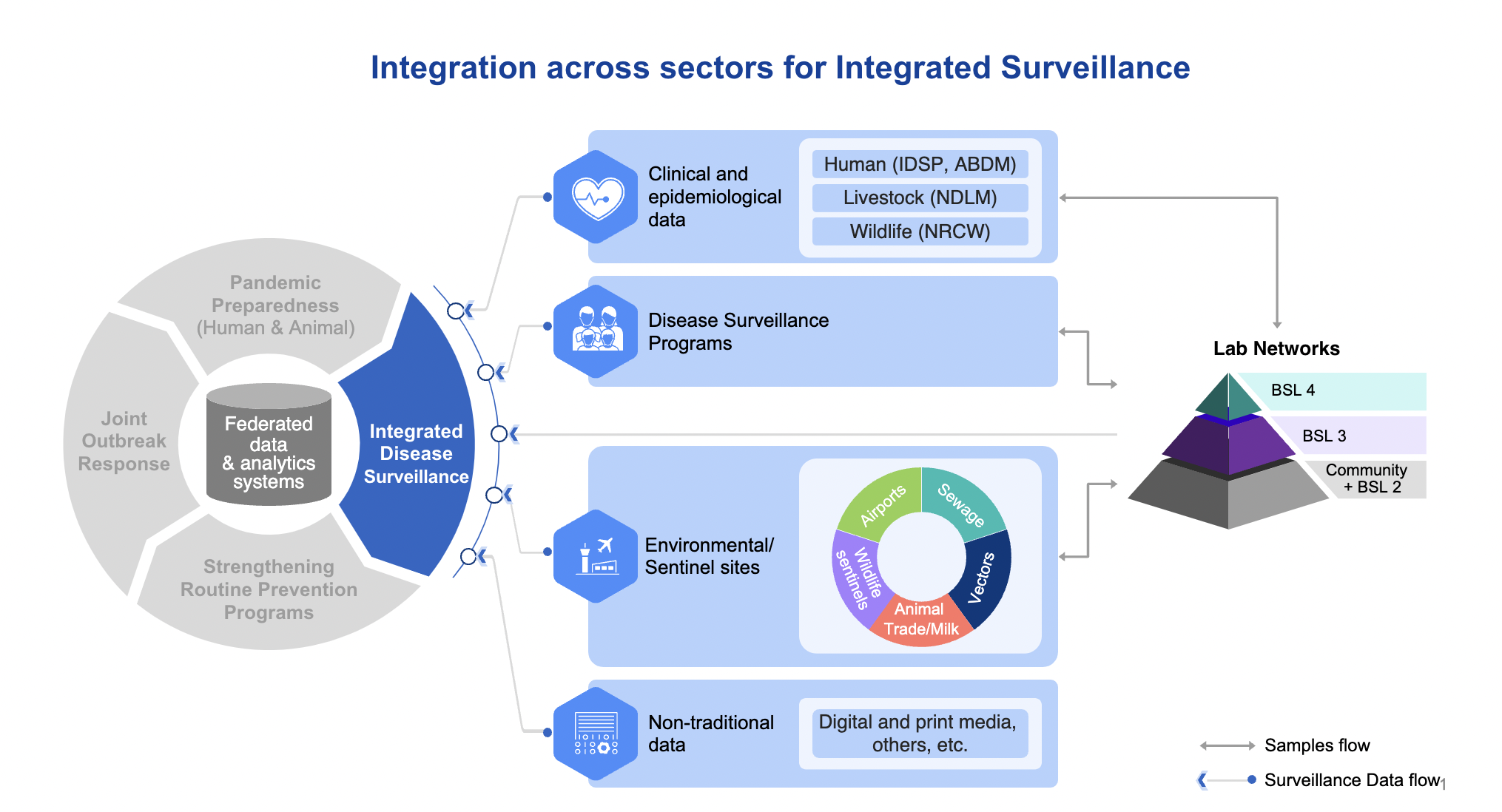
Implementing integrated disease surveillance within and across human, animal, and environmental sectors to address communicable diseases of zoonotic, transboundary animal diseases and diseases of epidemic/pandemic potential. This includes building early warning systems and integrating information coming from clinical and epidemiological data, information from various surveillance programs regardless of the agencies across sectors implementing it and deploying novel approaches such as environmental surveillance for timely and more accurate detection of diseases.
Integration across sectors for Integrated Surveillance
Environmental surveillance system- The One Health Mission envisions a robust network of sentinel-based surveillance that provides an ongoing real time picture of pathogens/disease spread that when linked to other sources of information, can be powerful adjunct to fill a major gap in our understanding of disease transmission dynamics across multiple diseases across human, animal husbandry and wildlife.
Sentinels include sewage, vectors (such as mosquitoes, ticks, rodents etc.), milk, places of aggregation such as animal trade and water holes, abattoir effluents and ports of entry such as airports. This system can also serve as the backbone, once established to bring the environmental components, including signs of habitat change, AMR surveillance, water quality etc. A pictorial representation environmental surveillance, its methodologies and sentinels is depicted below
Environmental surveillance provides cost effective and sensitive approaches to detect diseases that are priority for elimination or eradication since as the disease prevalence goes down and program gets closer to elimination, traditional surveillance methodologies may not provide sufficient sensitivity. Introducing environmental surveillance can serve as a powerful and novel adjunct to the disease elimination programs. List of diseases that are on target for elimination and concerted efforts are to be undertaken to implement sentinel-based surveillance for these diseases.
Develop robust outbreak investigation mechanisms for effective investigation and control of diseases across human, animal husbandry and wildlife sectors with framework for joint investigations. This includes building outbreak response teams at national levels linked to respective state programs and strengthening district level outbreak response teams such as Rapid Response Teams (RRTs), with clear framework for functioning as a connected system for routine disease control programs for addressing both endemic and emerging diseases.
Joint Outbreak Investigation & Response Process
All the aspects of pandemic preparedness will be embedded in the routine prevention programs to ensure sustainability and continued improvement of both aspects.
Image
image and link
Time
asd
Link
Is Archived
Off
Link
Link Title
Read More
Link Type
External
Link URL
https://www.psa.gov.in/oneHealthMission
NewsTitle
Latest News
Test-Critical
Enablers of the One Health Mission
These outcomes of the One Health Mission will be supported by critical enabling initiatives. Many of these initiatives are ongoing and will be strengthened under the mission and several new activities that will facilitate the goals of the mission will be undertaken.
Test-Critical R&D
Title
Build a Governance Model
Description
One Health mission has a collaborative Governance model with decentralized decision making. To ensure sustainability and continued improvement of all aspects of the mission, integration of the efforts into existing programs will be done.
To effectively address the diverse aspects of the National One Health Mission, four specialized advisory and review committees have been established. These committees focus on the following key themes:
1. National network of BSL 3/ 4 laboratories
2. Technology enhanced integrated surveillance & outbreak investigation
3. Research and Development on medical countermeasures
4. Integration of databases and data sharing.
One health mission will enable the development of critical tools such as vaccines, diagnostics, therapeutics and other disease prevention tools for better disease control and pandemic preparedness.
One Health mission will focus on enabling research by streamlining regulatory approvals for interdisciplinary research as well on streamlining current regulatory processes of medical products.
for a robust regulatory ecosystem, which spurs the R and D ecosystem in the health and medical products.
State government’s involvement is pivotal in advancing the goals of One Health Mission. They play a significant role in enacting and enforcing policies, enhancing surveillance systems to detect and respond to disease outbreaks, supporting disease control and prevention efforts. The mission will aim to converge and synergize the One Health activities in the states to the national effort for better health outcomes.
The G20- Chief Science Advisers Roundtable (G20-CSAR), held under India’s Presidency, prioritized "One Health" as one of the topics in 2023. As an outcome of the G20 discussions, a virtual 'Network of One Health Institutes' has been created that can improve collaboration and information exchange in One Health, with participation from over 10 countries and quadripartite representatives.
The ability to predict, detect and respond to an infectious disease reflects fundamental capability of a system, and the efforts mentioned above are useful not just for natural origins of the infection but also accidental or intentional spreads. One Health concept is comprehensive and encompasses overall health of all living beings as well as that of the environment. This includes issues such as food security, water quality, antimicrobial resistance, and climate change. These are also being handled globally through quadripartite and G-20 forum. This mission aims to take up the specific issue of integrated disease control and pandemic preparedness within the broader landscape of One Health. Achieving meaningful progress in a focused manner will not only help in addressing this important topic and but also will provide valuable insights and lessons to further take up other issues of One Health.
The ability to predict, detect and respond to an infectious disease reflects fundamental capability of a system, and the efforts mentioned above are useful not just for natural origins of the infection but also accidental or intentional spreads. One Health concept is comprehensive and encompasses overall health of all living beings as well as that of the environment. This includes issues such as food security, water quality, antimicrobial resistance, and climate change. These are also being handled globally through quadripartite and G-20 forum. This mission aims to take up the specific issue of integrated disease control and pandemic preparedness within the broader landscape of One Health. Achieving meaningful progress in a focused manner will not only help in addressing this important topic and but also will provide valuable insights and lessons to further take up other issues of One Health.
Test-Goals
Goals of the One Health Mission
The Mission aims to coordinate across achieving overall pandemic preparedness and integrated disease control against priority diseases of human, animal and environmental sectors with early warning systems built on integrated surveillance system and response readiness for endemic as well as emerging epidemic or pandemic threat.
The mission will also address critical pillars of preparedness in the form of targeted R&D to develop critical tools such as vaccines, diagnostics and therapeutics, readiness in terms of clinical care, streamline data and information linkages and access across sectors as well as close community participation to keep our readiness to respond.
The following robust efforts are being undertaken to achieve the various goals under the mission:
Test-National
Title
National One Health Mission
Description
There are many One Health efforts underway in various Ministries of the Government of India, in private organizations in addition to a range of activities globally. This presents a prospect to review the areas of focus underlying each effort, identify opportunities for collaboration and work towards filling any remaining gaps. Considering this, The Prime Minister's Science, Technology, and Innovation Advisory Council (PM-STIAC) in its 21st meeting, approved to set up a National One Health Mission with a cross-ministerial effort which will serve to coordinate, support, and integrate all the existing One Health activities in the country and fill gaps where it is appropriate. The Indian Council of Medical Research (ICMR) is the implementing agency for One Health Mission.
An integrated framework developed collaboratively by over 13 government ministries/ departments guides the mission. This framework facilitates coordination and synergy across sectors for priority activities.
The governance of the National One Health Mission is two tiered:
• Executive Committee: The Executive committee chaired by Hon’ble Minister, MoHFW with PSA as vice chair and Member Health, NITI Aayog is a permanent invitee. Secretaries of various stakeholder departments and two states (on rolling basis) are members. The committee provides overall policy guidance for the progress of the mission and its associated activities.
• Scientific Steering Committee: The committee is chaired by the PSA and has Secretaries/DGs of all stakeholder departments and two states (on rolling basis) as members. It provides overall scientific direction, oversight and guidance to the National One Health Mission.
All the aspects of pandemic preparedness will be embedded in the routine prevention programs to ensure sustainability and continued improvement of both aspects.
What is One Health
What is One Health
What is One Health des
One Health is a collaborative, multidisciplinary approach that unites human, animal, and environmental health sectors. It recognizes the interconnectedness of these domains, aiming to optimize health outcomes and address challenges across the sectors.
One Health has major implications for India. India with its diverse wildlife, one of the largest livestock populations and high density of human population, carries heightened risks for inter-compartmental spread of diseases. One health approach relies on shared and effective governance, communication, collaboration and coordination. Having the One Health approach in place makes it easier for people to better understand the co-benefits, risks, trade-offs and opportunities to advance equitable and holistic solutions.
The Covid pandemic, outbreaks of Lumpy Skin Disease in cattle and the constant threat of Avian Influenza demonstrate the need to address diseases across all sectors. Livestock, wildlife and plant sectors impact productivity, health and conservation aspects. This also opens opportunities for leveraging the complementarity and strengths that are inherent in each sector and devising integrated, robust and agile response systems.
These outcomes of the One Health Mission will be supported by critical enabling initiatives
Uri
/oneHealthMission/initiatives#critical-activities
Title
Publications & Reports
Sub heading
Access all the publications and reports published under National One Health Mission.
Link Type
Internal
Uri
/oneHealthMission/initiatives#publication
Title
FAQ
Sub heading
Frequently Asked Questions
Link Type
Internal
Uri
/oneHealthMission/initiatives#faq
Title
Meet the team
Sub heading
Meet the team behind One Health Mission
Link Type
Internal
Uri
/oneHealthMission/initiatives#faq
Faq
Faq Main Title
Frequently Asked Questions
Faqs
Faq Title
What are Zoonotic Diseases?
faq description
The World Health Organization (WHO) has defined Zoonotic diseases, as those diseases and infections, which are naturally transmitted between vertebrate animals and man, and infections that are shared between vertebrates and man. The zoonotic diseases include viral (rabies, yellow fever, influenza, Kyasanur forest disease, etc.), bacterial (anthrax, brucellosis, plague, leptospirosis, salmonellosis, etc.), rickettsial (tick typhus, scrub typhus, murine typhus, etc.), protozoal (toxoplasmosis, leishmaniasis, trypanosomiasis, etc.), helminths (hydatid disease, taeniasis, schistosomiasis, leishmaniasis, etc.), fungal (histoplasmosis, cryptococcus, etc.), and ectoparasites (scabies, myasis, etc.).
75% of newly emerging infectious diseases that have affected people over the last three decades are zoonotic in nature. One Health recognizes this interconnectedness and aims to prevent, detect, and respond to these threats more effectively.
One Health Quadripartite is a collaborative framework of the Food and Agriculture Organization of the United Nations (FAO), United Nations Environment Programme (UNEP), World Organization for Animal Health (WOAH), and World Health Organization (WHO). The One Health Quadripartite aims to sustainably balance and optimize the health of people, animals, and ecosystems. The Quadripartite leaders urge all countries and key stakeholders to promote and undertake various priority actions under the One Health Mission. To further support countries and governments putting the One Health approach into practice, the Quadripartite partners have developed the One Health Joint Plan of Action.
Faq Title
What resources are available for stakeholders?
faq description
The National One Health Mission webpage is the central hub for resources for all things related to the mission in India. You can access various guidelines documents, latest news and knowledge materials on this webpage. You can further look up the activities taken up by the quadripartite to understand the mission from a global perspective.
Faq Title
How can I participate in the National One Health Mission?
faq description
The mission welcomes participation from various stakeholders. Researchers, policymakers, veterinarians, public health professionals, and community members can all contribute to One Health initiatives. Stay tuned for updates on our website or contact the mission team for specific opportunities.
One Health Priority Diseases: Scrub Typhus, Glanders, Foot and Mouth Disease, Tuberculosis
Nodal officer with contact details
Governance & Policy
Established One Health Task Forces/Committees
State and District Level committees
Interdepartmental Collaborations
One Health Pilot Project with Animal Husbandry department
MoUs Signed with National & International Partners
MoU signed with UNDP for establishing mobile diagnostic units for disease surveillance in remote areas of Uttarakhand
Surveillance & Diagnostics
Presence of Zoonotic Disease Surveillance Networks
At state level and district level
Diagnostic Laboratories for One Health
List of referral laboratories
Data sharing mechanism
Research and Development
Research Projects
Research on development of diagnostics for Chandipura virus
Action Plans
Link for state action plans
Publications
Link of document (if any)
Capacity Building & Awareness
Number of One Health Training Programs Conducted
One Health Mobile van program piloted in Uttarkashi district for community engagement
Community engagement workshops on One Health approach
Public Awareness Campaigns Conducted (Number & Type)
Innovation & Technology Adoption
Any Digital Tools being used for One Health Monitoring
WP Title
Uttarakhand
Central Initiatives
Agencies
Foreground Image
Background Image
Link
Link Type
External
Link URL
https://www.icar.org.in/
Foreground Image
Background Image
Link
Link Type
External
Link URL
https://www.dahd.gov.in/
WP Description
Ministry/Department:Indian Council of Medical Research Initiative
Initiatives
India's Antimicrobial Resistance Surveillance & Research Initiative
Antimicrobial Stewardship Program Guideline
Building a surveillance model for detecting zoonotic spill over in increased animal-human interaction setting using a one health approach: a study at selected slaughter houses
WP Title
Indian Council of Medical Research Initiative
Multilateral Initiatives
Agencies
WP Description
WP Title
Multilateral Initiatives
OneHealth Video Image
Image
Video URL
https://www.youtube.com/watch?v=nMc8vJRaHe8
Date
State Content
State Title
UTTARAKHAND
State Description
One Health Priority Diseases:
Scrub Typhus, Glanders, Foot and Mouth Disease, Tuberculosis
Nodal Officer:
Mr. Rakesh Jain
Email: rakesh[dot]jain[at]gmail[dot]com
State Code
IN-UT
State Initiatives
Agencies
WP Description
One Health Priority Diseases: Scrub Typhus, Glanders, Foot and Mouth Disease, Tuberculosis
Nodal officer with contact details
Governance & Policy
Established One Health Task Forces/Committees
State and District Level committees
Interdepartmental Collaborations
One Health Pilot Project with Animal Husbandry department
MoUs Signed with National & International Partners
MoU signed with UNDP for establishing mobile diagnostic units for disease surveillance in remote areas of Uttarakhand
Surveillance & Diagnostics
Presence of Zoonotic Disease Surveillance Networks
At state level and district level
Diagnostic Laboratories for One Health
List of referral laboratories
Data sharing mechanism
Research and Development
Research Projects
Research on development of diagnostics for Chandipura virus
Action Plans
Link for state action plans
Publications
Link of document (if any)
Capacity Building & Awareness
Number of One Health Training Programs Conducted
One Health Mobile van program piloted in Uttarkashi district for community engagement
Community engagement workshops on One Health approach
Public Awareness Campaigns Conducted (Number & Type)
Innovation & Technology Adoption
Any Digital Tools being used for One Health Monitoring
WP Title
Uttarakhand
Multilateral Initiatives
multilateral Content Title
Locations
multi content description
Uttarakhand
Multilateral Initiatives Content
Multi initative title
Uttarakhand
Multi initative Description
Food and Agriculture Organization
• Transforming Indian agriculture for global environmental benefits and the conservation of critical biodiversity and forest landscapes (GEF Cycle 6) and Sustainable Aquaculture
• Surveillance and Epidemiology, Zoonoses, transboundary diseases (thematic pillar of GHSP and the Pandemic Fund project)- Pan India
• AMR Mitigation- Indian Network for Fishery and Animal Antimicrobial Resistance -INFAAR, (collaboration with ICAR institutes of livestock and aquaculture) – Present strength of INFAAR is 36 labs situated across India (ICAR institutes labs, CDDL, RDDLs and SAUs and SVUs labs), Livestock coordinator – ICAR - IVRI – ERS Kolkata and Fisheries/ Aquaculture Coordinator – ICAR - NBFGR, Lucknow.
• Pandemic Fund Project - Animal Health Security Strengthening in India for Pandemic Preparedness and Response
• USAID- Global Health Security Programme (GHSP) – Immediate technical assistance for animal health systems to address emerging and priority zoonotic diseases and health threats.
United Nations Development Programme
• Engagement with Ministry of Health and Family Welfare (MoH&FW) on development of State Action Plans for Dog mediated rabies elimination with one health approach
• Engagement with Ministry of Health and Family Welfare (MoH&FW) on Conducting Legal environment assessment to identify barriers to one health implementation
• Engagement with Ministry of Health and Family Welfare (MoH&FW) on Data analysis for integration of data from different departments for identifying critical areas towards development of a One Health platform
• Engagement with Ministry of Health and Family Welfare (MoH&FW) on Capacity building of Stakeholders on One Health
• Engagement with the Department of Animal Husbandry and Dairying (DAHD), MoFAHD in Livestock insurance and livelihood initiatives is under discussion
• Engagement with the Ministry of Environment, Forests and Climate change to provide support to integrating One Health component in the Biodiversity action plans
• Engagement with Ministry of Environment, Forest and Climate Change on Capacity building of Stakeholders on One Health
World Bank Group
• Animal health systems strengthening for One Health
• Transforming Public health system: ADB, World Bank and FAO collaboration for pandemic preparedness [NIOH setup and supporting 15+ BSL-3 labs]
• Surveillance on Brucellosis, Leptospirosis and Rabies for economic costs
• Strengthening veterinary laboratories at district level
• Pandemic Fund Grant "Animal Health Security Strengthening in India for Pandemic Preparedness and Response" - an ADB, World Bank and FAO collaboration with potential technical partner BIMSTEC and others
• Food Safety Review and Strengthening (with focus in livestock commodity value chains)
• Strengthening monitoring and surveillance of AMR
• Strengthening Zoonotic Surveillance sites both on human and animal side on priority zoonotic pathogens
• Mapping of Climate Sensitive Zoonotic Diseases and Non-Zoonotic High Threat Pathogens in India.
• Economic Burden of Selected Animal Diseases - Lumpy Skin Disease (LSD), Brucellosis and Foot and Mouth Disease.
• System Dynamics Modelling of African Swine Fever and LSK.
World Health Organization (WHO)
• Early warning systems under Integrated Health Information Platform (IHIP) [ nationwide; georeferenced]
• Capacity Building- Field Epidemiology training Programmes (FETP), including through Sector- Connect
• Supporting NCDC and states(as requested) in building contingency plans to address public health threats such as Nipah, Mpox, Avian influenza etc.
• AMR national action plan with support to states for state specific action plans (overall 11 states)
• Support NCDC- developing technical guidance documents for one health and promoting use of one health/IHR monitoring tools, including that for community engagement
International Union for Conservation of Nature (IUCN)
• One Health policy and project development integrating Ecosystem, Wildlife, and Human Health, focusing on Action Track 6 of the One Health Global Policy.
BrookeIndia
• Working with DADH/World Bank/CII in the Pandemic Fund Project on Animal Health Security Strengthening in India for Pandemic Preparedness & Response, One Health camps
• 36 equine welfare projects across India with 37 knowledge partners
• Collaborated with International Livestock Research Institute (ILRI) on CSO’s role in promoting One Health.
• Collaborated with National Academy of Veterinary Sciences (I) on Safe carcass disposal and its effective commercial utilization to safeguard One Health.
• Working with Health Parliament (HP) & World Veterinary Services (WVS), to shape the domain for digital health in India and creating the Professional Discussion Forum on OH & creating a Status paper on OH in India.
• Working with the OH Poultry Hub/JNU on multi-sectoral collaboration for the governance of AMR & contextual factors influencing usage of antibiotics in animals among Informal Prescribers
• Contributed recommendations for increasing investment in animal health to strengthen the animal health system under OH at C20 Integrated Holistic Health Working Group /G20 Health agenda/ AFAH Pandemic preparedness
• Supporting Universities & Institutions in workshops and seminars on OH
UK Government
• To nurture and fund tangible innovations for AMR in the environment.
Gates Foundation
• Development of pathogen surveillance and diagnostic kit for priority bovine diseases – mastitis, lumpy skin disease, foot and mouth disease
• Environmental surveillance for avian influenza virus and dairy pathogens
• National livestock disease epidemiology and disease modeling program
State Title
Andhra Pradesh
State Description
Andhra Pradesh
State Code
IN-AP
State Initiatives
Agencies
WP Title
Andhra Pradesh
Multilateral Initiatives
multilateral Content Title
Locations
multi content description
Andhra Pradesh
Multilateral Initiatives Content
Multi initative title
Andhra Pradesh
Multi initative Description
UK Government
• To nurture and fund tangible innovations for AMR in the environment.
Gates Foundation
• Development of pathogen surveillance and diagnostic kit for priority bovine diseases – mastitis, lumpy skin disease, foot and mouth disease
• Environmental surveillance for avian influenza virus and dairy pathogens
• National livestock disease epidemiology and disease modeling program
World Health Organization (WHO)
• Early warning systems under Integrated Health Information Platform (IHIP) [ nationwide; georeferenced]
• Capacity Building- Field Epidemiology training Programmes (FETP), including through Sector- Connect
• Supporting NCDC and states(as requested) in building contingency plans to address public health threats such as Nipah, Mpox, Avian influenza etc.
• AMR national action plan with support to states for state specific action plans (overall 11 states)
• Support NCDC- developing technical guidance documents for one health and promoting use of one health/IHR monitoring tools, including that for community engagement
International Union for Conservation of Nature (IUCN)
• One Health policy and project development integrating Ecosystem, Wildlife, and Human Health, focusing on Action Track 6 of the One Health Global Policy.
World Bank Group
• Animal health systems strengthening for One Health
• Transforming Public health system: ADB, World Bank and FAO collaboration for pandemic preparedness [NIOH setup and supporting 15+ BSL-3 labs]
• Surveillance on Brucellosis, Leptospirosis and Rabies for economic costs
• Strengthening veterinary laboratories at district level
• Pandemic Fund Grant "Animal Health Security Strengthening in India for Pandemic Preparedness and Response" - an ADB, World Bank and FAO collaboration with potential technical partner BIMSTEC and others
• Food Safety Review and Strengthening (with focus in livestock commodity value chains)
• Strengthening monitoring and surveillance of AMR
• Strengthening Zoonotic Surveillance sites both on human and animal side on priority zoonotic pathogens
• Mapping of Climate Sensitive Zoonotic Diseases and Non-Zoonotic High Threat Pathogens in India.
• Economic Burden of Selected Animal Diseases - Lumpy Skin Disease (LSD), Brucellosis and Foot and Mouth Disease.
• System Dynamics Modelling of African Swine Fever and LSK.
United Nations Development Programme
• Piloting of a Rabies and Snakebite helpline
• Piloting of the ZooWIN Platform (tracking of Rabies vaccine and Snake antivenom supply chain and beneficiaries tracking)
• Engagement with Ministry of Health and Family Welfare (MoH&FW) on development of State Action Plans for Dog mediated rabies elimination with one health approach
• Engagement with Ministry of Health and Family Welfare (MoH&FW) on Conducting Legal environment assessment to identify barriers to one health implementation
• Engagement with Ministry of Health and Family Welfare (MoH&FW) on Data analysis for integration of data from different departments for identifying critical areas towards development of a One Health platform
• Engagement with Ministry of Health and Family Welfare (MoH&FW) on Capacity building of Stakeholders on One Health
• Engagement with the Department of Animal Husbandry and Dairying (DAHD), MoFAHD in Livestock insurance and livelihood initiatives is under discussion
• Engagement with the Ministry of Environment, Forests and Climate change to provide support to integrating One Health component in the Biodiversity action plans
• Engagement with Ministry of Environment, Forest and Climate Change on Capacity building of Stakeholders on One Health
Food and Agriculture Organization
• Transforming Indian agriculture for global environmental benefits and the conservation of critical biodiversity and forest landscapes (GEF Cycle 6) and Sustainable Aquaculture
• Surveillance and Epidemiology, Zoonoses, transboundary diseases (thematic pillar of GHSP and the Pandemic Fund project)- Pan India
• AMR Mitigation- Indian Network for Fishery and Animal Antimicrobial Resistance -INFAAR, (collaboration with ICAR institutes of livestock and aquaculture) – Present strength of INFAAR is 36 labs situated across India (ICAR institutes labs, CDDL, RDDLs and SAUs and SVUs labs), Livestock coordinator – ICAR - IVRI – ERS Kolkata and Fisheries/ Aquaculture Coordinator – ICAR - NBFGR, Lucknow.
• Pandemic Fund Project - Animal Health Security Strengthening in India for Pandemic Preparedness and Response
• USAID- Global Health Security Programme (GHSP) – Immediate technical assistance for animal health systems to address emerging and priority zoonotic diseases and health threats.
State Title
Assam
State Description
Assam
State Code
IN-AS
State Initiatives
Agencies
WP Title
Assam
Multilateral Initiatives
multilateral Content Title
Locations
multi content description
Assam
Multilateral Initiatives Content
Multi initative title
Assam
Multi initative Description
Food and Agriculture Organization
• Surveillance and Epidemiology, Zoonoses, transboundary diseases (thematic pillar of GHSP and the Pandemic Fund project)- Pan India
• AMR Mitigation- Indian Network for Fishery and Animal Antimicrobial Resistance -INFAAR, (collaboration with ICAR institutes of livestock and aquaculture) – Present strength of INFAAR is 36 labs situated across India (ICAR institutes labs, CDDL, RDDLs and SAUs and SVUs labs), Livestock coordinator – ICAR - IVRI – ERS Kolkata and Fisheries/ Aquaculture Coordinator – ICAR - NBFGR, Lucknow.
• Pandemic Fund Project - Animal Health Security Strengthening in India for Pandemic Preparedness and Response
• USAID- Global Health Security Programme (GHSP) – Immediate technical assistance for animal health systems to address emerging and priority zoonotic diseases and health threats.
BrookeIndia
• 36 equine welfare projects across India with 37 knowledge partners
• Collaborated with International Livestock Research Institute (ILRI) on CSO’s role in promoting One Health.
• Collaborated with National Academy of Veterinary Sciences (I) on Safe carcass disposal and its effective commercial utilization to safeguard One Health.
• Working with Health Parliament (HP) & World Veterinary Services (WVS), to shape the domain for digital health in India and creating the Professional Discussion Forum on OH & creating a Status paper on OH in India.
• Working with the OH Poultry Hub/JNU on multi-sectoral collaboration for the governance of AMR & contextual factors influencing usage of antibiotics in animals among Informal Prescribers
• Contributed recommendations for increasing investment in animal health to strengthen the animal health system under OH at C20 Integrated Holistic Health Working Group /G20 Health agenda/ AFAH Pandemic preparedness
• Supporting Universities & Institutions in workshops and seminars on OH
ASIAN DEVELOPMENT BANK
• Assessments of animal health labs (7 labs-DAHD) and Veterinary manufacturing units
United Nations Development Programme
• Piloting of a Rabies and Snakebite helpline
• Piloting of the ZooWIN Platform (tracking of Rabies vaccine and Snake antivenom supply chain and beneficiaries tracking)
• Engagement with Ministry of Health and Family Welfare (MoH&FW) on development of State Action Plans for Dog mediated rabies elimination with one health approach
• Engagement with Ministry of Health and Family Welfare (MoH&FW) on Conducting Legal environment assessment to identify barriers to one health implementation
• Engagement with Ministry of Health and Family Welfare (MoH&FW) on Data analysis for integration of data from different departments for identifying critical areas towards development of a One Health platform
• Engagement with Ministry of Health and Family Welfare (MoH&FW) on Capacity building of Stakeholders on One Health
• Engagement with the Department of Animal Husbandry and Dairying (DAHD), MoFAHD in Livestock insurance and livelihood initiatives is under discussion
• Engagement with the Ministry of Environment, Forests and Climate change to provide support to integrating One Health component in the Biodiversity action plans
• Engagement with Ministry of Environment, Forest and Climate Change on Capacity building of Stakeholders on One Health
World Health Organization (WHO)
• Early warning systems under Integrated Health Information Platform (IHIP) [ nationwide; georeferenced]
• Capacity Building- Field Epidemiology training Programmes (FETP), including through Sector- Connect
• Supporting NCDC and states(as requested) in building contingency plans to address public health threats such as Nipah, Mpox, Avian influenza etc.
• AMR national action plan with support to states for state specific action plans (overall 11 states)
• Support NCDC- developing technical guidance documents for one health and promoting use of one health/IHR monitoring tools, including that for community engagement
International Union for Conservation of Nature (IUCN)
• One Health policy and project development integrating Ecosystem, Wildlife, and Human Health, focusing on Action Track 6 of the One Health Global Policy.
World Bank Group
• Animal health systems strengthening for One Health
• Transforming Public health system: ADB, World Bank and FAO collaboration for pandemic preparedness [NIOH setup and supporting 15+ BSL-3 labs]
• Surveillance on Brucellosis, Leptospirosis and Rabies for economic costs
<>• Strengthening veterinary laboratories at district level
• Pandemic Fund Grant "Animal Health Security Strengthening in India for Pandemic Preparedness and Response" - an ADB, World Bank and FAO collaboration with potential technical partner BIMSTEC and others
• Food Safety Review and Strengthening (with focus in livestock commodity value chains)
• Strengthening monitoring and surveillance of AMR
• Strengthening Zoonotic Surveillance sites both on human and animal side on priority zoonotic pathogens
• Mapping of Climate Sensitive Zoonotic Diseases and Non-Zoonotic High Threat Pathogens in India.
• Economic Burden of Selected Animal Diseases - Lumpy Skin Disease (LSD), Brucellosis and Foot and Mouth Disease.
• System Dynamics Modelling of African Swine Fever and LSK.
Gates Foundation
• Development of pathogen surveillance and diagnostic kit for priority bovine diseases – mastitis, lumpy skin disease, foot and mouth disease
• Environmental surveillance for avian influenza virus and dairy pathogens
• National livestock disease epidemiology and disease modeling program
UK Government
• To nurture and fund tangible innovations for AMR in the environment.
State Title
Bihar
State Description
Bihar
State Code
IN-BR
State Initiatives
WP Title
Bihar
Multilateral Initiatives
multilateral Content Title
Locations
multi content description
Bihar
Multilateral Initiatives Content
Multi initative title
Bihar
Multi initative Description
UK Government
• To nurture and fund tangible innovations for AMR in the environment.
Gates Foundation
• Development of pathogen surveillance and diagnostic kit for priority bovine diseases – mastitis, lumpy skin disease, foot and mouth disease
• Environmental surveillance for avian influenza virus and dairy pathogens
• National livestock disease epidemiology and disease modeling program
United Nations Development Programme
• Engagement with Ministry of Health and Family Welfare (MoH&FW) on development of State Action Plans for Dog mediated rabies elimination with one health approach
• Engagement with Ministry of Health and Family Welfare (MoH&FW) on Conducting Legal environment assessment to identify barriers to one health implementation
• Engagement with Ministry of Health and Family Welfare (MoH&FW) on Data analysis for integration of data from different departments for identifying critical areas towards development of a One Health platform
• Engagement with Ministry of Health and Family Welfare (MoH&FW) on Capacity building of Stakeholders on One Health
• Engagement with the Department of Animal Husbandry and Dairying (DAHD), MoFAHD in Livestock insurance and livelihood initiatives is under discussion
• Engagement with the Ministry of Environment, Forests and Climate change to provide support to integrating One Health component in the Biodiversity action plans
• Engagement with Ministry of Environment, Forest and Climate Change on Capacity building of Stakeholders on One Health
World Health Organization (WHO)
• Early warning systems under Integrated Health Information Platform (IHIP) [ nationwide; georeferenced]
• Capacity Building- Field Epidemiology training Programmes (FETP), including through Sector- Connect
• Supporting NCDC and states(as requested) in building contingency plans to address public health threats such as Nipah, Mpox, Avian influenza etc.
• AMR national action plan with support to states for state specific action plans (overall 11 states)
• Support NCDC- developing technical guidance documents for one health and promoting use of one health/IHR monitoring tools, including that for community engagement
International Union for Conservation of Nature (IUCN)
• One Health policy and project development integrating Ecosystem, Wildlife, and Human Health, focusing on Action Track 6 of the One Health Global Policy.
World Bank Group
• Animal health systems strengthening for One Health
• Transforming Public health system: ADB, World Bank and FAO collaboration for pandemic preparedness [NIOH setup and supporting 15+ BSL-3 labs]
• Surveillance on Brucellosis, Leptospirosis and Rabies for economic costs
• Strengthening veterinary laboratories at district level
• Pandemic Fund Grant "Animal Health Security Strengthening in India for Pandemic Preparedness and Response" - an ADB, World Bank and FAO collaboration with potential technical partner BIMSTEC and others
• Food Safety Review and Strengthening (with focus in livestock commodity value chains)
• Strengthening monitoring and surveillance of AMR
• Strengthening Zoonotic Surveillance sites both on human and animal side on priority zoonotic pathogens
• Mapping of Climate Sensitive Zoonotic Diseases and Non-Zoonotic High Threat Pathogens in India.
• Economic Burden of Selected Animal Diseases - Lumpy Skin Disease (LSD), Brucellosis and Foot and Mouth Disease.
• System Dynamics Modelling of African Swine Fever and LSK.
BrookeIndia
• 36 equine welfare projects across India with 37 knowledge partners
• Collaborated with International Livestock Research Institute (ILRI) on CSO’s role in promoting One Health.
• Collaborated with National Academy of Veterinary Sciences (I) on Safe carcass disposal and its effective commercial utilization to safeguard One Health.
• Working with Health Parliament (HP) & World Veterinary Services (WVS), to shape the domain for digital health in India and creating the Professional Discussion Forum on OH & creating a Status paper on OH in India.
• Working with the OH Poultry Hub/JNU on multi-sectoral collaboration for the governance of AMR & contextual factors influencing usage of antibiotics in animals among Informal Prescribers
• Contributed recommendations for increasing investment in animal health to strengthen the animal health system under OH at C20 Integrated Holistic Health Working Group /G20 Health agenda/ AFAH Pandemic preparedness
• Supporting Universities & Institutions in workshops and seminars on OH
Food and Agriculture Organization
• Surveillance and Epidemiology, Zoonoses, transboundary diseases (thematic pillar of GHSP and the Pandemic Fund project)- Pan India
• AMR Mitigation- Indian Network for Fishery and Animal Antimicrobial Resistance -INFAAR, (collaboration with ICAR institutes of livestock and aquaculture) – Present strength of INFAAR is 36 labs situated across India (ICAR institutes labs, CDDL, RDDLs and SAUs and SVUs labs), Livestock coordinator – ICAR - IVRI – ERS Kolkata and Fisheries/ Aquaculture Coordinator – ICAR - NBFGR, Lucknow.
• Pandemic Fund Project - Animal Health Security Strengthening in India for Pandemic Preparedness and Response
• USAID- Global Health Security Programme (GHSP) – Immediate technical assistance for animal health systems to address emerging and priority zoonotic diseases and health threats.
State Title
Gujarat
State Code
IN-GJ
State Initiatives
Agencies
WP Title
Gujarat
Multilateral Initiatives
multilateral Content Title
Locations
multi content description
Gujarat
Multilateral Initiatives Content
Multi initative title
Gujarat
Multi initative Description
UK Government
• To nurture and fund tangible innovations for AMR in the environment.
Bill and Melinda Gates Foundation
• Development of pathogen surveillance and diagnostic kit for priority bovine diseases – mastitis, lumpy skin disease, foot and mouth disease
• Environmental surveillance for avian influenza virus and dairy pathogens
• National livestock disease epidemiology and disease modeling program
United Nations Development Programme
• Engagement with Ministry of Health and Family Welfare (MoH&FW) on development of State Action Plans for Dog mediated rabies elimination with one health approach
• Engagement with Ministry of Health and Family Welfare (MoH&FW) on Conducting Legal environment assessment to identify barriers to one health implementation
• Engagement with Ministry of Health and Family Welfare (MoH&FW) on Data analysis for integration of data from different departments for identifying critical areas towards development of a One Health platform
• Engagement with Ministry of Health and Family Welfare (MoH&FW) on Capacity building of Stakeholders on One Health
• Engagement with the Department of Animal Husbandry and Dairying (DAHD), MoFAHD in Livestock insurance and livelihood initiatives is under discussion
• Engagement with the Ministry of Environment, Forests and Climate change to provide support to integrating One Health component in the Biodiversity action plans
• Engagement with Ministry of Environment, Forest and Climate Change on Capacity building of Stakeholders on One Health
World Health Organization (WHO)
• Early warning systems under Integrated Health Information Platform (IHIP) [ nationwide; georeferenced]
• Capacity Building- Field Epidemiology training Programmes (FETP), including through Sector- Connect
• Supporting NCDC and states(as requested) in building contingency plans to address public health threats such as Nipah, Mpox, Avian influenza etc.
• AMR national action plan with support to states for state specific action plans (overall 11 states)
• Support NCDC- developing technical guidance documents for one health and promoting use of one health/IHR monitoring tools, including that for community engagement
International Union for Conservation of Nature (IUCN)
• One Health policy and project development integrating Ecosystem, Wildlife, and Human Health, focusing on Action Track 6 of the One Health Global Policy.
World Bank Group
• Animal health systems strengthening for One Health
• Transforming Public health system: ADB, World Bank and FAO collaboration for pandemic preparedness [NIOH setup and supporting 15+ BSL-3 labs]
• Surveillance on Brucellosis, Leptospirosis and Rabies for economic costs
• Strengthening veterinary laboratories at district level
• Pandemic Fund Grant "Animal Health Security Strengthening in India for Pandemic Preparedness and Response" - an ADB, World Bank and FAO collaboration with potential technical partner BIMSTEC and others
• Food Safety Review and Strengthening (with focus in livestock commodity value chains)
• Strengthening monitoring and surveillance of AMR
• Strengthening Zoonotic Surveillance sites both on human and animal side on priority zoonotic pathogens
• Mapping of Climate Sensitive Zoonotic Diseases and Non-Zoonotic High Threat Pathogens in India.
• Economic Burden of Selected Animal Diseases - Lumpy Skin Disease (LSD), Brucellosis and Foot and Mouth Disease.
• System Dynamics Modelling of African Swine Fever and LSK.
BrookeIndia
• 36 equine welfare projects across India with 37 knowledge partners
• Collaborated with International Livestock Research Institute (ILRI) on CSO’s role in promoting One Health.
• Collaborated with National Academy of Veterinary Sciences (I) on Safe carcass disposal and its effective commercial utilization to safeguard One Health.
• Working with Health Parliament (HP) & World Veterinary Services (WVS), to shape the domain for digital health in India and creating the Professional Discussion Forum on OH & creating a Status paper on OH in India.
• Working with the OH Poultry Hub/JNU on multi-sectoral collaboration for the governance of AMR & contextual factors influencing usage of antibiotics in animals among Informal Prescribers
• Contributed recommendations for increasing investment in animal health to strengthen the animal health system under OH at C20 Integrated Holistic Health Working Group /G20 Health agenda/ AFAH Pandemic preparedness
• Supporting Universities & Institutions in workshops and seminars on OH
Food and Agriculture Organization
• Establishing pathways to integrate nutritional and therapeutic potential of non-bovine milk (Camel and Goat)
• Surveillance and Epidemiology, Zoonoses, transboundary diseases (thematic pillar of GHSP and the Pandemic Fund project)- Pan India
• AMR Mitigation- Indian Network for Fishery and Animal Antimicrobial Resistance -INFAAR, (collaboration with ICAR institutes of livestock and aquaculture) – Present strength of INFAAR is 36 labs situated across India (ICAR institutes labs, CDDL, RDDLs and SAUs and SVUs labs), Livestock coordinator – ICAR - IVRI – ERS Kolkata and Fisheries/ Aquaculture Coordinator – ICAR - NBFGR, Lucknow.
• Pandemic Fund Project - Animal Health Security Strengthening in India for Pandemic Preparedness and Response
• USAID- Global Health Security Programme (GHSP) – Immediate technical assistance for animal health systems to address emerging and priority zoonotic diseases and health threats.
State Title
Haryana
State Code
IN-HR
State Initiatives
Agencies
WP Title
Haryana
Multilateral Initiatives
multilateral Content Title
Locations
multi content description
Haryana
Multilateral Initiatives Content
Multi initative title
Haryana
Multi initative Description
UK Government
• To nurture and fund tangible innovations for AMR in the environment.
Gates Foundation
• Development of pathogen surveillance and diagnostic kit for priority bovine diseases – mastitis, lumpy skin disease, foot and mouth disease
• Environmental surveillance for avian influenza virus and dairy pathogens
• National livestock disease epidemiology and disease modeling program
United Nations Development Programme
• Engagement with Ministry of Health and Family Welfare (MoH&FW) on development of State Action Plans for Dog mediated rabies elimination with one health approach
• Engagement with Ministry of Health and Family Welfare (MoH&FW) on Conducting Legal environment assessment to identify barriers to one health implementation
• Engagement with Ministry of Health and Family Welfare (MoH&FW) on Data analysis for integration of data from different departments for identifying critical areas towards development of a One Health platform
• Engagement with Ministry of Health and Family Welfare (MoH&FW) on Capacity building of Stakeholders on One Health
• Engagement with the Department of Animal Husbandry and Dairying (DAHD), MoFAHD in Livestock insurance and livelihood initiatives is under discussion
• Engagement with the Ministry of Environment, Forests and Climate change to provide support to integrating One Health component in the Biodiversity action plans
• Engagement with Ministry of Environment, Forest and Climate Change on Capacity building of Stakeholders on One Health
World Health Organization (WHO)
• Early warning systems under Integrated Health Information Platform (IHIP) [ nationwide; georeferenced]
• Capacity Building- Field Epidemiology training Programmes (FETP), including through Sector- Connect
• Supporting NCDC and states(as requested) in building contingency plans to address public health threats such as Nipah, Mpox, Avian influenza etc.
• AMR national action plan with support to states for state specific action plans (overall 11 states)
• Support NCDC- developing technical guidance documents for one health and promoting use of one health/IHR monitoring tools, including that for community engagement
International Union for Conservation of Nature (IUCN)
• One Health policy and project development integrating Ecosystem, Wildlife, and Human Health, focusing on Action Track 6 of the One Health Global Policy.
World Bank Group
• Animal health systems strengthening for One Health
• Transforming Public health system: ADB, World Bank and FAO collaboration for pandemic preparedness [NIOH setup and supporting 15+ BSL-3 labs]
• Surveillance on Brucellosis, Leptospirosis and Rabies for economic costs
• Strengthening veterinary laboratories at district level
• Pandemic Fund Grant "Animal Health Security Strengthening in India for Pandemic Preparedness and Response" - an ADB, World Bank and FAO collaboration with potential technical partner BIMSTEC and others
• Food Safety Review and Strengthening (with focus in livestock commodity value chains)
• Strengthening monitoring and surveillance of AMR
• Strengthening Zoonotic Surveillance sites both on human and animal side on priority zoonotic pathogens
• Mapping of Climate Sensitive Zoonotic Diseases and Non-Zoonotic High Threat Pathogens in India.
• Economic Burden of Selected Animal Diseases - Lumpy Skin Disease (LSD), Brucellosis and Foot and Mouth Disease.
• System Dynamics Modelling of African Swine Fever and LSK.
BrookeIndia
• 36 equine welfare projects across India with 37 knowledge partners
• Collaborated with International Livestock Research Institute (ILRI) on CSO’s role in promoting One Health.
• Collaborated with National Academy of Veterinary Sciences (I) on Safe carcass disposal and its effective commercial utilization to safeguard One Health.
• Working with Health Parliament (HP) & World Veterinary Services (WVS), to shape the domain for digital health in India and creating the Professional Discussion Forum on OH & creating a Status paper on OH in India.
• Working with the OH Poultry Hub/JNU on multi-sectoral collaboration for the governance of AMR & contextual factors influencing usage of antibiotics in animals among Informal Prescribers
• Contributed recommendations for increasing investment in animal health to strengthen the animal health system under OH at C20 Integrated Holistic Health Working Group /G20 Health agenda/ AFAH Pandemic preparedness
• Supporting Universities & Institutions in workshops and seminars on OH
Food and Agriculture Organization
• Surveillance and Epidemiology, Zoonoses, transboundary diseases (thematic pillar of GHSP and the Pandemic Fund project)- Pan India
• AMR Mitigation- Indian Network for Fishery and Animal Antimicrobial Resistance -INFAAR, (collaboration with ICAR institutes of livestock and aquaculture) – Present strength of INFAAR is 36 labs situated across India (ICAR institutes labs, CDDL, RDDLs and SAUs and SVUs labs), Livestock coordinator – ICAR - IVRI – ERS Kolkata and Fisheries/ Aquaculture Coordinator – ICAR - NBFGR, Lucknow.
• Pandemic Fund Project - Animal Health Security Strengthening in India for Pandemic Preparedness and Response
• USAID- Global Health Security Programme (GHSP) – Immediate technical assistance for animal health systems to address emerging and priority zoonotic diseases and health threats.
State Title
Himachal Pradesh
State Code
IN-HP
State Initiatives
Agencies
WP Title
Himachal Pradesh
Multilateral Initiatives
multilateral Content Title
Locations
multi content description
Himachal Pradesh
Multilateral Initiatives Content
Multi initative title
Himachal Pradesh
Multi initative Description
BrookeIndia
• 36 equine welfare projects across India with 37 knowledge partners
• Collaborated with International Livestock Research Institute (ILRI) on CSO’s role in promoting One Health.
• Collaborated with National Academy of Veterinary Sciences (I) on Safe carcass disposal and its effective commercial utilization to safeguard One Health.
• Working with Health Parliament (HP) & World Veterinary Services (WVS), to shape the domain for digital health in India and creating the Professional Discussion Forum on OH & creating a Status paper on OH in India.
• Working with the OH Poultry Hub/JNU on multi-sectoral collaboration for the governance of AMR & contextual factors influencing usage of antibiotics in animals among Informal Prescribers
• Contributed recommendations for increasing investment in animal health to strengthen the animal health system under OH at C20 Integrated Holistic Health Working Group /G20 Health agenda/ AFAH Pandemic preparedness
• Supporting Universities & Institutions in workshops and seminars on OH
Food and Agriculture Organization
• Surveillance and Epidemiology, Zoonoses, transboundary diseases (thematic pillar of GHSP and the Pandemic Fund project)- Pan India
• AMR Mitigation- Indian Network for Fishery and Animal Antimicrobial Resistance -INFAAR, (collaboration with ICAR institutes of livestock and aquaculture) – Present strength of INFAAR is 36 labs situated across India (ICAR institutes labs, CDDL, RDDLs and SAUs and SVUs labs), Livestock coordinator – ICAR - IVRI – ERS Kolkata and Fisheries/ Aquaculture Coordinator – ICAR - NBFGR, Lucknow.
• Pandemic Fund Project - Animal Health Security Strengthening in India for Pandemic Preparedness and Response
• USAID- Global Health Security Programme (GHSP) – Immediate technical assistance for animal health systems to address emerging and priority zoonotic diseases and health threats.
United Nations Development Programme
• Engagement with Ministry of Health and Family Welfare (MoH&FW) on development of State Action Plans for Dog mediated rabies elimination with one health approach
• Engagement with Ministry of Health and Family Welfare (MoH&FW) on Conducting Legal environment assessment to identify barriers to one health implementation
• Engagement with Ministry of Health and Family Welfare (MoH&FW) on Data analysis for integration of data from different departments for identifying critical areas towards development of a One Health platform
• Engagement with Ministry of Health and Family Welfare (MoH&FW) on Capacity building of Stakeholders on One Health
• Engagement with the Department of Animal Husbandry and Dairying (DAHD), MoFAHD in Livestock insurance and livelihood initiatives is under discussion
• Engagement with the Ministry of Environment, Forests and Climate change to provide support to integrating One Health component in the Biodiversity action plans
• Engagement with Ministry of Environment, Forest and Climate Change on Capacity building of Stakeholders on One Health
World Health Organization (WHO)
• Early warning systems under Integrated Health Information Platform (IHIP) [ nationwide; georeferenced]
• Capacity Building- Field Epidemiology training Programmes (FETP), including through Sector- Connect
• Supporting NCDC and states(as requested) in building contingency plans to address public health threats such as Nipah, Mpox, Avian influenza etc.
• AMR national action plan with support to states for state specific action plans (overall 11 states)
• Support NCDC- developing technical guidance documents for one health and promoting use of one health/IHR monitoring tools, including that for community engagement
International Union for Conservation of Nature (IUCN)
• One Health policy and project development integrating Ecosystem, Wildlife, and Human Health, focusing on Action Track 6 of the One Health Global Policy.
World Bank Group
• Animal health systems strengthening for One Health
• Transforming Public health system: ADB, World Bank and FAO collaboration for pandemic preparedness [NIOH setup and supporting 15+ BSL-3 labs]
• Surveillance on Brucellosis, Leptospirosis and Rabies for economic costs
• Strengthening veterinary laboratories at district level
• Pandemic Fund Grant "Animal Health Security Strengthening in India for Pandemic Preparedness and Response" - an ADB, World Bank and FAO collaboration with potential technical partner BIMSTEC and others
• Food Safety Review and Strengthening (with focus in livestock commodity value chains)
• Strengthening monitoring and surveillance of AMR
• Strengthening Zoonotic Surveillance sites both on human and animal side on priority zoonotic pathogens
• Mapping of Climate Sensitive Zoonotic Diseases and Non-Zoonotic High Threat Pathogens in India.
• Economic Burden of Selected Animal Diseases - Lumpy Skin Disease (LSD), Brucellosis and Foot and Mouth Disease.
• System Dynamics Modelling of African Swine Fever and LSK.
UK Government
• To nurture and fund tangible innovations for AMR in the environment.
Gates Foundation
• Development of pathogen surveillance and diagnostic kit for priority bovine diseases – mastitis, lumpy skin disease, foot and mouth disease
• Environmental surveillance for avian influenza virus and dairy pathogens
• National livestock disease epidemiology and disease modeling program
State Title
Jharkhand
State Code
IN-JH
State Initiatives
Agencies
WP Title
Jharkhand
Multilateral Initiatives
multilateral Content Title
Locations
multi content description
Jharkhand
Multilateral Initiatives Content
Multi initative title
Jharkhand
Multi initative Description
UK Government
• To nurture and fund tangible innovations for AMR in the environment.
Gates Foundation
• Development of pathogen surveillance and diagnostic kit for priority bovine diseases – mastitis, lumpy skin disease, foot and mouth disease
• Environmental surveillance for avian influenza virus and dairy pathogens
• National livestock disease epidemiology and disease modeling program
United Nations Development Programme
• Engagement with Ministry of Health and Family Welfare (MoH&FW) on development of State Action Plans for Dog mediated rabies elimination with one health approach
• Engagement with Ministry of Health and Family Welfare (MoH&FW) on Conducting Legal environment assessment to identify barriers to one health implementation
• Engagement with Ministry of Health and Family Welfare (MoH&FW) on Data analysis for integration of data from different departments for identifying critical areas towards development of a One Health platform
• Engagement with Ministry of Health and Family Welfare (MoH&FW) on Capacity building of Stakeholders on One Health
• Engagement with the Department of Animal Husbandry and Dairying (DAHD), MoFAHD in Livestock insurance and livelihood initiatives is under discussion
• Engagement with the Ministry of Environment, Forests and Climate change to provide support to integrating One Health component in the Biodiversity action plans
• Engagement with Ministry of Environment, Forest and Climate Change on Capacity building of Stakeholders on One Health
World Health Organization (WHO)
• Early warning systems under Integrated Health Information Platform (IHIP) [ nationwide; georeferenced]
• Capacity Building- Field Epidemiology training Programmes (FETP), including through Sector- Connect
• Supporting NCDC and states(as requested) in building contingency plans to address public health threats such as Nipah, Mpox, Avian influenza etc.
• AMR national action plan with support to states for state specific action plans (overall 11 states)
• Support NCDC- developing technical guidance documents for one health and promoting use of one health/IHR monitoring tools, including that for community engagement
International Union for Conservation of Nature (IUCN)
• One Health policy and project development integrating Ecosystem, Wildlife, and Human Health, focusing on Action Track 6 of the One Health Global Policy.
World Bank Group
• Animal health systems strengthening for One Health
• Transforming Public health system: ADB, World Bank and FAO collaboration for pandemic preparedness [NIOH setup and supporting 15+ BSL-3 labs]
• Surveillance on Brucellosis, Leptospirosis and Rabies for economic costs
• Strengthening veterinary laboratories at district level
• Pandemic Fund Grant "Animal Health Security Strengthening in India for Pandemic Preparedness and Response" - an ADB, World Bank and FAO collaboration with potential technical partner BIMSTEC and others
• Food Safety Review and Strengthening (with focus in livestock commodity value chains)
• Strengthening monitoring and surveillance of AMR
• Strengthening Zoonotic Surveillance sites both on human and animal side on priority zoonotic pathogens
• Mapping of Climate Sensitive Zoonotic Diseases and Non-Zoonotic High Threat Pathogens in India.
• Economic Burden of Selected Animal Diseases - Lumpy Skin Disease (LSD), Brucellosis and Foot and Mouth Disease.
• System Dynamics Modelling of African Swine Fever and LSK.
Program for Appropriate Technology in Health
• Technical assistance (TA) for the operationalization of the Rabies Free City Initiative under the National Rabies Control Program
• TA for implementation of the National One Health Program for Prevention and Control of Zoonotic Diseases (NOHPPCZ)
• TA for AMR containment through the development of state-level action plans, training, and awareness programs, along with support in leveraging digital technology to strengthen AMR surveillance, raise awareness, and enhance antimicrobial stewardship practices.
Food and Agriculture Organization
• Surveillance and Epidemiology, Zoonoses, transboundary diseases (thematic pillar of GHSP and the Pandemic Fund project)- Pan India
• AMR Mitigation- Indian Network for Fishery and Animal Antimicrobial Resistance -INFAAR, (collaboration with ICAR institutes of livestock and aquaculture) – Present strength of INFAAR is 36 labs situated across India (ICAR institutes labs, CDDL, RDDLs and SAUs and SVUs labs), Livestock coordinator – ICAR - IVRI – ERS Kolkata and Fisheries/ Aquaculture Coordinator – ICAR - NBFGR, Lucknow.
• Pandemic Fund Project - Animal Health Security Strengthening in India for Pandemic Preparedness and Response
• USAID- Global Health Security Programme (GHSP) – Immediate technical assistance for animal health systems to address emerging and priority zoonotic diseases and health threats.
State Title
Karnataka
State Code
IN-KA
State Initiatives
Agencies
WP Title
Karnataka
Multilateral Initiatives
multilateral Content Title
Locations
multi content description
Karnataka
Multilateral Initiatives Content
Multi initative title
Karnataka
Multi initative Description
Program for Appropriate Technology in Health
•Technical assistance (TA) for the operationalization of the Rabies Free City Initiative under the National Rabies Control Program
•TA for implementation of the National One Health Program for Prevention and Control of Zoonotic Diseases (NOHPPCZ)
•TA for AMR containment through the development of state-level action plans, training, and awareness programs, along with support in leveraging digital technology to strengthen AMR surveillance, raise awareness, and enhance antimicrobial stewardship practices.
ASIAN DEVELOPMENT BANK
• Assessments of animal health labs (7 labs-DAHD) and Veterinary manufacturing units
Food and Agriculture Organization
• Surveillance and Epidemiology, Zoonoses, transboundary diseases (thematic pillar of GHSP and the Pandemic Fund project)- Pan India
• AMR Mitigation- Indian Network for Fishery and Animal Antimicrobial Resistance -INFAAR, (collaboration with ICAR institutes of livestock and aquaculture) – Present strength of INFAAR is 36 labs situated across India (ICAR institutes labs, CDDL, RDDLs and SAUs and SVUs labs), Livestock coordinator – ICAR - IVRI – ERS Kolkata and Fisheries/ Aquaculture Coordinator – ICAR - NBFGR, Lucknow.
• Pandemic Fund Project - Animal Health Security Strengthening in India for Pandemic Preparedness and Response
• USAID- Global Health Security Programme (GHSP) – Immediate technical assistance for animal health systems to address emerging and priority zoonotic diseases and health threats.
United Nations Development Programme
• Engagement with Ministry of Health and Family Welfare (MoH&FW) on development of State Action Plans for Dog mediated rabies elimination with one health approach
• Engagement with Ministry of Health and Family Welfare (MoH&FW) on Conducting Legal environment assessment to identify barriers to one health implementation
• Engagement with Ministry of Health and Family Welfare (MoH&FW) on Data analysis for integration of data from different departments for identifying critical areas towards development of a One Health platform
• Engagement with Ministry of Health and Family Welfare (MoH&FW) on Capacity building of Stakeholders on One Health
• Engagement with the Department of Animal Husbandry and Dairying (DAHD), MoFAHD in Livestock insurance and livelihood initiatives is under discussion
• Engagement with the Ministry of Environment, Forests and Climate change to provide support to integrating One Health component in the Biodiversity action plans
• Engagement with Ministry of Environment, Forest and Climate Change on Capacity building of Stakeholders on One Health
World Health Organization (WHO)
• Early warning systems under Integrated Health Information Platform (IHIP) [ nationwide; georeferenced]
• Capacity Building- Field Epidemiology training Programmes (FETP), including through Sector- Connect
• Supporting NCDC and states(as requested) in building contingency plans to address public health threats such as Nipah, Mpox, Avian influenza etc.
• AMR national action plan with support to states for state specific action plans (overall 11 states)
• Support NCDC- developing technical guidance documents for one health and promoting use of one health/IHR monitoring tools, including that for community engagement
International Union for Conservation of Nature (IUCN)
• One Health policy and project development integrating Ecosystem, Wildlife, and Human Health, focusing on Action Track 6 of the One Health Global Policy.
World Bank Group
• Animal health systems strengthening for One Health
• Transforming Public health system: ADB, World Bank and FAO collaboration for pandemic preparedness [NIOH setup and supporting 15+ BSL-3 labs]
• Surveillance on Brucellosis, Leptospirosis and Rabies for economic costs
• Strengthening veterinary laboratories at district level
• Pandemic Fund Grant "Animal Health Security Strengthening in India for Pandemic Preparedness and Response" - an ADB, World Bank and FAO collaboration with potential technical partner BIMSTEC and others
• Food Safety Review and Strengthening (with focus in livestock commodity value chains)
• Strengthening monitoring and surveillance of AMR
• Strengthening Zoonotic Surveillance sites both on human and animal side on priority zoonotic pathogens
• Mapping of Climate Sensitive Zoonotic Diseases and Non-Zoonotic High Threat Pathogens in India.
• Economic Burden of Selected Animal Diseases - Lumpy Skin Disease (LSD), Brucellosis and Foot and Mouth Disease.
• System Dynamics Modelling of African Swine Fever and LSK.
World Organisation for Animal Health
• Sub-regional Training Workshop: Animal Rabies Diagnosis for South Asia - WOAH - Asia
Gates Foundation
• Development of pathogen surveillance and diagnostic kit for priority bovine diseases – mastitis, lumpy skin disease, foot and mouth disease
• Environmental surveillance for avian influenza virus and dairy pathogens
• National livestock disease epidemiology and disease modeling program
UK Government
• Global Health Research Unit on Genomics and enabling data for Surveillance of Antimicrobial Resistance
• Improving FMD vaccine quality in India and development of supporting tools
• Assay development to measure immune response following lumpy skin disease (LSD) infection and vaccination. Identify factors driving LSD transmission and severity in India
• To nurture and fund tangible innovations for AMR in the environment.
State Title
Madhya Pradesh
State Code
IN-MP
State Initiatives
Agencies
WP Title
Madhya Pradesh
Multilateral Initiatives
multilateral Content Title
Locations
multi content description
Madhya Pradesh
Multilateral Initiatives Content
Multi initative title
Madhya Pradesh
Multi initative Description
Program for Appropriate Technology in Health
• Technical assistance (TA) for the operationalization of the Rabies Free City Initiative under the National Rabies Control Program
• TA for implementation of the National One Health Program for Prevention and Control of Zoonotic Diseases (NOHPPCZ)
• TA for AMR containment through the development of state-level action plans, training, and awareness programs, along with support in leveraging digital technology to strengthen AMR surveillance, raise awareness, and enhance antimicrobial stewardship practices.
BrookeIndia
• 36 equine welfare projects across India with 37 knowledge partners
• Collaborated with International Livestock Research Institute (ILRI) on CSO’s role in promoting One Health.
• Collaborated with National Academy of Veterinary Sciences (I) on Safe carcass disposal and its effective commercial utilization to safeguard One Health.
• Working with Health Parliament (HP) & World Veterinary Services (WVS), to shape the domain for digital health in India and creating the Professional Discussion Forum on OH & creating a Status paper on OH in India.
• Working with the OH Poultry Hub/JNU on multi-sectoral collaboration for the governance of AMR & contextual factors influencing usage of antibiotics in animals among Informal Prescribers
• Contributed recommendations for increasing investment in animal health to strengthen the animal health system under OH at C20 Integrated Holistic Health Working Group /G20 Health agenda/ AFAH Pandemic preparedness
• Supporting Universities & Institutions in workshops and seminars on OH
International Union for Conservation of Nature (IUCN)
• One Health policy and project development integrating Ecosystem, Wildlife, and Human Health, focusing on Action Track 6 of the One Health Global Policy.
UK Government
• To nurture and fund tangible innovations for AMR in the environment.
Gates Foundation
• Development of pathogen surveillance and diagnostic kit for priority bovine diseases – mastitis, lumpy skin disease, foot and mouth disease
• Environmental surveillance for avian influenza virus and dairy pathogens
• National livestock disease epidemiology and disease modeling program
United Nations Development Programme
• Piloting of a Rabies and Snakebite helpline
• Piloting of the ZooWIN Platform (tracking of Rabies vaccine and Snake antivenom supply chain and beneficiaries tracking)
• Engagement with Ministry of Health and Family Welfare (MoH&FW) on development of State Action Plans for Dog mediated rabies elimination with one health approach
• Engagement with Ministry of Health and Family Welfare (MoH&FW) on Conducting Legal environment assessment to identify barriers to one health implementation
• Engagement with Ministry of Health and Family Welfare (MoH&FW) on Data analysis for integration of data from different departments for identifying critical areas towards development of a One Health platform
• Engagement with Ministry of Health and Family Welfare (MoH&FW) on Capacity building of Stakeholders on One Health
• Engagement with the Department of Animal Husbandry and Dairying (DAHD), MoFAHD in Livestock insurance and livelihood initiatives is under discussion
• Engagement with the Ministry of Environment, Forests and Climate change to provide support to integrating One Health component in the Biodiversity action plans
• Engagement with Ministry of Environment, Forest and Climate Change on Capacity building of Stakeholders on One Health
World Bank Group
• Animal health systems strengthening for One Health
• Transforming Public health system: ADB, World Bank and FAO collaboration for pandemic preparedness [NIOH setup and supporting 15+ BSL-3 labs]
• Surveillance on Brucellosis, Leptospirosis and Rabies for economic costs
• Strengthening veterinary laboratories at district level
• Pandemic Fund Grant "Animal Health Security Strengthening in India for Pandemic Preparedness and Response" - an ADB, World Bank and FAO collaboration with potential technical partner BIMSTEC and others
• Food Safety Review and Strengthening (with focus in livestock commodity value chains)
• Strengthening monitoring and surveillance of AMR
• Strengthening Zoonotic Surveillance sites both on human and animal side on priority zoonotic pathogens
• Mapping of Climate Sensitive Zoonotic Diseases and Non-Zoonotic High Threat Pathogens in India.
• Economic Burden of Selected Animal Diseases - Lumpy Skin Disease (LSD), Brucellosis and Foot and Mouth Disease.
• System Dynamics Modelling of African Swine Fever and LSK.
Food and Agriculture Organization
• Transforming Indian agriculture for global environmental benefits and the conservation of critical biodiversity and forest landscapes (GEF Cycle 6) and Sustainable Aquaculture
• Surveillance and Epidemiology, Zoonoses, transboundary diseases (thematic pillar of GHSP and the Pandemic Fund project)- Pan India
• AMR Mitigation- Indian Network for Fishery and Animal Antimicrobial Resistance -INFAAR, (collaboration with ICAR institutes of livestock and aquaculture) – Present strength of INFAAR is 36 labs situated across India (ICAR institutes labs, CDDL, RDDLs and SAUs and SVUs labs), Livestock coordinator – ICAR - IVRI – ERS Kolkata and Fisheries/ Aquaculture Coordinator – ICAR - NBFGR, Lucknow.
• Pandemic Fund Project - Animal Health Security Strengthening in India for Pandemic Preparedness and Response
• USAID- Global Health Security Programme (GHSP) – Immediate technical assistance for animal health systems to address emerging and priority zoonotic diseases and health threats.
World Health Organization (WHO)
• Early warning systems under Integrated Health Information Platform (IHIP) [ nationwide; georeferenced]
• Capacity Building- Field Epidemiology training Programmes (FETP), including through Sector- Connect
• Supporting NCDC and states(as requested) in building contingency plans to address public health threats such as Nipah, Mpox, Avian influenza etc.
• AMR national action plan with support to states for state specific action plans (overall 11 states)
• Support NCDC- developing technical guidance documents for one health and promoting use of one health/IHR monitoring tools, including that for community engagement
State Title
Maharashtra
State Code
IN-MH
State Initiatives
Agencies
WP Title
Maharashtra
Multilateral Initiatives
multilateral Content Title
Locations
multi content description
Maharashtra
Multilateral Initiatives Content
Multi initative title
Maharashtra
Multi initative Description
Program for Appropriate Technology in Health
• Technical assistance (TA) for the operationalization of the Rabies Free City Initiative under the National Rabies Control Program
• TA for implementation of the National One Health Program for Prevention and Control of Zoonotic Diseases (NOHPPCZ)
• TA for AMR containment through the development of state-level action plans, training, and awareness programs, along with support in leveraging digital technology to strengthen AMR surveillance, raise awareness, and enhance antimicrobial stewardship practices.
BrookeIndia
• 36 equine welfare projects across India with 37 knowledge partners
• Collaborated with International Livestock Research Institute (ILRI) on CSO’s role in promoting One Health.
• Collaborated with National Academy of Veterinary Sciences (I) on Safe carcass disposal and its effective commercial utilization to safeguard One Health.
• Working with Health Parliament (HP) & World Veterinary Services (WVS), to shape the domain for digital health in India and creating the Professional Discussion Forum on OH & creating a Status paper on OH in India.
• Working with the OH Poultry Hub/JNU on multi-sectoral collaboration for the governance of AMR & contextual factors influencing usage of antibiotics in animals among Informal Prescribers
• Contributed recommendations for increasing investment in animal health to strengthen the animal health system under OH at C20 Integrated Holistic Health Working Group /G20 Health agenda/ AFAH Pandemic preparedness
• Supporting Universities & Institutions in workshops and seminars on OH
Food and Agriculture Organization
• Transforming Indian agriculture for global environmental benefits and the conservation of critical biodiversity and forest landscapes (GEF Cycle 6) and Sustainable Aquaculture
• Surveillance and Epidemiology, Zoonoses, transboundary diseases (thematic pillar of GHSP and the Pandemic Fund project)- Pan India
• AMR Mitigation- Indian Network for Fishery and Animal Antimicrobial Resistance -INFAAR, (collaboration with ICAR institutes of livestock and aquaculture) – Present strength of INFAAR is 36 labs situated across India (ICAR institutes labs, CDDL, RDDLs and SAUs and SVUs labs), Livestock coordinator – ICAR - IVRI – ERS Kolkata and Fisheries/ Aquaculture Coordinator – ICAR - NBFGR, Lucknow.
• Pandemic Fund Project - Animal Health Security Strengthening in India for Pandemic Preparedness and Response
• USAID- Global Health Security Programme (GHSP) – Immediate technical assistance for animal health systems to address emerging and priority zoonotic diseases and health threats.
World Health Organization (WHO)
• Early warning systems under Integrated Health Information Platform (IHIP) [ nationwide; georeferenced]
• Capacity Building- Field Epidemiology training Programmes (FETP), including through Sector- Connect
• Supporting NCDC and states(as requested) in building contingency plans to address public health threats such as Nipah, Mpox, Avian influenza etc.
• AMR national action plan with support to states for state specific action plans (overall 11 states)
• Support NCDC- developing technical guidance documents for one health and promoting use of one health/IHR monitoring tools, including that for community engagement
Gates Foundation
• Development of pathogen surveillance and diagnostic kit for priority bovine diseases – mastitis, lumpy skin disease, foot and mouth disease
• Environmental surveillance for avian influenza virus and dairy pathogens
• National livestock disease epidemiology and disease modeling program
International Union for Conservation of Nature (IUCN)
• One Health policy and project development integrating Ecosystem, Wildlife, and Human Health, focusing on Action Track 6 of the One Health Global Policy.
Path
• Technical assistance (TA) for the operationalization of the Rabies Free City Initiative under the National Rabies Control Program
• TA for implementation of the National One Health Program for Prevention and Control of Zoonotic Diseases (NOHPPCZ)
• TA for AMR containment through the development of state-level action plans, training, and awareness programs, along with support in leveraging digital technology to strengthen AMR surveillance, raise awareness, and enhance antimicrobial stewardship practices.
World Bank Group
• Animal health systems strengthening for One Health
• Transforming Public health system: ADB, World Bank and FAO collaboration for pandemic preparedness [NIOH setup and supporting 15+ BSL-3 labs]
• Surveillance on Brucellosis, Leptospirosis and Rabies for economic costs
• Strengthening veterinary laboratories at district level
• Pandemic Fund Grant "Animal Health Security Strengthening in India for Pandemic Preparedness and Response" - an ADB, World Bank and FAO collaboration with potential technical partner BIMSTEC and others
• Food Safety Review and Strengthening (with focus in livestock commodity value chains)
• Strengthening monitoring and surveillance of AMR
• Strengthening Zoonotic Surveillance sites both on human and animal side on priority zoonotic pathogens
• Mapping of Climate Sensitive Zoonotic Diseases and Non-Zoonotic High Threat Pathogens in India.
• Economic Burden of Selected Animal Diseases - Lumpy Skin Disease (LSD), Brucellosis and Foot and Mouth Disease.
• System Dynamics Modelling of African Swine Fever and LSK.
United Nations Development Programme
• Piloting of Animal Vaccine Information Network (AVIN) for real-time tracking of Animal vaccine stocks and storage temperatures in two districts - Alwar (RJ) and Ahmednagar (MH)
• Piloting of a Rabies and Snakebite helpline
• Piloting of the ZooWIN Platform (tracking of Rabies vaccine and Snake antivenom supply chain and beneficiaries tracking)
• Engagement with Ministry of Health and Family Welfare (MoH&FW) on development of State Action Plans for Dog mediated rabies elimination with one health approach
• Engagement with Ministry of Health and Family Welfare (MoH&FW) on Conducting Legal environment assessment to identify barriers to one health implementation
• Engagement with Ministry of Health and Family Welfare (MoH&FW) on Data analysis for integration of data from different departments for identifying critical areas towards development of a One Health platform
• Engagement with Ministry of Health and Family Welfare (MoH&FW) on Capacity building of Stakeholders on One Health
• Engagement with the Department of Animal Husbandry and Dairying (DAHD), MoFAHD in Livestock insurance and livelihood initiatives is under discussion
• Engagement with the Ministry of Environment, Forests and Climate change to provide support to integrating One Health component in the Biodiversity action plans
• Engagement with Ministry of Environment, Forest and Climate Change on Capacity building of Stakeholders on One Health
ASIAN DEVELOPMENT BANK
• Assessments of animal health labs (7 labs-DAHD) and Veterinary manufacturing units
UK Government
• To nurture and fund tangible innovations for AMR in the environment.
State Title
Manipur
State Code
IN-MN
State Initiatives
Agencies
WP Title
Manipur
Multilateral Initiatives
multilateral Content Title
Locations
multi content description
Manipur
Multilateral Initiatives Content
Multi initative title
Manipur
Multi initative Description
Food and Agriculture Organization
• Surveillance and Epidemiology, Zoonoses, transboundary diseases (thematic pillar of GHSP and the Pandemic Fund project)- Pan India
• AMR Mitigation- Indian Network for Fishery and Animal Antimicrobial Resistance -INFAAR, (collaboration with ICAR institutes of livestock and aquaculture) – Present strength of INFAAR is 36 labs situated across India (ICAR institutes labs, CDDL, RDDLs and SAUs and SVUs labs), Livestock coordinator – ICAR - IVRI – ERS Kolkata and Fisheries/ Aquaculture Coordinator – ICAR - NBFGR, Lucknow.
• Pandemic Fund Project - Animal Health Security Strengthening in India for Pandemic Preparedness and Response
• USAID- Global Health Security Programme (GHSP) – Immediate technical assistance for animal health systems to address emerging and priority zoonotic diseases and health threats.
United Nations Development Programme
• Engagement with Ministry of Health and Family Welfare (MoH&FW) on development of State Action Plans for Dog mediated rabies elimination with one health approach
• Engagement with Ministry of Health and Family Welfare (MoH&FW) on Conducting Legal environment assessment to identify barriers to one health implementation
• Engagement with Ministry of Health and Family Welfare (MoH&FW) on Data analysis for integration of data from different departments for identifying critical areas towards development of a One Health platform
• Engagement with Ministry of Health and Family Welfare (MoH&FW) on Capacity building of Stakeholders on One Health
• Engagement with the Department of Animal Husbandry and Dairying (DAHD), MoFAHD in Livestock insurance and livelihood initiatives is under discussion
• Engagement with the Ministry of Environment, Forests and Climate change to provide support to integrating One Health component in the Biodiversity action plans
• Engagement with Ministry of Environment, Forest and Climate Change on Capacity building of Stakeholders on One Health
World Bank Group
• Animal health systems strengthening for One Health
• Transforming Public health system: ADB, World Bank and FAO collaboration for pandemic preparedness [NIOH setup and supporting 15+ BSL-3 labs]
• Surveillance on Brucellosis, Leptospirosis and Rabies for economic costs
• Strengthening veterinary laboratories at district level
• Pandemic Fund Grant "Animal Health Security Strengthening in India for Pandemic Preparedness and Response" - an ADB, World Bank and FAO collaboration with potential technical partner BIMSTEC and others
• Food Safety Review and Strengthening (with focus in livestock commodity value chains)
• Strengthening monitoring and surveillance of AMR
• Strengthening Zoonotic Surveillance sites both on human and animal side on priority zoonotic pathogens
• Mapping of Climate Sensitive Zoonotic Diseases and Non-Zoonotic High Threat Pathogens in India.
• Economic Burden of Selected Animal Diseases - Lumpy Skin Disease (LSD), Brucellosis and Foot and Mouth Disease.
• System Dynamics Modelling of African Swine Fever and LSK.
World Health Organization (WHO)
• Early warning systems under Integrated Health Information Platform (IHIP) [ nationwide; georeferenced]
• Capacity Building- Field Epidemiology training Programmes (FETP), including through Sector- Connect
• Supporting NCDC and states(as requested) in building contingency plans to address public health threats such as Nipah, Mpox, Avian influenza etc.
• AMR national action plan with support to states for state specific action plans (overall 11 states)
• Support NCDC- developing technical guidance documents for one health and promoting use of one health/IHR monitoring tools, including that for community engagement
International Union for Conservation of Nature (IUCN)
• One Health policy and project development integrating Ecosystem, Wildlife, and Human Health, focusing on Action Track 6 of the One Health Global Policy.
Program for Appropriate Technology in Health
• Technical assistance (TA) for the operationalization of the Rabies Free City Initiative under the National Rabies Control Program
• TA for implementation of the National One Health Program for Prevention and Control of Zoonotic Diseases (NOHPPCZ)
• TA for AMR containment through the development of state-level action plans, training, and awareness programs, along with support in leveraging digital technology to strengthen AMR surveillance, raise awareness, and enhance antimicrobial stewardship practices.
UK Government
• To nurture and fund tangible innovations for AMR in the environment.
Gates Foundation
• Development of pathogen surveillance and diagnostic kit for priority bovine diseases – mastitis, lumpy skin disease, foot and mouth disease
• Environmental surveillance for avian influenza virus and dairy pathogens
• National livestock disease epidemiology and disease modeling program
State Title
Mizoram
State Code
IN-MZ
State Initiatives
Agencies
WP Title
Mizoram
Multilateral Initiatives
multilateral Content Title
Locations
multi content description
Mizoram
Multilateral Initiatives Content
Multi initative title
Mizoram
Multi initative Description
Food and Agriculture Organization
• Transforming Indian agriculture for global environmental benefits and the conservation of critical biodiversity and forest landscapes (GEF Cycle 6) and Sustainable Aquaculture
• Surveillance and Epidemiology, Zoonoses, transboundary diseases (thematic pillar of GHSP and the Pandemic Fund project)- Pan India
• AMR Mitigation- Indian Network for Fishery and Animal Antimicrobial Resistance -INFAAR, (collaboration with ICAR institutes of livestock and aquaculture) – Present strength of INFAAR is 36 labs situated across India (ICAR institutes labs, CDDL, RDDLs and SAUs and SVUs labs), Livestock coordinator – ICAR - IVRI – ERS Kolkata and Fisheries/ Aquaculture Coordinator – ICAR - NBFGR, Lucknow.
• Pandemic Fund Project - Animal Health Security Strengthening in India for Pandemic Preparedness and Response
• USAID- Global Health Security Programme (GHSP) – Immediate technical assistance for animal health systems to address emerging and priority zoonotic diseases and health threats.
United Nations Development Programme
• Engagement with Ministry of Health and Family Welfare (MoH&FW) on development of State Action Plans for Dog mediated rabies elimination with one health approach
• Engagement with Ministry of Health and Family Welfare (MoH&FW) on Conducting Legal environment assessment to identify barriers to one health implementation
• Engagement with Ministry of Health and Family Welfare (MoH&FW) on Data analysis for integration of data from different departments for identifying critical areas towards development of a One Health platform
• Engagement with Ministry of Health and Family Welfare (MoH&FW) on Capacity building of Stakeholders on One Health
• Engagement with the Department of Animal Husbandry and Dairying (DAHD), MoFAHD in Livestock insurance and livelihood initiatives is under discussion
• Engagement with the Ministry of Environment, Forests and Climate change to provide support to integrating One Health component in the Biodiversity action plans
• Engagement with Ministry of Environment, Forest and Climate Change on Capacity building of Stakeholders on One Health
World Bank Group
• Animal health systems strengthening for One Health
• Transforming Public health system: ADB, World Bank and FAO collaboration for pandemic preparedness [NIOH setup and supporting 15+ BSL-3 labs]
• Surveillance on Brucellosis, Leptospirosis and Rabies for economic costs
• Strengthening veterinary laboratories at district level
• Pandemic Fund Grant "Animal Health Security Strengthening in India for Pandemic Preparedness and Response" - an ADB, World Bank and FAO collaboration with potential technical partner BIMSTEC and others
• Food Safety Review and Strengthening (with focus in livestock commodity value chains)
• Strengthening monitoring and surveillance of AMR
• Strengthening Zoonotic Surveillance sites both on human and animal side on priority zoonotic pathogens
• Mapping of Climate Sensitive Zoonotic Diseases and Non-Zoonotic High Threat Pathogens in India.
• Economic Burden of Selected Animal Diseases - Lumpy Skin Disease (LSD), Brucellosis and Foot and Mouth Disease.
• System Dynamics Modelling of African Swine Fever and LSK.
Gates Foundation
• Development of pathogen surveillance and diagnostic kit for priority bovine diseases – mastitis, lumpy skin disease, foot and mouth disease
• Environmental surveillance for avian influenza virus and dairy pathogens
• National livestock disease epidemiology and disease modeling program
World Health Organization (WHO)
• Early warning systems under Integrated Health Information Platform (IHIP) [ nationwide; georeferenced]
• Capacity Building- Field Epidemiology training Programmes (FETP), including through Sector- Connect
• Supporting NCDC and states(as requested) in building contingency plans to address public health threats such as Nipah, Mpox, Avian influenza etc.
• AMR national action plan with support to states for state specific action plans (overall 11 states)
• Support NCDC- developing technical guidance documents for one health and promoting use of one health/IHR monitoring tools, including that for community engagement
International Union for Conservation of Nature (IUCN)
• One Health policy and project development integrating Ecosystem, Wildlife, and Human Health, focusing on Action Track 6 of the One Health Global Policy.
UK Government
• To nurture and fund tangible innovations for AMR in the environment.
State Title
Odisha
State Code
IN-OR
State Initiatives
Agencies
WP Title
Odisha
Multilateral Initiatives
multilateral Content Title
Locatons
multi content description
Odisha
Multilateral Initiatives Content
Multi initative title
Odisha
Multi initative Description
Food and Agriculture Organization
• Transforming Indian agriculture for global environmental benefits and the conservation of critical biodiversity and forest landscapes (GEF Cycle 6) and Sustainable Aquaculture
• Surveillance and Epidemiology, Zoonoses, transboundary diseases (thematic pillar of GHSP and the Pandemic Fund project)- Pan India
• AMR Mitigation- Indian Network for Fishery and Animal Antimicrobial Resistance -INFAAR, (collaboration with ICAR institutes of livestock and aquaculture) – Present strength of INFAAR is 36 labs situated across India (ICAR institutes labs, CDDL, RDDLs and SAUs and SVUs labs), Livestock coordinator – ICAR - IVRI – ERS Kolkata and Fisheries/ Aquaculture Coordinator – ICAR - NBFGR, Lucknow.
• Pandemic Fund Project - Animal Health Security Strengthening in India for Pandemic Preparedness and Response
• USAID- Global Health Security Programme (GHSP) – Immediate technical assistance for animal health systems to address emerging and priority zoonotic diseases and health threats.
United Nations Development Programme
• Engagement with Ministry of Health and Family Welfare (MoH&FW) on development of State Action Plans for Dog mediated rabies elimination with one health approach
• Engagement with Ministry of Health and Family Welfare (MoH&FW) on Conducting Legal environment assessment to identify barriers to one health implementation
• Engagement with Ministry of Health and Family Welfare (MoH&FW) on Data analysis for integration of data from different departments for identifying critical areas towards development of a One Health platform
• Engagement with Ministry of Health and Family Welfare (MoH&FW) on Capacity building of Stakeholders on One Health
• Engagement with the Department of Animal Husbandry and Dairying (DAHD), MoFAHD in Livestock insurance and livelihood initiatives is under discussion
• Engagement with the Ministry of Environment, Forests and Climate change to provide support to integrating One Health component in the Biodiversity action plans
• Engagement with Ministry of Environment, Forest and Climate Change on Capacity building of Stakeholders on One Health
World Bank Group
• Animal health systems strengthening for One Health
• Transforming Public health system: ADB, World Bank and FAO collaboration for pandemic preparedness [NIOH setup and supporting 15+ BSL-3 labs]
• Surveillance on Brucellosis, Leptospirosis and Rabies for economic costs
• Strengthening veterinary laboratories at district level
• Pandemic Fund Grant "Animal Health Security Strengthening in India for Pandemic Preparedness and Response" - an ADB, World Bank and FAO collaboration with potential technical partner BIMSTEC and others
• Food Safety Review and Strengthening (with focus in livestock commodity value chains)
• Strengthening monitoring and surveillance of AMR
• Strengthening Zoonotic Surveillance sites both on human and animal side on priority zoonotic pathogens
• Mapping of Climate Sensitive Zoonotic Diseases and Non-Zoonotic High Threat Pathogens in India.
• Economic Burden of Selected Animal Diseases - Lumpy Skin Disease (LSD), Brucellosis and Foot and Mouth Disease.
• System Dynamics Modelling of African Swine Fever and LSK.
World Health Organization (WHO)
• Early warning systems under Integrated Health Information Platform (IHIP) [ nationwide; georeferenced]
• Capacity Building- Field Epidemiology training Programmes (FETP), including through Sector- Connect
• Supporting NCDC and states(as requested) in building contingency plans to address public health threats such as Nipah, Mpox, Avian influenza etc.
• AMR national action plan with support to states for state specific action plans (overall 11 states)
• Support NCDC- developing technical guidance documents for one health and promoting use of one health/IHR monitoring tools, including that for community engagement
International Union for Conservation of Nature (IUCN)
• One Health policy and project development integrating Ecosystem, Wildlife, and Human Health, focusing on Action Track 6 of the One Health Global Policy.
Program for Appropriate Technology in Health
• Technical assistance (TA) for the operationalization of the Rabies Free City Initiative under the National Rabies Control Program
• TA for implementation of the National One Health Program for Prevention and Control of Zoonotic Diseases (NOHPPCZ)
• TA for AMR containment through the development of state-level action plans, training, and awareness programs, along with support in leveraging digital technology to strengthen AMR surveillance, raise awareness, and enhance antimicrobial stewardship practices.
UK Government
• Improving FMD vaccine quality in India and development of supporting tools
• To nurture and fund tangible innovations for AMR in the environment.
Gates Foundation
• Development of pathogen surveillance and diagnostic kit for priority bovine diseases – mastitis, lumpy skin disease, foot and mouth disease
• Environmental surveillance for avian influenza virus and dairy pathogens
• National livestock disease epidemiology and disease modeling program
State Title
Punjab
State Code
IN-PB
State Initiatives
Agencies
WP Title
Punjab
Multilateral Initiatives
multilateral Content Title
Locations
multi content description
Punjab
Multilateral Initiatives Content
Multi initative title
Punjab
Multi initative Description
Food and Agriculture Organization
• Surveillance and Epidemiology, Zoonoses, transboundary diseases (thematic pillar of GHSP and the Pandemic Fund project)- Pan India
• AMR Mitigation- Indian Network for Fishery and Animal Antimicrobial Resistance -INFAAR, (collaboration with ICAR institutes of livestock and aquaculture) – Present strength of INFAAR is 36 labs situated across India (ICAR institutes labs, CDDL, RDDLs and SAUs and SVUs labs), Livestock coordinator – ICAR - IVRI – ERS Kolkata and Fisheries/ Aquaculture Coordinator – ICAR - NBFGR, Lucknow.
• Pandemic Fund Project - Animal Health Security Strengthening in India for Pandemic Preparedness and Response
• USAID- Global Health Security Programme (GHSP) – Immediate technical assistance for animal health systems to address emerging and priority zoonotic diseases and health threats.
United Nations Development Programme
• Engagement with Ministry of Health and Family Welfare (MoH&FW) on development of State Action Plans for Dog mediated rabies elimination with one health approach
• Engagement with Ministry of Health and Family Welfare (MoH&FW) on Conducting Legal environment assessment to identify barriers to one health implementation
• Engagement with Ministry of Health and Family Welfare (MoH&FW) on Data analysis for integration of data from different departments for identifying critical areas towards development of a One Health platform
• Engagement with Ministry of Health and Family Welfare (MoH&FW) on Capacity building of Stakeholders on One Health
• Engagement with the Department of Animal Husbandry and Dairying (DAHD), MoFAHD in Livestock insurance and livelihood initiatives is under discussion
• Engagement with the Ministry of Environment, Forests and Climate change to provide support to integrating One Health component in the Biodiversity action plans
• Engagement with Ministry of Environment, Forest and Climate Change on Capacity building of Stakeholders on One Health
World Bank Group
• Animal health systems strengthening for One Health
• Transforming Public health system: ADB, World Bank and FAO collaboration for pandemic preparedness [NIOH setup and supporting 15+ BSL-3 labs]
• Surveillance on Brucellosis, Leptospirosis and Rabies for economic costs
• Strengthening veterinary laboratories at district level
• Pandemic Fund Grant "Animal Health Security Strengthening in India for Pandemic Preparedness and Response" - an ADB, World Bank and FAO collaboration with potential technical partner BIMSTEC and others
• Food Safety Review and Strengthening (with focus in livestock commodity value chains)
• Strengthening monitoring and surveillance of AMR
• Strengthening Zoonotic Surveillance sites both on human and animal side on priority zoonotic pathogens
• Mapping of Climate Sensitive Zoonotic Diseases and Non-Zoonotic High Threat Pathogens in India.
• Economic Burden of Selected Animal Diseases - Lumpy Skin Disease (LSD), Brucellosis and Foot and Mouth Disease.
• System Dynamics Modelling of African Swine Fever and LSK.
World Health Organization (WHO)
• Early warning systems under Integrated Health Information Platform (IHIP) [ nationwide; georeferenced]
• Capacity Building- Field Epidemiology training Programmes (FETP), including through Sector- Connect
• Supporting NCDC and states(as requested) in building contingency plans to address public health threats such as Nipah, Mpox, Avian influenza etc.
• AMR national action plan with support to states for state specific action plans (overall 11 states)
• Support NCDC- developing technical guidance documents for one health and promoting use of one health/IHR monitoring tools, including that for community engagement
International Union for Conservation of Nature (IUCN)
• One Health policy and project development integrating Ecosystem, Wildlife, and Human Health, focusing on Action Track 6 of the One Health Global Policy.
BrookeIndia
• 36 equine welfare projects across India with 37 knowledge partners
• Collaborated with International Livestock Research Institute (ILRI) on CSO’s role in promoting One Health.
• Collaborated with National Academy of Veterinary Sciences (I) on Safe carcass disposal and its effective commercial utilization to safeguard One Health.
• Working with Health Parliament (HP) & World Veterinary Services (WVS), to shape the domain for digital health in India and creating the Professional Discussion Forum on OH & creating a Status paper on OH in India.
• Working with the OH Poultry Hub/JNU on multi-sectoral collaboration for the governance of AMR & contextual factors influencing usage of antibiotics in animals among Informal Prescribers
• Contributed recommendations for increasing investment in animal health to strengthen the animal health system under OH at C20 Integrated Holistic Health Working Group /G20 Health agenda/ AFAH Pandemic preparedness
• Supporting Universities & Institutions in workshops and seminars on OH
ASIAN DEVELOPMENT BANK
• Assessments of animal health labs (7 labs-DAHD) and Veterinary manufacturing units
Gates Foundation
• Development of pathogen surveillance and diagnostic kit for priority bovine diseases – mastitis, lumpy skin disease, foot and mouth disease
• Environmental surveillance for avian influenza virus and dairy pathogens
• National livestock disease epidemiology and disease modeling program
UK Government
• To nurture and fund tangible innovations for AMR in the environment.
State Title
Rajasthan
State Code
IN-RJ
State Initiatives
Agencies
WP Title
Rajasthan
Multilateral Initiatives
multilateral Content Title
Locations
multi content description
Rajasthan
Multilateral Initiatives Content
Multi initative title
Rajasthan
Multi initative Description
Food and Agriculture Organization
• Establishing pathways to integrate nutritional and therapeutic potential of non-bovine milk (Camel and Goat)
• Transforming Indian agriculture for global environmental benefits and the conservation of critical biodiversity and forest landscapes (GEF Cycle 6) and Sustainable Aquaculture
• Certification of livestock products (milk & dairy products) and livelihoods
• Surveillance and Epidemiology, Zoonoses, transboundary diseases (thematic pillar of GHSP and the Pandemic Fund project)- Pan India
• AMR Mitigation- Indian Network for Fishery and Animal Antimicrobial Resistance -INFAAR, (collaboration with ICAR institutes of livestock and aquaculture) – Present strength of INFAAR is 36 labs situated across India (ICAR institutes labs, CDDL, RDDLs and SAUs and SVUs labs), Livestock coordinator – ICAR - IVRI – ERS Kolkata and Fisheries/ Aquaculture Coordinator – ICAR - NBFGR, Lucknow.
• Pandemic Fund Project - Animal Health Security Strengthening in India for Pandemic Preparedness and Response
• USAID- Global Health Security Programme (GHSP) – Immediate technical assistance for animal health systems to address emerging and priority zoonotic diseases and health threats.
United Nations Development Programme
• Piloting of Animal Vaccine Information Network (AVIN) for real-time tracking of Animal vaccine stocks and storage temperatures in two districts - Alwar (RJ) and Ahmednagar (MH)
• Engagement with Ministry of Health and Family Welfare (MoH&FW) on development of State Action Plans for Dog mediated rabies elimination with one health approach
• Engagement with Ministry of Health and Family Welfare (MoH&FW) on Conducting Legal environment assessment to identify barriers to one health implementation
• Engagement with Ministry of Health and Family Welfare (MoH&FW) on Data analysis for integration of data from different departments for identifying critical areas towards development of a One Health platform
• Engagement with Ministry of Health and Family Welfare (MoH&FW) on Capacity building of Stakeholders on One Health
• Engagement with the Department of Animal Husbandry and Dairying (DAHD), MoFAHD in Livestock insurance and livelihood initiatives is under discussion
• Engagement with the Ministry of Environment, Forests and Climate change to provide support to integrating One Health component in the Biodiversity action plans
• Engagement with Ministry of Environment, Forest and Climate Change on Capacity building of Stakeholders on One Health
World Bank Group
• Animal health systems strengthening for One Health
• Transforming Public health system: ADB, World Bank and FAO collaboration for pandemic preparedness [NIOH setup and supporting 15+ BSL-3 labs]
• Surveillance on Brucellosis, Leptospirosis and Rabies for economic costs
• Strengthening veterinary laboratories at district level
• Pandemic Fund Grant "Animal Health Security Strengthening in India for Pandemic Preparedness and Response" - an ADB, World Bank and FAO collaboration with potential technical partner BIMSTEC and others
• Food Safety Review and Strengthening (with focus in livestock commodity value chains)
• Strengthening monitoring and surveillance of AMR
• Strengthening Zoonotic Surveillance sites both on human and animal side on priority zoonotic pathogens
• Mapping of Climate Sensitive Zoonotic Diseases and Non-Zoonotic High Threat Pathogens in India.
• Economic Burden of Selected Animal Diseases - Lumpy Skin Disease (LSD), Brucellosis and Foot and Mouth Disease.
• System Dynamics Modelling of African Swine Fever and LSK.
World Health Organization (WHO)
• Early warning systems under Integrated Health Information Platform (IHIP) [ nationwide; georeferenced]
• Capacity Building- Field Epidemiology training Programmes (FETP), including through Sector- Connect
• Supporting NCDC and states(as requested) in building contingency plans to address public health threats such as Nipah, Mpox, Avian influenza etc.
• AMR national action plan with support to states for state specific action plans (overall 11 states)
• Support NCDC- developing technical guidance documents for one health and promoting use of one health/IHR monitoring tools, including that for community engagement
International Union for Conservation of Nature (IUCN)
• One Health policy and project development integrating Ecosystem, Wildlife, and Human Health, focusing on Action Track 6 of the One Health Global Policy.
Program for Appropriate Technology in Health
• Technical assistance (TA) for the operationalization of the Rabies Free City Initiative under the National Rabies Control Program
• TA for implementation of the National One Health Program for Prevention and Control of Zoonotic Diseases (NOHPPCZ)
• TA for AMR containment through the development of state-level action plans, training, and awareness programs, along with support in leveraging digital technology to strengthen AMR surveillance, raise awareness, and enhance antimicrobial stewardship practices.
BrookeIndia
• 36 equine welfare projects across India with 37 knowledge partners
• Collaborated with International Livestock Research Institute (ILRI) on CSO’s role in promoting One Health.
• Collaborated with National Academy of Veterinary Sciences (I) on Safe carcass disposal and its effective commercial utilization to safeguard One Health.
• Working with Health Parliament (HP) & World Veterinary Services (WVS), to shape the domain for digital health in India and creating the Professional Discussion Forum on OH & creating a Status paper on OH in India.
• Working with the OH Poultry Hub/JNU on multi-sectoral collaboration for the governance of AMR & contextual factors influencing usage of antibiotics in animals among Informal Prescribers
• Contributed recommendations for increasing investment in animal health to strengthen the animal health system under OH at C20 Integrated Holistic Health Working Group /G20 Health agenda/ AFAH Pandemic preparedness
• Supporting Universities & Institutions in workshops and seminars on OH
UK Government
• To nurture and fund tangible innovations for AMR in the environment.
Gates Foundation
• Development of pathogen surveillance and diagnostic kit for priority bovine diseases – mastitis, lumpy skin disease, foot and mouth disease
• Environmental surveillance for avian influenza virus and dairy pathogens
• National livestock disease epidemiology and disease modeling program
State Title
Telangana
State Code
IN-TG
State Initiatives
Agencies
WP Title
Telangana
Multilateral Initiatives
multilateral Content Title
Locations
multi content description
Telangana
Multilateral Initiatives Content
Multi initative title
Telangana
Multi initative Description
Food and Agriculture Organization
• Surveillance and Epidemiology, Zoonoses, transboundary diseases (thematic pillar of GHSP and the Pandemic Fund project)- Pan India
• AMR Mitigation- Indian Network for Fishery and Animal Antimicrobial Resistance -INFAAR, (collaboration with ICAR institutes of livestock and aquaculture) – Present strength of INFAAR is 36 labs situated across India (ICAR institutes labs, CDDL, RDDLs and SAUs and SVUs labs), Livestock coordinator – ICAR - IVRI – ERS Kolkata and Fisheries/ Aquaculture Coordinator – ICAR - NBFGR, Lucknow.
• Pandemic Fund Project - Animal Health Security Strengthening in India for Pandemic Preparedness and Response
• USAID- Global Health Security Programme (GHSP) – Immediate technical assistance for animal health systems to address emerging and priority zoonotic diseases and health threats.
United Nations Development Programme
• Engagement with Ministry of Health and Family Welfare (MoH&FW) on development of State Action Plans for Dog mediated rabies elimination with one health approach
• Engagement with Ministry of Health and Family Welfare (MoH&FW) on Conducting Legal environment assessment to identify barriers to one health implementation
• Engagement with Ministry of Health and Family Welfare (MoH&FW) on Data analysis for integration of data from different departments for identifying critical areas towards development of a One Health platform
• Engagement with Ministry of Health and Family Welfare (MoH&FW) on Capacity building of Stakeholders on One Health
• Engagement with the Department of Animal Husbandry and Dairying (DAHD), MoFAHD in Livestock insurance and livelihood initiatives is under discussion
• Engagement with the Ministry of Environment, Forests and Climate change to provide support to integrating One Health component in the Biodiversity action plans
• Engagement with Ministry of Environment, Forest and Climate Change on Capacity building of Stakeholders on One Health
World Bank Group
• Animal health systems strengthening for One Health
• Transforming Public health system: ADB, World Bank and FAO collaboration for pandemic preparedness [NIOH setup and supporting 15+ BSL-3 labs]
• Surveillance on Brucellosis, Leptospirosis and Rabies for economic costs
• Strengthening veterinary laboratories at district level
• Pandemic Fund Grant "Animal Health Security Strengthening in India for Pandemic Preparedness and Response" - an ADB, World Bank and FAO collaboration with potential technical partner BIMSTEC and others
• Food Safety Review and Strengthening (with focus in livestock commodity value chains)
• Strengthening monitoring and surveillance of AMR
• Strengthening Zoonotic Surveillance sites both on human and animal side on priority zoonotic pathogens
• Mapping of Climate Sensitive Zoonotic Diseases and Non-Zoonotic High Threat Pathogens in India.
• Economic Burden of Selected Animal Diseases - Lumpy Skin Disease (LSD), Brucellosis and Foot and Mouth Disease.
• System Dynamics Modelling of African Swine Fever and LSK.
World Health Organization (WHO)
• Early warning systems under Integrated Health Information Platform (IHIP) [ nationwide; georeferenced]
• Capacity Building- Field Epidemiology training Programmes (FETP), including through Sector- Connect
• Supporting NCDC and states(as requested) in building contingency plans to address public health threats such as Nipah, Mpox, Avian influenza etc.
• AMR national action plan with support to states for state specific action plans (overall 11 states)
• Support NCDC- developing technical guidance documents for one health and promoting use of one health/IHR monitoring tools, including that for community engagement
International Union for Conservation of Nature (IUCN)
• One Health policy and project development integrating Ecosystem, Wildlife, and Human Health, focusing on Action Track 6 of the One Health Global Policy.
World Organisation for Animal Health
• Workshop on risk-based management of spillover events in wildlife in India (2023)
UK Government
• Improving FMD vaccine quality in India and development of supporting tools
• In silico synthesis of Lumpy skin disease virus (LSDV) genome to develop the next generation of vaccines
• To nurture and fund tangible innovations for AMR in the environment.
Gates Foundation
• Development of pathogen surveillance and diagnostic kit for priority bovine diseases – mastitis, lumpy skin disease, foot and mouth disease
• Environmental surveillance for avian influenza virus and dairy pathogens
• National livestock disease epidemiology and disease modeling program
State Title
Uttar Pradesh
State Code
IN-UP
State Initiatives
Agencies
WP Title
Uttar Pradesh
Multilateral Initiatives
multilateral Content Title
Locations
multi content description
Uttar Pradesh
Multilateral Initiatives Content
Multi initative title
Uttar Pradesh
Multi initative Description
Food and Agriculture Organization
• Establishing pathways to integrate nutritional and therapeutic potential of non-bovine milk (Camel and Goat)
• Certification of livestock products (milk & dairy products) and livelihoods
• Surveillance and Epidemiology, Zoonoses, transboundary diseases (thematic pillar of GHSP and the Pandemic Fund project)- Pan India
• AMR Mitigation- Indian Network for Fishery and Animal Antimicrobial Resistance -INFAAR, (collaboration with ICAR institutes of livestock and aquaculture) – Present strength of INFAAR is 36 labs situated across India (ICAR institutes labs, CDDL, RDDLs and SAUs and SVUs labs), Livestock coordinator – ICAR - IVRI – ERS Kolkata and Fisheries/ Aquaculture Coordinator – ICAR - NBFGR, Lucknow.
• Pandemic Fund Project - Animal Health Security Strengthening in India for Pandemic Preparedness and Response
• USAID- Global Health Security Programme (GHSP) – Immediate technical assistance for animal health systems to address emerging and priority zoonotic diseases and health threats.
United Nations Development Programme
• Engagement with Ministry of Health and Family Welfare (MoH&FW) on development of State Action Plans for Dog mediated rabies elimination with one health approach
• Engagement with Ministry of Health and Family Welfare (MoH&FW) on Conducting Legal environment assessment to identify barriers to one health implementation
• Engagement with Ministry of Health and Family Welfare (MoH&FW) on Data analysis for integration of data from different departments for identifying critical areas towards development of a One Health platform
• Engagement with Ministry of Health and Family Welfare (MoH&FW) on Capacity building of Stakeholders on One Health
• Engagement with the Department of Animal Husbandry and Dairying (DAHD), MoFAHD in Livestock insurance and livelihood initiatives is under discussion
• Engagement with the Ministry of Environment, Forests and Climate change to provide support to integrating One Health component in the Biodiversity action plans
• Engagement with Ministry of Environment, Forest and Climate Change on Capacity building of Stakeholders on One Health
World Bank Group
• Animal health systems strengthening for One Health
• Transforming Public health system: ADB, World Bank and FAO collaboration for pandemic preparedness [NIOH setup and supporting 15+ BSL-3 labs]
• Surveillance on Brucellosis, Leptospirosis and Rabies for economic costs
• Strengthening veterinary laboratories at district level
• Pandemic Fund Grant "Animal Health Security Strengthening in India for Pandemic Preparedness and Response" - an ADB, World Bank and FAO collaboration with potential technical partner BIMSTEC and others
• Food Safety Review and Strengthening (with focus in livestock commodity value chains)
• Strengthening monitoring and surveillance of AMR
• Strengthening Zoonotic Surveillance sites both on human and animal side on priority zoonotic pathogens
• Mapping of Climate Sensitive Zoonotic Diseases and Non-Zoonotic High Threat Pathogens in India.
• Economic Burden of Selected Animal Diseases - Lumpy Skin Disease (LSD), Brucellosis and Foot and Mouth Disease.
• System Dynamics Modelling of African Swine Fever and LSK.
World Health Organization (WHO)
• Early warning systems under Integrated Health Information Platform (IHIP) [ nationwide; georeferenced]
• Capacity Building- Field Epidemiology training Programmes (FETP), including through Sector- Connect
• Supporting NCDC and states(as requested) in building contingency plans to address public health threats such as Nipah, Mpox, Avian influenza etc.
• AMR national action plan with support to states for state specific action plans (overall 11 states)
• Support NCDC- developing technical guidance documents for one health and promoting use of one health/IHR monitoring tools, including that for community engagement
International Union for Conservation of Nature (IUCN)
• One Health policy and project development integrating Ecosystem, Wildlife, and Human Health, focusing on Action Track 6 of the One Health Global Policy.
BrookeIndia
• 36 equine welfare projects across India with 37 knowledge partners
• Collaborated with International Livestock Research Institute (ILRI) on CSO’s role in promoting One Health.
• Collaborated with National Academy of Veterinary Sciences (I) on Safe carcass disposal and its effective commercial utilization to safeguard One Health.
• Working with Health Parliament (HP) & World Veterinary Services (WVS), to shape the domain for digital health in India and creating the Professional Discussion Forum on OH & creating a Status paper on OH in India.
• Working with the OH Poultry Hub/JNU on multi-sectoral collaboration for the governance of AMR & contextual factors influencing usage of antibiotics in animals among Informal Prescribers
• Contributed recommendations for increasing investment in animal health to strengthen the animal health system under OH at C20 Integrated Holistic Health Working Group /G20 Health agenda/ AFAH Pandemic preparedness
• Supporting Universities & Institutions in workshops and seminars on OH
ASIAN DEVELOPMENT BANK
• Assessments of animal health labs (7 labs-DAHD) and Veterinary manufacturing units
UK Government
• To nurture and fund tangible innovations for AMR in the environment.
Gates Foundation
• Support to develop the Unified Disease Surveillance Platform, now designated as UP's One Health platform
• Development of pathogen surveillance and diagnostic kit for priority bovine diseases – mastitis, lumpy skin disease, foot and mouth disease
• Environmental surveillance for avian influenza virus and dairy pathogens
• National livestock disease epidemiology and disease modeling program
State Title
West Bengal
State Code
IN-WB
State Initiatives
Agencies
WP Title
West Bengal
Multilateral Initiatives
multilateral Content Title
Locations
multi content description
West Bengal
Multilateral Initiatives Content
Multi initative title
West Bengal
Multi initative Description
Food and Agriculture Organization
• Surveillance and Epidemiology, Zoonoses, transboundary diseases (thematic pillar of GHSP and the Pandemic Fund project)- Pan India
• AMR Mitigation- Indian Network for Fishery and Animal Antimicrobial Resistance -INFAAR, (collaboration with ICAR institutes of livestock and aquaculture) – Present strength of INFAAR is 36 labs situated across India (ICAR institutes labs, CDDL, RDDLs and SAUs and SVUs labs), Livestock coordinator – ICAR - IVRI – ERS Kolkata and Fisheries/ Aquaculture Coordinator – ICAR - NBFGR, Lucknow.
• Pandemic Fund Project - Animal Health Security Strengthening in India for Pandemic Preparedness and Response
• USAID- Global Health Security Programme (GHSP) – Immediate technical assistance for animal health systems to address emerging and priority zoonotic diseases and health threats.
United Nations Development Programme
• Engagement with Ministry of Health and Family Welfare (MoH&FW) on development of State Action Plans for Dog mediated rabies elimination with one health approach
• Engagement with Ministry of Health and Family Welfare (MoH&FW) on Conducting Legal environment assessment to identify barriers to one health implementation
• Engagement with Ministry of Health and Family Welfare (MoH&FW) on Data analysis for integration of data from different departments for identifying critical areas towards development of a One Health platform
• Engagement with Ministry of Health and Family Welfare (MoH&FW) on Capacity building of Stakeholders on One Health
• Engagement with the Department of Animal Husbandry and Dairying (DAHD), MoFAHD in Livestock insurance and livelihood initiatives is under discussion
• Engagement with the Ministry of Environment, Forests and Climate change to provide support to integrating One Health component in the Biodiversity action plans
• Engagement with Ministry of Environment, Forest and Climate Change on Capacity building of Stakeholders on One Health
World Bank Group
• Animal health systems strengthening for One Health
• Transforming Public health system: ADB, World Bank and FAO collaboration for pandemic preparedness [NIOH setup and supporting 15+ BSL-3 labs]
• Surveillance on Brucellosis, Leptospirosis and Rabies for economic costs
• Strengthening veterinary laboratories at district level
• Pandemic Fund Grant "Animal Health Security Strengthening in India for Pandemic Preparedness and Response" - an ADB, World Bank and FAO collaboration with potential technical partner BIMSTEC and others
• Food Safety Review and Strengthening (with focus in livestock commodity value chains)
• Strengthening monitoring and surveillance of AMR
• Strengthening Zoonotic Surveillance sites both on human and animal side on priority zoonotic pathogens
• Mapping of Climate Sensitive Zoonotic Diseases and Non-Zoonotic High Threat Pathogens in India.
• Economic Burden of Selected Animal Diseases - Lumpy Skin Disease (LSD), Brucellosis and Foot and Mouth Disease.
• System Dynamics Modelling of African Swine Fever and LSK.
World Health Organization (WHO)
• Early warning systems under Integrated Health Information Platform (IHIP) [ nationwide; georeferenced]
• Capacity Building- Field Epidemiology training Programmes (FETP), including through Sector- Connect
• Supporting NCDC and states(as requested) in building contingency plans to address public health threats such as Nipah, Mpox, Avian influenza etc.
• AMR national action plan with support to states for state specific action plans (overall 11 states)
• Support NCDC- developing technical guidance documents for one health and promoting use of one health/IHR monitoring tools, including that for community engagement
International Union for Conservation of Nature (IUCN)
• One Health policy and project development integrating Ecosystem, Wildlife, and Human Health, focusing on Action Track 6 of the One Health Global Policy.
ASIAN DEVELOPMENT BANK
• Assessments of animal health labs (7 labs-DAHD) and Veterinary manufacturing units
UK Government
• To nurture and fund tangible innovations for AMR in the environment.
Gates Foundation
• Development of pathogen surveillance and diagnostic kit for priority bovine diseases – mastitis, lumpy skin disease, foot and mouth disease
• Environmental surveillance for avian influenza virus and dairy pathogens
• National livestock disease epidemiology and disease modeling program
State Title
Delhi
State Code
IN-DL
State Initiatives
Agencies
Multilateral Initiatives
multilateral Content Title
Locations
multi content description
Delhi
Multilateral Initiatives Content
Multi initative title
Delhi
Multi initative Description
Food and Agriculture Organization
• Surveillance and Epidemiology, Zoonoses, transboundary diseases (thematic pillar of GHSP and the Pandemic Fund project)- Pan India
• AMR Mitigation- Indian Network for Fishery and Animal Antimicrobial Resistance -INFAAR, (collaboration with ICAR institutes of livestock and aquaculture) – Present strength of INFAAR is 36 labs situated across India (ICAR institutes labs, CDDL, RDDLs and SAUs and SVUs labs), Livestock coordinator – ICAR - IVRI – ERS Kolkata and Fisheries/ Aquaculture Coordinator – ICAR - NBFGR, Lucknow.
• Pandemic Fund Project - Animal Health Security Strengthening in India for Pandemic Preparedness and Response
• USAID- Global Health Security Programme (GHSP) – Immediate technical assistance for animal health systems to address emerging and priority zoonotic diseases and health threats.
United Nations Development Programme
• Piloting of a Rabies and Snakebite helpline
• Piloting of the ZooWIN Platform (tracking of Rabies vaccine and Snake antivenom supply chain and beneficiaries tracking)
• Engagement with Ministry of Health and Family Welfare (MoH&FW) on development of State Action Plans for Dog mediated rabies elimination with one health approach
• Engagement with Ministry of Health and Family Welfare (MoH&FW) on Conducting Legal environment assessment to identify barriers to one health implementation
• Engagement with Ministry of Health and Family Welfare (MoH&FW) on Data analysis for integration of data from different departments for identifying critical areas towards development of a One Health platform
• Engagement with Ministry of Health and Family Welfare (MoH&FW) on Capacity building of Stakeholders on One Health
• Engagement with the Department of Animal Husbandry and Dairying (DAHD), MoFAHD in Livestock insurance and livelihood initiatives is under discussion
• Engagement with the Ministry of Environment, Forests and Climate change to provide support to integrating One Health component in the Biodiversity action plans
• Engagement with Ministry of Environment, Forest and Climate Change on Capacity building of Stakeholders on One Health
World Bank Group
• Animal health systems strengthening for One Health
• Transforming Public health system: ADB, World Bank and FAO collaboration for pandemic preparedness [NIOH setup and supporting 15+ BSL-3 labs]
• Surveillance on Brucellosis, Leptospirosis and Rabies for economic costs
• Strengthening veterinary laboratories at district level
• Pandemic Fund Grant "Animal Health Security Strengthening in India for Pandemic Preparedness and Response" - an ADB, World Bank and FAO collaboration with potential technical partner BIMSTEC and others
• Food Safety Review and Strengthening (with focus in livestock commodity value chains)
• Strengthening monitoring and surveillance of AMR
• Strengthening Zoonotic Surveillance sites both on human and animal side on priority zoonotic pathogens
• Mapping of Climate Sensitive Zoonotic Diseases and Non-Zoonotic High Threat Pathogens in India.
• Economic Burden of Selected Animal Diseases - Lumpy Skin Disease (LSD), Brucellosis and Foot and Mouth Disease.
• System Dynamics Modelling of African Swine Fever and LSK.
World Health Organization (WHO)
• Early warning systems under Integrated Health Information Platform (IHIP) [ nationwide; georeferenced]
• Capacity Building- Field Epidemiology training Programmes (FETP), including through Sector- Connect
• Supporting NCDC and states(as requested) in building contingency plans to address public health threats such as Nipah, Mpox, Avian influenza etc.
• AMR national action plan with support to states for state specific action plans (overall 11 states)
• Support NCDC- developing technical guidance documents for one health and promoting use of one health/IHR monitoring tools, including that for community engagement
International Union for Conservation of Nature (IUCN)
• One Health policy and project development integrating Ecosystem, Wildlife, and Human Health, focusing on Action Track 6 of the One Health Global Policy.
ASIAN DEVELOPMENT BANK
• Assessments of animal health labs (7 labs-DAHD) and Veterinary manufacturing units
UK Government
• Improving FMD vaccine quality in India and development of supporting tools
• To nurture and fund tangible innovations for AMR in the environment.
Gates Foundation
• Development of pathogen surveillance and diagnostic kit for priority bovine diseases – mastitis, lumpy skin disease, foot and mouth disease
• Environmental surveillance for avian influenza virus and dairy pathogens
• National livestock disease epidemiology and disease modeling program
State Title
Pondicherry
State Code
IN-PY
State Initiatives
Agencies
WP Title
Pondicherry
Multilateral Initiatives
multilateral Content Title
Locations
multi content description
Pondicherry
Multilateral Initiatives Content
Multi initative title
Pondicherry
Multi initative Description
Food and Agriculture Organization
• Surveillance and Epidemiology, Zoonoses, transboundary diseases (thematic pillar of GHSP and the Pandemic Fund project)- Pan India
• AMR Mitigation- Indian Network for Fishery and Animal Antimicrobial Resistance -INFAAR, (collaboration with ICAR institutes of livestock and aquaculture) – Present strength of INFAAR is 36 labs situated across India (ICAR institutes labs, CDDL, RDDLs and SAUs and SVUs labs), Livestock coordinator – ICAR - IVRI – ERS Kolkata and Fisheries/ Aquaculture Coordinator – ICAR - NBFGR, Lucknow.
• Pandemic Fund Project - Animal Health Security Strengthening in India for Pandemic Preparedness and Response
• USAID- Global Health Security Programme (GHSP) – Immediate technical assistance for animal health systems to address emerging and priority zoonotic diseases and health threats.
United Nations Development Programme
• Piloting of a Rabies and Snakebite helpline
• Piloting of the ZooWIN Platform (tracking of Rabies vaccine and Snake antivenom supply chain and beneficiaries tracking)
• Engagement with Ministry of Health and Family Welfare (MoH&FW) on development of State Action Plans for Dog mediated rabies elimination with one health approach
• Engagement with Ministry of Health and Family Welfare (MoH&FW) on Conducting Legal environment assessment to identify barriers to one health implementation
• Engagement with Ministry of Health and Family Welfare (MoH&FW) on Data analysis for integration of data from different departments for identifying critical areas towards development of a One Health platform
• Engagement with Ministry of Health and Family Welfare (MoH&FW) on Capacity building of Stakeholders on One Health
• Engagement with the Department of Animal Husbandry and Dairying (DAHD), MoFAHD in Livestock insurance and livelihood initiatives is under discussion
• Engagement with the Ministry of Environment, Forests and Climate change to provide support to integrating One Health component in the Biodiversity action plans
• Engagement with Ministry of Environment, Forest and Climate Change on Capacity building of Stakeholders on One Health
World Bank Group
• Animal health systems strengthening for One Health
• Transforming Public health system: ADB, World Bank and FAO collaboration for pandemic preparedness [NIOH setup and supporting 15+ BSL-3 labs]
• Surveillance on Brucellosis, Leptospirosis and Rabies for economic costs
• Strengthening veterinary laboratories at district level
• Pandemic Fund Grant "Animal Health Security Strengthening in India for Pandemic Preparedness and Response" - an ADB, World Bank and FAO collaboration with potential technical partner BIMSTEC and others
• Food Safety Review and Strengthening (with focus in livestock commodity value chains)
• Strengthening monitoring and surveillance of AMR
• Strengthening Zoonotic Surveillance sites both on human and animal side on priority zoonotic pathogens
• Mapping of Climate Sensitive Zoonotic Diseases and Non-Zoonotic High Threat Pathogens in India.
• Economic Burden of Selected Animal Diseases - Lumpy Skin Disease (LSD), Brucellosis and Foot and Mouth Disease.
• System Dynamics Modelling of African Swine Fever and LSK.
World Health Organization (WHO)
• Early warning systems under Integrated Health Information Platform (IHIP) [ nationwide; georeferenced]
• Capacity Building- Field Epidemiology training Programmes (FETP), including through Sector- Connect
• Supporting NCDC and states(as requested) in building contingency plans to address public health threats such as Nipah, Mpox, Avian influenza etc.
• AMR national action plan with support to states for state specific action plans (overall 11 states)
• Support NCDC- developing technical guidance documents for one health and promoting use of one health/IHR monitoring tools, including that for community engagement
International Union for Conservation of Nature (IUCN)
• One Health policy and project development integrating Ecosystem, Wildlife, and Human Health, focusing on Action Track 6 of the One Health Global Policy.
UK Government
• To nurture and fund tangible innovations for AMR in the environment.
Gates Foundation
• Development of pathogen surveillance and diagnostic kit for priority bovine diseases – mastitis, lumpy skin disease, foot and mouth disease
• Environmental surveillance for avian influenza virus and dairy pathogens
• National livestock disease epidemiology and disease modeling program
State Title
Jammu & Kashmir
State Code
IN-JK
State Initiatives
Agencies
WP Title
Jammu & Kashmir
Multilateral Initiatives
multilateral Content Title
Locations
multi content description
Jammu & Kashmir
Multilateral Initiatives Content
Multi initative title
Jammu & Kashmir
Multi initative Description
Food and Agriculture Organization
• Surveillance and Epidemiology, Zoonoses, transboundary diseases (thematic pillar of GHSP and the Pandemic Fund project)- Pan India
• AMR Mitigation- Indian Network for Fishery and Animal Antimicrobial Resistance -INFAAR, (collaboration with ICAR institutes of livestock and aquaculture) – Present strength of INFAAR is 36 labs situated across India (ICAR institutes labs, CDDL, RDDLs and SAUs and SVUs labs), Livestock coordinator – ICAR - IVRI – ERS Kolkata and Fisheries/ Aquaculture Coordinator – ICAR - NBFGR, Lucknow.
• Pandemic Fund Project - Animal Health Security Strengthening in India for Pandemic Preparedness and Response
• USAID- Global Health Security Programme (GHSP) – Immediate technical assistance for animal health systems to address emerging and priority zoonotic diseases and health threats.
United Nations Development Programme
• Engagement with Ministry of Health and Family Welfare (MoH&FW) on development of State Action Plans for Dog mediated rabies elimination with one health approach
• Engagement with Ministry of Health and Family Welfare (MoH&FW) on Conducting Legal environment assessment to identify barriers to one health implementation
• Engagement with Ministry of Health and Family Welfare (MoH&FW) on Data analysis for integration of data from different departments for identifying critical areas towards development of a One Health platform
• Engagement with Ministry of Health and Family Welfare (MoH&FW) on Capacity building of Stakeholders on One Health
• Engagement with the Department of Animal Husbandry and Dairying (DAHD), MoFAHD in Livestock insurance and livelihood initiatives is under discussion
• Engagement with the Ministry of Environment, Forests and Climate change to provide support to integrating One Health component in the Biodiversity action plans
• Engagement with Ministry of Environment, Forest and Climate Change on Capacity building of Stakeholders on One Health
World Bank Group
• Animal health systems strengthening for One Health
• Transforming Public health system: ADB, World Bank and FAO collaboration for pandemic preparedness [NIOH setup and supporting 15+ BSL-3 labs]
• Surveillance on Brucellosis, Leptospirosis and Rabies for economic costs
• Strengthening veterinary laboratories at district level
• Pandemic Fund Grant "Animal Health Security Strengthening in India for Pandemic Preparedness and Response" - an ADB, World Bank and FAO collaboration with potential technical partner BIMSTEC and others
• Food Safety Review and Strengthening (with focus in livestock commodity value chains)
• Strengthening monitoring and surveillance of AMR
• Strengthening Zoonotic Surveillance sites both on human and animal side on priority zoonotic pathogens
• Mapping of Climate Sensitive Zoonotic Diseases and Non-Zoonotic High Threat Pathogens in India.
• Economic Burden of Selected Animal Diseases - Lumpy Skin Disease (LSD), Brucellosis and Foot and Mouth Disease.
• System Dynamics Modelling of African Swine Fever and LSK.
World Health Organization (WHO)
• Early warning systems under Integrated Health Information Platform (IHIP) [ nationwide; georeferenced]
• Capacity Building- Field Epidemiology training Programmes (FETP), including through Sector- Connect
• Supporting NCDC and states(as requested) in building contingency plans to address public health threats such as Nipah, Mpox, Avian influenza etc.
• AMR national action plan with support to states for state specific action plans (overall 11 states)
• Support NCDC- developing technical guidance documents for one health and promoting use of one health/IHR monitoring tools, including that for community engagement
International Union for Conservation of Nature (IUCN)
• One Health policy and project development integrating Ecosystem, Wildlife, and Human Health, focusing on Action Track 6 of the One Health Global Policy.
BrookeIndia
• 36 equine welfare projects across India with 37 knowledge partners
• Collaborated with International Livestock Research Institute (ILRI) on CSO’s role in promoting One Health.
• Collaborated with National Academy of Veterinary Sciences (I) on Safe carcass disposal and its effective commercial utilization to safeguard One Health.
• Working with Health Parliament (HP) & World Veterinary Services (WVS), to shape the domain for digital health in India and creating the Professional Discussion Forum on OH & creating a Status paper on OH in India.
• Working with the OH Poultry Hub/JNU on multi-sectoral collaboration for the governance of AMR & contextual factors influencing usage of antibiotics in animals among Informal Prescribers
• Contributed recommendations for increasing investment in animal health to strengthen the animal health system under OH at C20 Integrated Holistic Health Working Group /G20 Health agenda/ AFAH Pandemic preparedness
• Supporting Universities & Institutions in workshops and seminars on OH
UK Government
• To nurture and fund tangible innovations for AMR in the environment.
Gates Foundation
• Development of pathogen surveillance and diagnostic kit for priority bovine diseases – mastitis, lumpy skin disease, foot and mouth disease
• Environmental surveillance for avian influenza virus and dairy pathogens
• National livestock disease epidemiology and disease modeling program
State Title
Ladakh
State Code
IN-LA
State Initiatives
Multilateral Initiatives
multilateral Content Title
Locations
multi content description
Ladakh
Multilateral Initiatives Content
Multi initative title
Ladakh
Multi initative Description
Food and Agriculture Organization
• Surveillance and Epidemiology, Zoonoses, transboundary diseases (thematic pillar of GHSP and the Pandemic Fund project)- Pan India
• AMR Mitigation- Indian Network for Fishery and Animal Antimicrobial Resistance -INFAAR, (collaboration with ICAR institutes of livestock and aquaculture) – Present strength of INFAAR is 36 labs situated across India (ICAR institutes labs, CDDL, RDDLs and SAUs and SVUs labs), Livestock coordinator – ICAR - IVRI – ERS Kolkata and Fisheries/ Aquaculture Coordinator – ICAR - NBFGR, Lucknow.
• Pandemic Fund Project - Animal Health Security Strengthening in India for Pandemic Preparedness and Response
• USAID- Global Health Security Programme (GHSP) – Immediate technical assistance for animal health systems to address emerging and priority zoonotic diseases and health threats.
United Nations Development Programme
• Engagement with Ministry of Health and Family Welfare (MoH&FW) on development of State Action Plans for Dog mediated rabies elimination with one health approach
• Engagement with Ministry of Health and Family Welfare (MoH&FW) on Conducting Legal environment assessment to identify barriers to one health implementation
• Engagement with Ministry of Health and Family Welfare (MoH&FW) on Data analysis for integration of data from different departments for identifying critical areas towards development of a One Health platform
• Engagement with Ministry of Health and Family Welfare (MoH&FW) on Capacity building of Stakeholders on One Health
• Engagement with the Department of Animal Husbandry and Dairying (DAHD), MoFAHD in Livestock insurance and livelihood initiatives is under discussion
• Engagement with the Ministry of Environment, Forests and Climate change to provide support to integrating One Health component in the Biodiversity action plans
• Engagement with Ministry of Environment, Forest and Climate Change on Capacity building of Stakeholders on One Health
World Bank Group
• Animal health systems strengthening for One Health
• Transforming Public health system: ADB, World Bank and FAO collaboration for pandemic preparedness [NIOH setup and supporting 15+ BSL-3 labs]
• Surveillance on Brucellosis, Leptospirosis and Rabies for economic costs
• Strengthening veterinary laboratories at district level
• Pandemic Fund Grant "Animal Health Security Strengthening in India for Pandemic Preparedness and Response" - an ADB, World Bank and FAO collaboration with potential technical partner BIMSTEC and others
• Food Safety Review and Strengthening (with focus in livestock commodity value chains)
• Strengthening monitoring and surveillance of AMR
• Strengthening Zoonotic Surveillance sites both on human and animal side on priority zoonotic pathogens
• Mapping of Climate Sensitive Zoonotic Diseases and Non-Zoonotic High Threat Pathogens in India.
• Economic Burden of Selected Animal Diseases - Lumpy Skin Disease (LSD), Brucellosis and Foot and Mouth Disease.
• System Dynamics Modelling of African Swine Fever and LSK.
World Health Organization (WHO)
• Early warning systems under Integrated Health Information Platform (IHIP) [ nationwide; georeferenced]
• Capacity Building- Field Epidemiology training Programmes (FETP), including through Sector- Connect
• Supporting NCDC and states(as requested) in building contingency plans to address public health threats such as Nipah, Mpox, Avian influenza etc.
• AMR national action plan with support to states for state specific action plans (overall 11 states)
• Support NCDC- developing technical guidance documents for one health and promoting use of one health/IHR monitoring tools, including that for community engagement
International Union for Conservation of Nature (IUCN)
• One Health policy and project development integrating Ecosystem, Wildlife, and Human Health, focusing on Action Track 6 of the One Health Global Policy.
BrookeIndia
• Working with DADH/World Bank/CII in the Pandemic Fund Project on Animal Health Security Strengthening in India for Pandemic Preparedness & Response, One Health camps
• 36 equine welfare projects across India with 37 knowledge partners
• Collaborated with International Livestock Research Institute (ILRI) on CSO’s role in promoting One Health.
• Collaborated with National Academy of Veterinary Sciences (I) on Safe carcass disposal and its effective commercial utilization to safeguard One Health.
• Working with Health Parliament (HP) & World Veterinary Services (WVS), to shape the domain for digital health in India and creating the Professional Discussion Forum on OH & creating a Status paper on OH in India.
• Working with the OH Poultry Hub/JNU on multi-sectoral collaboration for the governance of AMR & contextual factors influencing usage of antibiotics in animals among Informal Prescribers
• Contributed recommendations for increasing investment in animal health to strengthen the animal health system under OH at C20 Integrated Holistic Health Working Group /G20 Health agenda/ AFAH Pandemic preparedness
• Supporting Universities & Institutions in workshops and seminars on OH
UK Government
• To nurture and fund tangible innovations for AMR in the environment.
Gates Foundation
• Development of pathogen surveillance and diagnostic kit for priority bovine diseases – mastitis, lumpy skin disease, foot and mouth disease
• Environmental surveillance for avian influenza virus and dairy pathogens
• National livestock disease epidemiology and disease modeling program
State Title
Meghalaya
State Code
IN-ML
State Initiatives
Agencies
Multilateral Initiatives
multilateral Content Title
Locations
multi content description
Meghalaya
Multilateral Initiatives Content
Multi initative title
Meghalaya
Multi initative Description
Food and Agriculture Organization
• Surveillance and Epidemiology, Zoonoses, transboundary diseases (thematic pillar of GHSP and the Pandemic Fund project)- Pan India
• AMR Mitigation- Indian Network for Fishery and Animal Antimicrobial Resistance -INFAAR, (collaboration with ICAR institutes of livestock and aquaculture) – Present strength of INFAAR is 36 labs situated across India (ICAR institutes labs, CDDL, RDDLs and SAUs and SVUs labs), Livestock coordinator – ICAR - IVRI – ERS Kolkata and Fisheries/ Aquaculture Coordinator – ICAR - NBFGR, Lucknow.
• Pandemic Fund Project - Animal Health Security Strengthening in India for Pandemic Preparedness and Response
• USAID- Global Health Security Programme (GHSP) – Immediate technical assistance for animal health systems to address emerging and priority zoonotic diseases and health threats.
United Nations Development Programme
• Engagement with Ministry of Health and Family Welfare (MoH&FW) on development of State Action Plans for Dog mediated rabies elimination with one health approach
• Engagement with Ministry of Health and Family Welfare (MoH&FW) on Conducting Legal environment assessment to identify barriers to one health implementation
• Engagement with Ministry of Health and Family Welfare (MoH&FW) on Data analysis for integration of data from different departments for identifying critical areas towards development of a One Health platform
• Engagement with Ministry of Health and Family Welfare (MoH&FW) on Capacity building of Stakeholders on One Health
• Engagement with the Department of Animal Husbandry and Dairying (DAHD), MoFAHD in Livestock insurance and livelihood initiatives is under discussion
• Engagement with the Ministry of Environment, Forests and Climate change to provide support to integrating One Health component in the Biodiversity action plans
• Engagement with Ministry of Environment, Forest and Climate Change on Capacity building of Stakeholders on One Health
World Bank Group
• Animal health systems strengthening for One Health
• Transforming Public health system: ADB, World Bank and FAO collaboration for pandemic preparedness [NIOH setup and supporting 15+ BSL-3 labs]
• Surveillance on Brucellosis, Leptospirosis and Rabies for economic costs
• Strengthening veterinary laboratories at district level
• Pandemic Fund Grant "Animal Health Security Strengthening in India for Pandemic Preparedness and Response" - an ADB, World Bank and FAO collaboration with potential technical partner BIMSTEC and others
• Food Safety Review and Strengthening (with focus in livestock commodity value chains)
• Strengthening monitoring and surveillance of AMR
• Strengthening Zoonotic Surveillance sites both on human and animal side on priority zoonotic pathogens
• Mapping of Climate Sensitive Zoonotic Diseases and Non-Zoonotic High Threat Pathogens in India.
• Economic Burden of Selected Animal Diseases - Lumpy Skin Disease (LSD), Brucellosis and Foot and Mouth Disease.
• System Dynamics Modelling of African Swine Fever and LSK.
World Health Organization (WHO)
• Early warning systems under Integrated Health Information Platform (IHIP) [ nationwide; georeferenced]
• Capacity Building- Field Epidemiology training Programmes (FETP), including through Sector- Connect
• Supporting NCDC and states(as requested) in building contingency plans to address public health threats such as Nipah, Mpox, Avian influenza etc.
• AMR national action plan with support to states for state specific action plans (overall 11 states)
• Support NCDC- developing technical guidance documents for one health and promoting use of one health/IHR monitoring tools, including that for community engagement
International Union for Conservation of Nature (IUCN)
• One Health policy and project development integrating Ecosystem, Wildlife, and Human Health, focusing on Action Track 6 of the One Health Global Policy.
BrookeIndia
• Working with DADH/World Bank/CII in the Pandemic Fund Project on Animal Health Security Strengthening in India for Pandemic Preparedness & Response, One Health camps
• 36 equine welfare projects across India with 37 knowledge partners
• Collaborated with International Livestock Research Institute (ILRI) on CSO’s role in promoting One Health.
• Collaborated with National Academy of Veterinary Sciences (I) on Safe carcass disposal and its effective commercial utilization to safeguard One Health.
• Working with Health Parliament (HP) & World Veterinary Services (WVS), to shape the domain for digital health in India and creating the Professional Discussion Forum on OH & creating a Status paper on OH in India.
• Working with the OH Poultry Hub/JNU on multi-sectoral collaboration for the governance of AMR & contextual factors influencing usage of antibiotics in animals among Informal Prescribers
• Contributed recommendations for increasing investment in animal health to strengthen the animal health system under OH at C20 Integrated Holistic Health Working Group /G20 Health agenda/ AFAH Pandemic preparedness
• Supporting Universities & Institutions in workshops and seminars on OH
UK Government
• To nurture and fund tangible innovations for AMR in the environment.
Gates Foundation
• Development of pathogen surveillance and diagnostic kit for priority bovine diseases – mastitis, lumpy skin disease, foot and mouth disease
• Environmental surveillance for avian influenza virus and dairy pathogens
• National livestock disease epidemiology and disease modeling program
State Title
Sikkim
State Code
IN-SK
State Initiatives
Agencies
Multilateral Initiatives
multilateral Content Title
Location
multi content description
Sikkim
Multilateral Initiatives Content
Multi initative title
Sikkim
Multi initative Description
Food and Agriculture Organization
• Surveillance and Epidemiology, Zoonoses, transboundary diseases (thematic pillar of GHSP and the Pandemic Fund project)- Pan India
• AMR Mitigation- Indian Network for Fishery and Animal Antimicrobial Resistance -INFAAR, (collaboration with ICAR institutes of livestock and aquaculture) – Present strength of INFAAR is 36 labs situated across India (ICAR institutes labs, CDDL, RDDLs and SAUs and SVUs labs), Livestock coordinator – ICAR - IVRI – ERS Kolkata and Fisheries/ Aquaculture Coordinator – ICAR - NBFGR, Lucknow.
• Pandemic Fund Project - Animal Health Security Strengthening in India for Pandemic Preparedness and Response
• USAID- Global Health Security Programme (GHSP) – Immediate technical assistance for animal health systems to address emerging and priority zoonotic diseases and health threats.
United Nations Development Programme
• Engagement with Ministry of Health and Family Welfare (MoH&FW) on development of State Action Plans for Dog mediated rabies elimination with one health approach
• Engagement with Ministry of Health and Family Welfare (MoH&FW) on Conducting Legal environment assessment to identify barriers to one health implementation
• Engagement with Ministry of Health and Family Welfare (MoH&FW) on Data analysis for integration of data from different departments for identifying critical areas towards development of a One Health platform
• Engagement with Ministry of Health and Family Welfare (MoH&FW) on Capacity building of Stakeholders on One Health
• Engagement with the Department of Animal Husbandry and Dairying (DAHD), MoFAHD in Livestock insurance and livelihood initiatives is under discussion
• Engagement with the Ministry of Environment, Forests and Climate change to provide support to integrating One Health component in the Biodiversity action plans
• Engagement with Ministry of Environment, Forest and Climate Change on Capacity building of Stakeholders on One Health
World Bank Group
• Animal health systems strengthening for One Health
• Transforming Public health system: ADB, World Bank and FAO collaboration for pandemic preparedness [NIOH setup and supporting 15+ BSL-3 labs]
• Surveillance on Brucellosis, Leptospirosis and Rabies for economic costs
• Strengthening veterinary laboratories at district level
• Pandemic Fund Grant "Animal Health Security Strengthening in India for Pandemic Preparedness and Response" - an ADB, World Bank and FAO collaboration with potential technical partner BIMSTEC and others
• Food Safety Review and Strengthening (with focus in livestock commodity value chains)
• Strengthening monitoring and surveillance of AMR
• Strengthening Zoonotic Surveillance sites both on human and animal side on priority zoonotic pathogens
• Mapping of Climate Sensitive Zoonotic Diseases and Non-Zoonotic High Threat Pathogens in India.
• Economic Burden of Selected Animal Diseases - Lumpy Skin Disease (LSD), Brucellosis and Foot and Mouth Disease.
• System Dynamics Modelling of African Swine Fever and LSK.
World Health Organization (WHO)
• Early warning systems under Integrated Health Information Platform (IHIP) [ nationwide; georeferenced]
• Capacity Building- Field Epidemiology training Programmes (FETP), including through Sector- Connect
• Supporting NCDC and states(as requested) in building contingency plans to address public health threats such as Nipah, Mpox, Avian influenza etc.
• AMR national action plan with support to states for state specific action plans (overall 11 states)
• Support NCDC- developing technical guidance documents for one health and promoting use of one health/IHR monitoring tools, including that for community engagement
International Union for Conservation of Nature (IUCN)
• One Health policy and project development integrating Ecosystem, Wildlife, and Human Health, focusing on Action Track 6 of the One Health Global Policy.
BrookeIndia
• Working with DADH/World Bank/CII in the Pandemic Fund Project on Animal Health Security Strengthening in India for Pandemic Preparedness & Response, One Health camps
• 36 equine welfare projects across India with 37 knowledge partners
• Collaborated with International Livestock Research Institute (ILRI) on CSO’s role in promoting One Health.
• Collaborated with National Academy of Veterinary Sciences (I) on Safe carcass disposal and its effective commercial utilization to safeguard One Health.
• Working with Health Parliament (HP) & World Veterinary Services (WVS), to shape the domain for digital health in India and creating the Professional Discussion Forum on OH & creating a Status paper on OH in India.
• Working with the OH Poultry Hub/JNU on multi-sectoral collaboration for the governance of AMR & contextual factors influencing usage of antibiotics in animals among Informal Prescribers
• Contributed recommendations for increasing investment in animal health to strengthen the animal health system under OH at C20 Integrated Holistic Health Working Group /G20 Health agenda/ AFAH Pandemic preparedness
• Supporting Universities & Institutions in workshops and seminars on OH
UK Government
• To nurture and fund tangible innovations for AMR in the environment.
Gates Foundation
• Development of pathogen surveillance and diagnostic kit for priority bovine diseases – mastitis, lumpy skin disease, foot and mouth disease
• Environmental surveillance for avian influenza virus and dairy pathogens
• National livestock disease epidemiology and disease modeling program
State Title
Tripura
State Code
IN-TR
State Initiatives
Agencies
Multilateral Initiatives
multilateral Content Title
Location
multi content description
Tripura
Multilateral Initiatives Content
Multi initative Description
Food and Agriculture Organization
• Surveillance and Epidemiology, Zoonoses, transboundary diseases (thematic pillar of GHSP and the Pandemic Fund project)- Pan India
• AMR Mitigation- Indian Network for Fishery and Animal Antimicrobial Resistance -INFAAR, (collaboration with ICAR institutes of livestock and aquaculture) – Present strength of INFAAR is 36 labs situated across India (ICAR institutes labs, CDDL, RDDLs and SAUs and SVUs labs), Livestock coordinator – ICAR - IVRI – ERS Kolkata and Fisheries/ Aquaculture Coordinator – ICAR - NBFGR, Lucknow.
• Pandemic Fund Project - Animal Health Security Strengthening in India for Pandemic Preparedness and Response
• USAID- Global Health Security Programme (GHSP) – Immediate technical assistance for animal health systems to address emerging and priority zoonotic diseases and health threats.
United Nations Development Programme
• Engagement with Ministry of Health and Family Welfare (MoH&FW) on development of State Action Plans for Dog mediated rabies elimination with one health approach
• Engagement with Ministry of Health and Family Welfare (MoH&FW) on Conducting Legal environment assessment to identify barriers to one health implementation
• Engagement with Ministry of Health and Family Welfare (MoH&FW) on Data analysis for integration of data from different departments for identifying critical areas towards development of a One Health platform
• Engagement with Ministry of Health and Family Welfare (MoH&FW) on Capacity building of Stakeholders on One Health
• Engagement with the Department of Animal Husbandry and Dairying (DAHD), MoFAHD in Livestock insurance and livelihood initiatives is under discussion
• Engagement with the Ministry of Environment, Forests and Climate change to provide support to integrating One Health component in the Biodiversity action plans
• Engagement with Ministry of Environment, Forest and Climate Change on Capacity building of Stakeholders on One Health
World Bank Group
• Animal health systems strengthening for One Health
• Transforming Public health system: ADB, World Bank and FAO collaboration for pandemic preparedness [NIOH setup and supporting 15+ BSL-3 labs]
• Surveillance on Brucellosis, Leptospirosis and Rabies for economic costs
• Strengthening veterinary laboratories at district level
• Pandemic Fund Grant "Animal Health Security Strengthening in India for Pandemic Preparedness and Response" - an ADB, World Bank and FAO collaboration with potential technical partner BIMSTEC and others
• Food Safety Review and Strengthening (with focus in livestock commodity value chains)
• Strengthening monitoring and surveillance of AMR
• Strengthening Zoonotic Surveillance sites both on human and animal side on priority zoonotic pathogens
• Mapping of Climate Sensitive Zoonotic Diseases and Non-Zoonotic High Threat Pathogens in India.
• Economic Burden of Selected Animal Diseases - Lumpy Skin Disease (LSD), Brucellosis and Foot and Mouth Disease.
• System Dynamics Modelling of African Swine Fever and LSK.
World Health Organization (WHO)
• Early warning systems under Integrated Health Information Platform (IHIP) [ nationwide; georeferenced]
• Capacity Building- Field Epidemiology training Programmes (FETP), including through Sector- Connect
• Supporting NCDC and states(as requested) in building contingency plans to address public health threats such as Nipah, Mpox, Avian influenza etc.
• AMR national action plan with support to states for state specific action plans (overall 11 states)
• Support NCDC- developing technical guidance documents for one health and promoting use of one health/IHR monitoring tools, including that for community engagement
International Union for Conservation of Nature (IUCN)
• One Health policy and project development integrating Ecosystem, Wildlife, and Human Health, focusing on Action Track 6 of the One Health Global Policy.
BrookeIndia
• Working with DADH/World Bank/CII in the Pandemic Fund Project on Animal Health Security Strengthening in India for Pandemic Preparedness & Response, One Health camps
• 36 equine welfare projects across India with 37 knowledge partners
• Collaborated with International Livestock Research Institute (ILRI) on CSO’s role in promoting One Health.
• Collaborated with National Academy of Veterinary Sciences (I) on Safe carcass disposal and its effective commercial utilization to safeguard One Health.
• Working with Health Parliament (HP) & World Veterinary Services (WVS), to shape the domain for digital health in India and creating the Professional Discussion Forum on OH & creating a Status paper on OH in India.
• Working with the OH Poultry Hub/JNU on multi-sectoral collaboration for the governance of AMR & contextual factors influencing usage of antibiotics in animals among Informal Prescribers
• Contributed recommendations for increasing investment in animal health to strengthen the animal health system under OH at C20 Integrated Holistic Health Working Group /G20 Health agenda/ AFAH Pandemic preparedness
• Supporting Universities & Institutions in workshops and seminars on OH
UK Government
• To nurture and fund tangible innovations for AMR in the environment.
Gates Foundation
• Development of pathogen surveillance and diagnostic kit for priority bovine diseases – mastitis, lumpy skin disease, foot and mouth disease
• Environmental surveillance for avian influenza virus and dairy pathogens
• National livestock disease epidemiology and disease modeling program
State Title
Tamil Nadu
State Code
IN-TN
State Initiatives
Agencies
Multilateral Initiatives
multilateral Content Title
Locations
multi content description
Tamil Nadu
Multilateral Initiatives Content
Multi initative title
Tamil Nadu
Multi initative Description
Food and Agriculture Organization
• Surveillance and Epidemiology, Zoonoses, transboundary diseases (thematic pillar of GHSP and the Pandemic Fund project)- Pan India
• AMR Mitigation- Indian Network for Fishery and Animal Antimicrobial Resistance -INFAAR, (collaboration with ICAR institutes of livestock and aquaculture) – Present strength of INFAAR is 36 labs situated across India (ICAR institutes labs, CDDL, RDDLs and SAUs and SVUs labs), Livestock coordinator – ICAR - IVRI – ERS Kolkata and Fisheries/ Aquaculture Coordinator – ICAR - NBFGR, Lucknow.
• Pandemic Fund Project - Animal Health Security Strengthening in India for Pandemic Preparedness and Response
• USAID- Global Health Security Programme (GHSP) – Immediate technical assistance for animal health systems to address emerging and priority zoonotic diseases and health threats.
United Nations Development Programme
• Engagement with Ministry of Health and Family Welfare (MoH&FW) on development of State Action Plans for Dog mediated rabies elimination with one health approach
• Engagement with Ministry of Health and Family Welfare (MoH&FW) on Conducting Legal environment assessment to identify barriers to one health implementation
• Engagement with Ministry of Health and Family Welfare (MoH&FW) on Data analysis for integration of data from different departments for identifying critical areas towards development of a One Health platform
• Engagement with Ministry of Health and Family Welfare (MoH&FW) on Capacity building of Stakeholders on One Health
• Engagement with the Department of Animal Husbandry and Dairying (DAHD), MoFAHD in Livestock insurance and livelihood initiatives is under discussion
• Engagement with the Ministry of Environment, Forests and Climate change to provide support to integrating One Health component in the Biodiversity action plans
• Engagement with Ministry of Environment, Forest and Climate Change on Capacity building of Stakeholders on One Health
World Bank Group
• Animal health systems strengthening for One Health
• Transforming Public health system: ADB, World Bank and FAO collaboration for pandemic preparedness [NIOH setup and supporting 15+ BSL-3 labs]
• Surveillance on Brucellosis, Leptospirosis and Rabies for economic costs
• Strengthening veterinary laboratories at district level
• Pandemic Fund Grant "Animal Health Security Strengthening in India for Pandemic Preparedness and Response" - an ADB, World Bank and FAO collaboration with potential technical partner BIMSTEC and others
• Food Safety Review and Strengthening (with focus in livestock commodity value chains)
• Strengthening monitoring and surveillance of AMR
• Strengthening Zoonotic Surveillance sites both on human and animal side on priority zoonotic pathogens
• Mapping of Climate Sensitive Zoonotic Diseases and Non-Zoonotic High Threat Pathogens in India.
• Economic Burden of Selected Animal Diseases - Lumpy Skin Disease (LSD), Brucellosis and Foot and Mouth Disease.
• System Dynamics Modelling of African Swine Fever and LSK.
World Health Organization (WHO)
• Early warning systems under Integrated Health Information Platform (IHIP) [ nationwide; georeferenced]
• Capacity Building- Field Epidemiology training Programmes (FETP), including through Sector- Connect
• Supporting NCDC and states(as requested) in building contingency plans to address public health threats such as Nipah, Mpox, Avian influenza etc.
• AMR national action plan with support to states for state specific action plans (overall 11 states)
• Support NCDC- developing technical guidance documents for one health and promoting use of one health/IHR monitoring tools, including that for community engagement
International Union for Conservation of Nature (IUCN)
• One Health policy and project development integrating Ecosystem, Wildlife, and Human Health, focusing on Action Track 6 of the One Health Global Policy.
BrookeIndia
• Working with DADH/World Bank/CII in the Pandemic Fund Project on Animal Health Security Strengthening in India for Pandemic Preparedness & Response, One Health camps
• 36 equine welfare projects across India with 37 knowledge partners
• Collaborated with International Livestock Research Institute (ILRI) on CSO’s role in promoting One Health.
• Collaborated with National Academy of Veterinary Sciences (I) on Safe carcass disposal and its effective commercial utilization to safeguard One Health.
• Working with Health Parliament (HP) & World Veterinary Services (WVS), to shape the domain for digital health in India and creating the Professional Discussion Forum on OH & creating a Status paper on OH in India.
• Working with the OH Poultry Hub/JNU on multi-sectoral collaboration for the governance of AMR & contextual factors influencing usage of antibiotics in animals among Informal Prescribers
• Contributed recommendations for increasing investment in animal health to strengthen the animal health system under OH at C20 Integrated Holistic Health Working Group /G20 Health agenda/ AFAH Pandemic preparedness
• Supporting Universities & Institutions in workshops and seminars on OH
UK Government
• To nurture and fund tangible innovations for AMR in the environment.
Gates Foundation
• Development of pathogen surveillance and diagnostic kit for priority bovine diseases – mastitis, lumpy skin disease, foot and mouth disease
• Environmental surveillance for avian influenza virus and dairy pathogens
• National livestock disease epidemiology and disease modeling program
State Title
Kerala
State Code
IN-KL
State Initiatives
Agencies
Multilateral Initiatives
multilateral Content Title
Locations
multi content description
Kerala
Multilateral Initiatives Content
Multi initative title
Kerala
Multi initative Description
Food and Agriculture Organization
• Surveillance and Epidemiology, Zoonoses, transboundary diseases (thematic pillar of GHSP and the Pandemic Fund project)- Pan India
• AMR Mitigation- Indian Network for Fishery and Animal Antimicrobial Resistance -INFAAR, (collaboration with ICAR institutes of livestock and aquaculture) – Present strength of INFAAR is 36 labs situated across India (ICAR institutes labs, CDDL, RDDLs and SAUs and SVUs labs), Livestock coordinator – ICAR - IVRI – ERS Kolkata and Fisheries/ Aquaculture Coordinator – ICAR - NBFGR, Lucknow.
• Pandemic Fund Project - Animal Health Security Strengthening in India for Pandemic Preparedness and Response
• USAID- Global Health Security Programme (GHSP) – Immediate technical assistance for animal health systems to address emerging and priority zoonotic diseases and health threats.
United Nations Development Programme
• Engagement with Ministry of Health and Family Welfare (MoH&FW) on development of State Action Plans for Dog mediated rabies elimination with one health approach
• Engagement with Ministry of Health and Family Welfare (MoH&FW) on Conducting Legal environment assessment to identify barriers to one health implementation
• Engagement with Ministry of Health and Family Welfare (MoH&FW) on Data analysis for integration of data from different departments for identifying critical areas towards development of a One Health platform
• Engagement with Ministry of Health and Family Welfare (MoH&FW) on Capacity building of Stakeholders on One Health
• Engagement with the Department of Animal Husbandry and Dairying (DAHD), MoFAHD in Livestock insurance and livelihood initiatives is under discussion
• Engagement with the Ministry of Environment, Forests and Climate change to provide support to integrating One Health component in the Biodiversity action plans
• Engagement with Ministry of Environment, Forest and Climate Change on Capacity building of Stakeholders on One Health
World Bank Group
• Animal health systems strengthening for One Health
• Transforming Public health system: ADB, World Bank and FAO collaboration for pandemic preparedness [NIOH setup and supporting 15+ BSL-3 labs]
• Surveillance on Brucellosis, Leptospirosis and Rabies for economic costs
• Strengthening veterinary laboratories at district level
• Pandemic Fund Grant "Animal Health Security Strengthening in India for Pandemic Preparedness and Response" - an ADB, World Bank and FAO collaboration with potential technical partner BIMSTEC and others
• Food Safety Review and Strengthening (with focus in livestock commodity value chains)
• Strengthening monitoring and surveillance of AMR
• Strengthening Zoonotic Surveillance sites both on human and animal side on priority zoonotic pathogens
• Mapping of Climate Sensitive Zoonotic Diseases and Non-Zoonotic High Threat Pathogens in India.
• Economic Burden of Selected Animal Diseases - Lumpy Skin Disease (LSD), Brucellosis and Foot and Mouth Disease.
• System Dynamics Modelling of African Swine Fever and LSK.
World Health Organization (WHO)
• Early warning systems under Integrated Health Information Platform (IHIP) [ nationwide; georeferenced]
• Capacity Building- Field Epidemiology training Programmes (FETP), including through Sector- Connect
• Supporting NCDC and states(as requested) in building contingency plans to address public health threats such as Nipah, Mpox, Avian influenza etc.
• AMR national action plan with support to states for state specific action plans (overall 11 states)
• Support NCDC- developing technical guidance documents for one health and promoting use of one health/IHR monitoring tools, including that for community engagement
International Union for Conservation of Nature (IUCN)
• One Health policy and project development integrating Ecosystem, Wildlife, and Human Health, focusing on Action Track 6 of the One Health Global Policy.
BrookeIndia
• Working with DADH/World Bank/CII in the Pandemic Fund Project on Animal Health Security Strengthening in India for Pandemic Preparedness & Response, One Health camps
• 36 equine welfare projects across India with 37 knowledge partners
• Collaborated with International Livestock Research Institute (ILRI) on CSO’s role in promoting One Health.
• Collaborated with National Academy of Veterinary Sciences (I) on Safe carcass disposal and its effective commercial utilization to safeguard One Health.
• Working with Health Parliament (HP) & World Veterinary Services (WVS), to shape the domain for digital health in India and creating the Professional Discussion Forum on OH & creating a Status paper on OH in India.
• Working with the OH Poultry Hub/JNU on multi-sectoral collaboration for the governance of AMR & contextual factors influencing usage of antibiotics in animals among Informal Prescribers
• Contributed recommendations for increasing investment in animal health to strengthen the animal health system under OH at C20 Integrated Holistic Health Working Group /G20 Health agenda/ AFAH Pandemic preparedness
• Supporting Universities & Institutions in workshops and seminars on OH
UK Government
• To nurture and fund tangible innovations for AMR in the environment.
Gates Foundation
• Development of pathogen surveillance and diagnostic kit for priority bovine diseases – mastitis, lumpy skin disease, foot and mouth disease
• Environmental surveillance for avian influenza virus and dairy pathogens
• National livestock disease epidemiology and disease modeling program
State Title
Arunachal Pradesh
State Code
IN-AR
State Initiatives
Agencies
Multilateral Initiatives
multilateral Content Title
Locations
multi content description
Arunachal Pradesh
Multilateral Initiatives Content
Multi initative title
Arunachal Pradesh
Multi initative Description
Food and Agriculture Organization
• Surveillance and Epidemiology, Zoonoses, transboundary diseases (thematic pillar of GHSP and the Pandemic Fund project)- Pan India
• AMR Mitigation- Indian Network for Fishery and Animal Antimicrobial Resistance -INFAAR, (collaboration with ICAR institutes of livestock and aquaculture) – Present strength of INFAAR is 36 labs situated across India (ICAR institutes labs, CDDL, RDDLs and SAUs and SVUs labs), Livestock coordinator – ICAR - IVRI – ERS Kolkata and Fisheries/ Aquaculture Coordinator – ICAR - NBFGR, Lucknow.
• Pandemic Fund Project - Animal Health Security Strengthening in India for Pandemic Preparedness and Response
• USAID- Global Health Security Programme (GHSP) – Immediate technical assistance for animal health systems to address emerging and priority zoonotic diseases and health threats.
United Nations Development Programme
• Engagement with Ministry of Health and Family Welfare (MoH&FW) on development of State Action Plans for Dog mediated rabies elimination with one health approach
• Engagement with Ministry of Health and Family Welfare (MoH&FW) on Conducting Legal environment assessment to identify barriers to one health implementation
• Engagement with Ministry of Health and Family Welfare (MoH&FW) on Data analysis for integration of data from different departments for identifying critical areas towards development of a One Health platform
• Engagement with Ministry of Health and Family Welfare (MoH&FW) on Capacity building of Stakeholders on One Health
• Engagement with the Department of Animal Husbandry and Dairying (DAHD), MoFAHD in Livestock insurance and livelihood initiatives is under discussion
• Engagement with the Ministry of Environment, Forests and Climate change to provide support to integrating One Health component in the Biodiversity action plans
• Engagement with Ministry of Environment, Forest and Climate Change on Capacity building of Stakeholders on One Health
World Bank Group
• Animal health systems strengthening for One Health
• Transforming Public health system: ADB, World Bank and FAO collaboration for pandemic preparedness [NIOH setup and supporting 15+ BSL-3 labs]
• Surveillance on Brucellosis, Leptospirosis and Rabies for economic costs
• Strengthening veterinary laboratories at district level
• Pandemic Fund Grant "Animal Health Security Strengthening in India for Pandemic Preparedness and Response" - an ADB, World Bank and FAO collaboration with potential technical partner BIMSTEC and others
• Food Safety Review and Strengthening (with focus in livestock commodity value chains)
• Strengthening monitoring and surveillance of AMR
• Strengthening Zoonotic Surveillance sites both on human and animal side on priority zoonotic pathogens
• Mapping of Climate Sensitive Zoonotic Diseases and Non-Zoonotic High Threat Pathogens in India.
• Economic Burden of Selected Animal Diseases - Lumpy Skin Disease (LSD), Brucellosis and Foot and Mouth Disease.
• System Dynamics Modelling of African Swine Fever and LSK.
World Health Organization (WHO)
• Early warning systems under Integrated Health Information Platform (IHIP) [ nationwide; georeferenced]
• Capacity Building- Field Epidemiology training Programmes (FETP), including through Sector- Connect
• Supporting NCDC and states(as requested) in building contingency plans to address public health threats such as Nipah, Mpox, Avian influenza etc.
• AMR national action plan with support to states for state specific action plans (overall 11 states)
• Support NCDC- developing technical guidance documents for one health and promoting use of one health/IHR monitoring tools, including that for community engagement
International Union for Conservation of Nature (IUCN)
• One Health policy and project development integrating Ecosystem, Wildlife, and Human Health, focusing on Action Track 6 of the One Health Global Policy.
BrookeIndia
• Working with DADH/World Bank/CII in the Pandemic Fund Project on Animal Health Security Strengthening in India for Pandemic Preparedness & Response, One Health camps
• 36 equine welfare projects across India with 37 knowledge partners
• Collaborated with International Livestock Research Institute (ILRI) on CSO’s role in promoting One Health.
• Collaborated with National Academy of Veterinary Sciences (I) on Safe carcass disposal and its effective commercial utilization to safeguard One Health.
• Working with Health Parliament (HP) & World Veterinary Services (WVS), to shape the domain for digital health in India and creating the Professional Discussion Forum on OH & creating a Status paper on OH in India.
• Working with the OH Poultry Hub/JNU on multi-sectoral collaboration for the governance of AMR & contextual factors influencing usage of antibiotics in animals among Informal Prescribers
• Contributed recommendations for increasing investment in animal health to strengthen the animal health system under OH at C20 Integrated Holistic Health Working Group /G20 Health agenda/ AFAH Pandemic preparedness
• Supporting Universities & Institutions in workshops and seminars on OH
UK Government
• To nurture and fund tangible innovations for AMR in the environment.
Gates Foundation
• Development of pathogen surveillance and diagnostic kit for priority bovine diseases – mastitis, lumpy skin disease, foot and mouth disease
• Environmental surveillance for avian influenza virus and dairy pathogens
• National livestock disease epidemiology and disease modeling program
State Title
Nagaland
State Code
IN-NL
State Initiatives
Agencies
Multilateral Initiatives
multilateral Content Title
Locations
multi content description
Nagaland
Multilateral Initiatives Content
Multi initative title
Nagaland
Multi initative Description
Food and Agriculture Organization
• Surveillance and Epidemiology, Zoonoses, transboundary diseases (thematic pillar of GHSP and the Pandemic Fund project)- Pan India
• AMR Mitigation- Indian Network for Fishery and Animal Antimicrobial Resistance -INFAAR, (collaboration with ICAR institutes of livestock and aquaculture) – Present strength of INFAAR is 36 labs situated across India (ICAR institutes labs, CDDL, RDDLs and SAUs and SVUs labs), Livestock coordinator – ICAR - IVRI – ERS Kolkata and Fisheries/ Aquaculture Coordinator – ICAR - NBFGR, Lucknow.
• Pandemic Fund Project - Animal Health Security Strengthening in India for Pandemic Preparedness and Response
• USAID- Global Health Security Programme (GHSP) – Immediate technical assistance for animal health systems to address emerging and priority zoonotic diseases and health threats.
United Nations Development Programme
• Engagement with Ministry of Health and Family Welfare (MoH&FW) on development of State Action Plans for Dog mediated rabies elimination with one health approach
• Engagement with Ministry of Health and Family Welfare (MoH&FW) on Conducting Legal environment assessment to identify barriers to one health implementation
• Engagement with Ministry of Health and Family Welfare (MoH&FW) on Data analysis for integration of data from different departments for identifying critical areas towards development of a One Health platform
• Engagement with Ministry of Health and Family Welfare (MoH&FW) on Capacity building of Stakeholders on One Health
• Engagement with the Department of Animal Husbandry and Dairying (DAHD), MoFAHD in Livestock insurance and livelihood initiatives is under discussion
• Engagement with the Ministry of Environment, Forests and Climate change to provide support to integrating One Health component in the Biodiversity action plans
• Engagement with Ministry of Environment, Forest and Climate Change on Capacity building of Stakeholders on One Health
World Bank Group
• Animal health systems strengthening for One Health
• Transforming Public health system: ADB, World Bank and FAO collaboration for pandemic preparedness [NIOH setup and supporting 15+ BSL-3 labs]
• Surveillance on Brucellosis, Leptospirosis and Rabies for economic costs
• Strengthening veterinary laboratories at district level
• Pandemic Fund Grant "Animal Health Security Strengthening in India for Pandemic Preparedness and Response" - an ADB, World Bank and FAO collaboration with potential technical partner BIMSTEC and others
• Food Safety Review and Strengthening (with focus in livestock commodity value chains)
• Strengthening monitoring and surveillance of AMR
• Strengthening Zoonotic Surveillance sites both on human and animal side on priority zoonotic pathogens
• Mapping of Climate Sensitive Zoonotic Diseases and Non-Zoonotic High Threat Pathogens in India.
• Economic Burden of Selected Animal Diseases - Lumpy Skin Disease (LSD), Brucellosis and Foot and Mouth Disease.
• System Dynamics Modelling of African Swine Fever and LSK.
World Health Organization (WHO)
• Early warning systems under Integrated Health Information Platform (IHIP) [ nationwide; georeferenced]
• Capacity Building- Field Epidemiology training Programmes (FETP), including through Sector- Connect
• Supporting NCDC and states(as requested) in building contingency plans to address public health threats such as Nipah, Mpox, Avian influenza etc.
• AMR national action plan with support to states for state specific action plans (overall 11 states)
• Support NCDC- developing technical guidance documents for one health and promoting use of one health/IHR monitoring tools, including that for community engagement
International Union for Conservation of Nature (IUCN)
• One Health policy and project development integrating Ecosystem, Wildlife, and Human Health, focusing on Action Track 6 of the One Health Global Policy.
BrookeIndia
• Working with DADH/World Bank/CII in the Pandemic Fund Project on Animal Health Security Strengthening in India for Pandemic Preparedness & Response, One Health camps
• 36 equine welfare projects across India with 37 knowledge partners
• Collaborated with International Livestock Research Institute (ILRI) on CSO’s role in promoting One Health.
• Collaborated with National Academy of Veterinary Sciences (I) on Safe carcass disposal and its effective commercial utilization to safeguard One Health.
• Working with Health Parliament (HP) & World Veterinary Services (WVS), to shape the domain for digital health in India and creating the Professional Discussion Forum on OH & creating a Status paper on OH in India.
• Working with the OH Poultry Hub/JNU on multi-sectoral collaboration for the governance of AMR & contextual factors influencing usage of antibiotics in animals among Informal Prescribers
• Contributed recommendations for increasing investment in animal health to strengthen the animal health system under OH at C20 Integrated Holistic Health Working Group /G20 Health agenda/ AFAH Pandemic preparedness
• Supporting Universities & Institutions in workshops and seminars on OH
UK Government
• To nurture and fund tangible innovations for AMR in the environment.
Gates Foundation
• Development of pathogen surveillance and diagnostic kit for priority bovine diseases – mastitis, lumpy skin disease, foot and mouth disease
• Environmental surveillance for avian influenza virus and dairy pathogens
• National livestock disease epidemiology and disease modeling program
State Title
Chhattisgarh
State Code
IN-CT
State Initiatives
Agencies
Multilateral Initiatives
multilateral Content Title
Locations
multi content description
Chhattisgarh
Multilateral Initiatives Content
Multi initative title
Chhattisgarh
Multi initative Description
Food and Agriculture Organization
• Surveillance and Epidemiology, Zoonoses, transboundary diseases (thematic pillar of GHSP and the Pandemic Fund project)- Pan India
• AMR Mitigation- Indian Network for Fishery and Animal Antimicrobial Resistance -INFAAR, (collaboration with ICAR institutes of livestock and aquaculture) – Present strength of INFAAR is 36 labs situated across India (ICAR institutes labs, CDDL, RDDLs and SAUs and SVUs labs), Livestock coordinator – ICAR - IVRI – ERS Kolkata and Fisheries/ Aquaculture Coordinator – ICAR - NBFGR, Lucknow.
• Pandemic Fund Project - Animal Health Security Strengthening in India for Pandemic Preparedness and Response
• USAID- Global Health Security Programme (GHSP) – Immediate technical assistance for animal health systems to address emerging and priority zoonotic diseases and health threats.
United Nations Development Programme
• Engagement with Ministry of Health and Family Welfare (MoH&FW) on development of State Action Plans for Dog mediated rabies elimination with one health approach
• Engagement with Ministry of Health and Family Welfare (MoH&FW) on Conducting Legal environment assessment to identify barriers to one health implementation
• Engagement with Ministry of Health and Family Welfare (MoH&FW) on Data analysis for integration of data from different departments for identifying critical areas towards development of a One Health platform
• Engagement with Ministry of Health and Family Welfare (MoH&FW) on Capacity building of Stakeholders on One Health
• Engagement with the Department of Animal Husbandry and Dairying (DAHD), MoFAHD in Livestock insurance and livelihood initiatives is under discussion
• Engagement with the Ministry of Environment, Forests and Climate change to provide support to integrating One Health component in the Biodiversity action plans
• Engagement with Ministry of Environment, Forest and Climate Change on Capacity building of Stakeholders on One Health
World Bank Group
• Animal health systems strengthening for One Health
• Transforming Public health system: ADB, World Bank and FAO collaboration for pandemic preparedness [NIOH setup and supporting 15+ BSL-3 labs]
• Surveillance on Brucellosis, Leptospirosis and Rabies for economic costs
• Strengthening veterinary laboratories at district level
• Pandemic Fund Grant "Animal Health Security Strengthening in India for Pandemic Preparedness and Response" - an ADB, World Bank and FAO collaboration with potential technical partner BIMSTEC and others
• Food Safety Review and Strengthening (with focus in livestock commodity value chains)
• Strengthening monitoring and surveillance of AMR
• Strengthening Zoonotic Surveillance sites both on human and animal side on priority zoonotic pathogens
• Mapping of Climate Sensitive Zoonotic Diseases and Non-Zoonotic High Threat Pathogens in India.
• Economic Burden of Selected Animal Diseases - Lumpy Skin Disease (LSD), Brucellosis and Foot and Mouth Disease.
• System Dynamics Modelling of African Swine Fever and LSK.
World Health Organization (WHO)
• Early warning systems under Integrated Health Information Platform (IHIP) [ nationwide; georeferenced]
• Capacity Building- Field Epidemiology training Programmes (FETP), including through Sector- Connect
• Supporting NCDC and states(as requested) in building contingency plans to address public health threats such as Nipah, Mpox, Avian influenza etc.
• AMR national action plan with support to states for state specific action plans (overall 11 states)
• Support NCDC- developing technical guidance documents for one health and promoting use of one health/IHR monitoring tools, including that for community engagement
International Union for Conservation of Nature (IUCN)
• One Health policy and project development integrating Ecosystem, Wildlife, and Human Health, focusing on Action Track 6 of the One Health Global Policy.
BrookeIndia
• Working with DADH/World Bank/CII in the Pandemic Fund Project on Animal Health Security Strengthening in India for Pandemic Preparedness & Response, One Health camps
• 36 equine welfare projects across India with 37 knowledge partners
• Collaborated with International Livestock Research Institute (ILRI) on CSO’s role in promoting One Health.
• Collaborated with National Academy of Veterinary Sciences (I) on Safe carcass disposal and its effective commercial utilization to safeguard One Health.
• Working with Health Parliament (HP) & World Veterinary Services (WVS), to shape the domain for digital health in India and creating the Professional Discussion Forum on OH & creating a Status paper on OH in India.
• Working with the OH Poultry Hub/JNU on multi-sectoral collaboration for the governance of AMR & contextual factors influencing usage of antibiotics in animals among Informal Prescribers
• Contributed recommendations for increasing investment in animal health to strengthen the animal health system under OH at C20 Integrated Holistic Health Working Group /G20 Health agenda/ AFAH Pandemic preparedness
• Supporting Universities & Institutions in workshops and seminars on OH
UK Government
• To nurture and fund tangible innovations for AMR in the environment.
Gates Foundation
• Development of pathogen surveillance and diagnostic kit for priority bovine diseases – mastitis, lumpy skin disease, foot and mouth disease
• Environmental surveillance for avian influenza virus and dairy pathogens
• National livestock disease epidemiology and disease modeling program
State Title
Andaman and Nicobar
State Code
IN-AN
State Initiatives
Agencies
Multilateral Initiatives
multilateral Content Title
Locations
multi content description
Andaman and Nicobar
Multilateral Initiatives Content
Multi initative title
Andaman and Nicobar
Multi initative Description
Food and Agriculture Organization
• Surveillance and Epidemiology, Zoonoses, transboundary diseases (thematic pillar of GHSP and the Pandemic Fund project)- Pan India
• AMR Mitigation- Indian Network for Fishery and Animal Antimicrobial Resistance -INFAAR, (collaboration with ICAR institutes of livestock and aquaculture) – Present strength of INFAAR is 36 labs situated across India (ICAR institutes labs, CDDL, RDDLs and SAUs and SVUs labs), Livestock coordinator – ICAR - IVRI – ERS Kolkata and Fisheries/ Aquaculture Coordinator – ICAR - NBFGR, Lucknow.
• Pandemic Fund Project - Animal Health Security Strengthening in India for Pandemic Preparedness and Response
• USAID- Global Health Security Programme (GHSP) – Immediate technical assistance for animal health systems to address emerging and priority zoonotic diseases and health threats.
United Nations Development Programme
• Engagement with Ministry of Health and Family Welfare (MoH&FW) on development of State Action Plans for Dog mediated rabies elimination with one health approach
• Engagement with Ministry of Health and Family Welfare (MoH&FW) on Conducting Legal environment assessment to identify barriers to one health implementation
• Engagement with Ministry of Health and Family Welfare (MoH&FW) on Data analysis for integration of data from different departments for identifying critical areas towards development of a One Health platform
• Engagement with Ministry of Health and Family Welfare (MoH&FW) on Capacity building of Stakeholders on One Health
• Engagement with the Department of Animal Husbandry and Dairying (DAHD), MoFAHD in Livestock insurance and livelihood initiatives is under discussion
• Engagement with the Ministry of Environment, Forests and Climate change to provide support to integrating One Health component in the Biodiversity action plans
• Engagement with Ministry of Environment, Forest and Climate Change on Capacity building of Stakeholders on One Health
World Bank Group
• Animal health systems strengthening for One Health
• Transforming Public health system: ADB, World Bank and FAO collaboration for pandemic preparedness [NIOH setup and supporting 15+ BSL-3 labs]
• Surveillance on Brucellosis, Leptospirosis and Rabies for economic costs
• Strengthening veterinary laboratories at district level
• Pandemic Fund Grant "Animal Health Security Strengthening in India for Pandemic Preparedness and Response" - an ADB, World Bank and FAO collaboration with potential technical partner BIMSTEC and others
• Food Safety Review and Strengthening (with focus in livestock commodity value chains)
• Strengthening monitoring and surveillance of AMR
• Strengthening Zoonotic Surveillance sites both on human and animal side on priority zoonotic pathogens
• Mapping of Climate Sensitive Zoonotic Diseases and Non-Zoonotic High Threat Pathogens in India.
• Economic Burden of Selected Animal Diseases - Lumpy Skin Disease (LSD), Brucellosis and Foot and Mouth Disease.
• System Dynamics Modelling of African Swine Fever and LSK.
World Health Organization (WHO)
• Early warning systems under Integrated Health Information Platform (IHIP) [ nationwide; georeferenced]
• Capacity Building- Field Epidemiology training Programmes (FETP), including through Sector- Connect
• Supporting NCDC and states(as requested) in building contingency plans to address public health threats such as Nipah, Mpox, Avian influenza etc.
• AMR national action plan with support to states for state specific action plans (overall 11 states)
• Support NCDC- developing technical guidance documents for one health and promoting use of one health/IHR monitoring tools, including that for community engagement
International Union for Conservation of Nature (IUCN)
• One Health policy and project development integrating Ecosystem, Wildlife, and Human Health, focusing on Action Track 6 of the One Health Global Policy.
BrookeIndia
• Working with DADH/World Bank/CII in the Pandemic Fund Project on Animal Health Security Strengthening in India for Pandemic Preparedness & Response, One Health camps
• 36 equine welfare projects across India with 37 knowledge partners
• Collaborated with International Livestock Research Institute (ILRI) on CSO’s role in promoting One Health.
• Collaborated with National Academy of Veterinary Sciences (I) on Safe carcass disposal and its effective commercial utilization to safeguard One Health.
• Working with Health Parliament (HP) & World Veterinary Services (WVS), to shape the domain for digital health in India and creating the Professional Discussion Forum on OH & creating a Status paper on OH in India.
• Working with the OH Poultry Hub/JNU on multi-sectoral collaboration for the governance of AMR & contextual factors influencing usage of antibiotics in animals among Informal Prescribers
• Contributed recommendations for increasing investment in animal health to strengthen the animal health system under OH at C20 Integrated Holistic Health Working Group /G20 Health agenda/ AFAH Pandemic preparedness
• Supporting Universities & Institutions in workshops and seminars on OH
UK Government
• To nurture and fund tangible innovations for AMR in the environment.
Gates Foundation
• Development of pathogen surveillance and diagnostic kit for priority bovine diseases – mastitis, lumpy skin disease, foot and mouth disease
• Environmental surveillance for avian influenza virus and dairy pathogens
• National livestock disease epidemiology and disease modeling program
Central Content
State Title
LOCATIONS
State Description
Maharashtra
Kerala
Karnataka
State Code
IN-MH,IN-KL,IN-KA
State Initiatives
Agencies
WP Description
Ministry/Department:Indian Council of Medical Research Initiative
Initiatives
India's Antimicrobial Resistance Surveillance & Research Initiative
Antimicrobial Stewardship Program Guideline
Building a surveillance model for detecting zoonotic spill over in increased animal-human interaction setting using a one health approach: a study at selected slaughter houses
WP Title
Indian Council of Medical Research Initiative
Multilateral Initiatives
Multilateral Initiatives Content
Publication and Reports
Title
One Health Governance Model Framework for State/Union Territories
Image
Link
Link Title
One Health Governance Model Framework for State/Union Territories
The Report for the State & Union Territory Engagement Workshop under the National One Health Mission released during the Third Scientific Steering Committee Meeting
Image
Link
Link Title
The Report for the State & Union Territory Engagement Workshop under the National One Health Mission released during the Third Scientific Steering Committee Meeting