Advancing indigenous foundation models
This mission will facilitate the advancement in the field of Artificial Intelligence by engaging closely with academia and industry to develop core research capability.
Establishing a robust AI infrastructure with over 10,000 GPUs through public-private partnerships to provide AI services and resources.
Focusing on the development and deployment of indigenous Large Multimodal Models and domain-specific foundational models.
Streamlining access to high-quality non-personal datasets to spur AI innovation.
Promoting the development and scaling of impactful AI solutions for socio-economic transformation.
Expanding AI education across academic levels and setting up Data and AI Labs in Tier 2 and 3 cities to nurture talent.
Accelerating deep-tech AI startups by facilitating access to funding for innovative projects.
Ensuring responsible AI development and deployment through indigenous tools, frameworks, and governance structures.


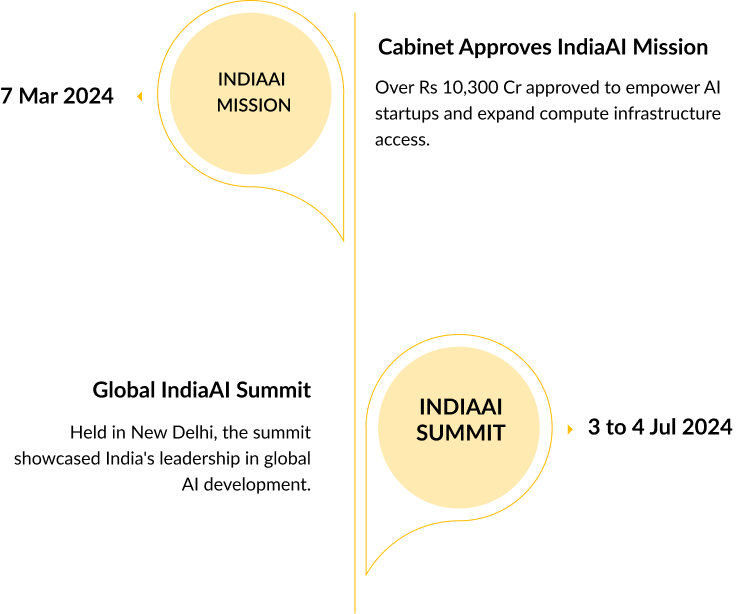
The Cabinet approved the IndiaAI Mission on 7th March 2024. The mission aims to harness AI's transformative potential across sectors and democratise access to computational resources, improve data quality, foster indigenous AI capabilities, attract top talent, support startups through risk capital, encourage industry collaboration, promote socially impactful AI projects, and ensure ethical AI development and use.
Recognising the importance of data in AI development, the Modi government has launched the IndiaAI Dataset Platform to provide seamless access to high-quality, non-personal datasets. This platform will house the largest collection of anonymised data, empowering Indian startups and researchers to develop advanced AI applications. By ensuring diverse and abundant datasets, this initiative will drive AI-driven solutions across key sectors, enhancing innovation and accuracy.
Advancing AI with Open Data and Centres of Excellence (CoE)
The platform will enable Indian startups and researchers to access a unified repository of high-quality, anonymised datasets, reducing barriers to AI innovation.
By providing large-scale, non-personal datasets, the initiative will help reduce biases and improve the reliability of AI applications across domains such as agriculture, weather forecasting, and traffic management.
The government has established three AI Centres of Excellence (CoE) in Healthcare, Agriculture, and Sustainable Cities in New Delhi. The Budget 2025 further announced a new CoE for AI in education with an outlay of ₹500 crore, making it the fourth such centre.
Plans are in place for five National Centres of Excellence for Skilling, which will equip youth with industry-relevant expertise. These centres will be set up in collaboration with global partners to support the 'Make for India, Make for the World' vision in manufacturing and AI innovation.
The government is facilitating the development of India's own foundational models, including Large Language Models (LLMs) and problem-specific AI solutions tailored to Indian needs. To foster AI research, multiple Centres of Excellence have also been set up.
India's AI Models and Language Technologies
IndiaAI has launched an initiative to develop indigenous foundational AI models, including LLMs and Small Language Models (SLMs), through a call for proposals.
An AI-led language translation platform designed to enable easy access to the internet and digital services in Indian languages, including voice-based access, and support content creation in Indian languages.
The world's first government-funded multimodal LLM initiative, BharatGen was launched in 2024 in Delhi. It aims to enhance public service delivery and citizen engagement through foundational models in language, speech, and computer vision.
A large language model optimised for Indian languages, Sarvam-1 has 2 billion parameters and supports ten major Indian languages. It is designed for applications such as language translation, text summarisation, and content generation.
An open-source video transcreation platform developed by AI4Bharat, Chitralekha enables users to generate and edit audio transcripts in various Indic languages.
A multilingual AI system developed by SML, Everest 1.0 supports 35 Indian languages, with plans to expand to 90.
India’s Digital Public Infrastructure (DPI) has redefined digital innovation by combining public funding with private sector-led innovation. Platforms like Aadhaar, UPI, and DigiLocker serve as the foundation, while private entities build application-specific solutions on top of them. This model is now being enhanced with AI, integrating intelligent solutions into financial and governance platforms. The global appeal of India’s DPI was evident at the G20 Summit, where several countries expressed interest in adopting similar frameworks. Japan’s patent grant to India’s UPI payment system further underscores its scalability.
For Mahakumbh 2025, AI-driven DPI solutions played a crucial role in managing the world’s largest human gathering. AI-powered tools monitored real-time railway passenger movement to optimise crowd dispersal in Prayagraj. The Bhashini-powered Kumbh Sah’AI’yak Chatbot enabled voice-based lost-and-found services, real-time translation, and multilingual assistance. Its integration with Indian Railways and UP Police streamlined communication, ensuring swift issue resolution. By leveraging AI with DPI, Mahakumbh 2025 set a global benchmark for tech-enabled, inclusive, and efficient event management.
AI Integration with Digital Public Infrastructure
India's workforce is at the heart of its digital revolution. The country is adding one Global Capability Center (GCC) every week, reinforcing its status as a preferred destination for global R and D and technological development. However, sustaining this growth will require continuous investment in education and skill development. The government is addressing this challenge by revamping university curricula to include AI, 5G, and semiconductor design, aligning with the National Education Policy (NEP) 2020. This ensures that graduates acquire job-ready skills, reducing the transition time between education and employment.
AI Talent and Workforce Development
Under the IndiaAI Future Skills initiative, AI education is being expanded across undergraduate, postgraduate, and Ph.D. programs. Fellowships are being provided to full-time Ph.D. scholars researching AI in the top 50 NIRF-ranked institutes. To enhance accessibility, Data and AI Labs are being established in Tier 2 and Tier 3 cities, with a model IndiaAI Data Lab already set up at NIELIT Delhi.
According to the Stanford AI Index 2024, India ranks first globally in AI skill penetration with a score of 2.8, ahead of the US (2.2) and Germany (1.9). AI talent concentration in India has grown by 263% since 2016, positioning the country as a major AI hub. India also leads in AI Skill Penetration for Women, with a score of 1.7, surpassing the US (1.2) and Israel (0.9).
India has emerged as the fastest-growing developer population globally and ranks second in public generative AI projects on GitHub. The country is home to 16% of the world’s AI talent, showcasing its growing influence in AI innovation and adoption.
The India Skills Report 2024 by Wheebox forecasts that India’s AI industry will reach USD 28.8 billion by 2025, with a CAGR of 45%. The AI-skilled workforce has seen a 14-fold increase from 2016 to 2023, making India one of the top five fastest-growing AI talent hubs, alongside Singapore, Finland, Ireland, and Canada. The demand for AI professionals in India is projected to reach 1 million by 2026.
India's Generative AI (GenAI) ecosystem has seen remarkable growth, even amid a global downturn. The country's AI landscape is evolving from experimental use cases to scalable, production-ready solutions, reflecting its growing maturity.
AI Adoption and Industry Growth
According to BCG, 80% of Indian companies consider AI a core strategic priority, surpassing the global average of 75%. Additionally, 69% plan to increase their tech investments in 2025, with one-third allocating over USD 25 million to AI initiatives.
According to a November 2024 report by National Association of Software and Service Companies (NASSCOM), Indian GenAI startup funding surged over six times quarter-on-quarter, reaching USD 51 million in Q2FY2025, driven by B2B and agentic AI startups.
The Randstad AI and Equity Report 2024 states that seven in 10 Indian employees used AI at work in 2024, up from five in 10 a year earlier, showcasing AI’s rapid integration into workplaces.
AI-driven technologies, such as autonomous agents, are helping SMBs scale efficiently, personalise customer experiences, and optimise operations. According to Salesforce, 78% of Indian SMBs using AI reported revenue growth, while 93% stated AI has contributed to increased revenues.
As per the BCG-NASSCOM Report 2024, India’s AI market is projected to grow at a CAGR of 25-35%, reinforcing its potential for innovation and job creation. While AI automates routine tasks, it is simultaneously generating new opportunities in data science, machine learning, and AI-driven applications.
India hosts 520+ tech incubators and accelerators, ranking third globally in active programs. 42% of these were established in the past five years, catering to the evolving needs of Indian startups. AI-focused accelerators like T-Hub MATH provide crucial mentorship in product development, business strategy, and scaling. In early 2024, MATH supported over 60 startups, with five actively discussing funding, highlighting India's growing AI startup landscape.
To foster informed deliberation and action among stakeholders engaged in shaping India’s artificial intelligence (AI) policy and governance landscape, the Office of the Principal Scientific Adviser to the Government of India is producing this White Paper Series. These papers are conceived as explanatory briefs that examine specific policy issues and their associated nuances, with the aim of enabling broader understanding and meaningful societal engagement. The White Papers are developed by drawing on collective insights from the extended AI ecosystem, including inputs from multi-stakeholder consultations, bilateral and multilateral AI policy engagements, and subsequent expert reviews. They are intended solely as explanatory documents that highlight identified policy priorities and stimulate further discussion. The views presented in these White Papers should not be construed as formal policy positions of the Office.