
Rural Technology Action Group (RuTAG) is an initiative of the Office of the PSA since 2004. RuTAG, supported by the Office of the PSA, was conceptualized as a mechanism to provide a higher level of S&T intervention and support for rural areas. Under this initiative, the interventions are designed to be primarily demand-driven, focusing on bridging technology gaps at the grassroots level, upgrading technology, and providing training and demonstrations through innovative projects.
Mandate and Objectives
(a) Mandate
- Updating traditional knowledge/methods and practices with appropriate technology developed by research institutions with potential for IPR.
- Connect at grass root level to understand the demands and develop the innovative rural technologies with commercialization potential.
(b) Objectives
- To connect with possible stakeholders like NGOs (Non-Government Organizations), SHGs, (Self Help Groups), COs (Community Organizations) Start-ups, Technology Incubators, and Fabricators to identify sector-specific technology needs.
- To develop demand-driven technologies based on socio-economic data coherent with national/regional priorities, national policies/ schemes etc.
- To validate developed prototypes supported with impact studies and explore their commercialization with scalability aspects.
- To commercialize the potentially validated technologies for national/global markets.
What We Do:
Empowering rural communities: We work to empower rural populations by providing them with the tools and technologies they need to thrive.
Demand-driven solutions: We focus on identifying and addressing specific technological challenges faced by rural communities.
Grassroots implementation: We prioritize practical implementation of solutions at the local level, ensuring a direct impact on people's lives.
Our Approach:
Bridging the technology gap: We bridge the gap between existing technologies and the needs of rural areas by adapting, innovating, and promoting appropriate solutions.
Technology upgrading: We support the upgrading of traditional practices and technologies by incorporating advancements from the established RuTAG Centres.
Capacity building: We provide training and demonstrations to ensure the effective adoption and utilization of new technologies by rural communities.
Promoting Sustainability: We focus on developing technologies with commercialization potential for long-term impact.
Collaboration: We work collaboratively with various stakeholders, including NGOs, SHGs, COs, startups, technology incubators, and fabricators, to achieve our goals.
Click Here to access RuTAG 2.0 ANNUAL PROGRESS REPORT (2024-25)

Launched in 2004, RuTAG Phase 1 established centers at seven selected Indian Institutes of Technology (IITs):
- Indian Institute of Technology Madras (2004)
- Indian Institute of Technology Guwahati(2005)
- Indian Institute of Technology Kharagpur (2008)
- Indian Institute of Technology Delhi (2009)
- Indian Institute of Technology Roorkee (2009)
- Indian Institute of Technology Bombay (2010)
- Indian Institute of Technology Kanpur (2013)
RuTAG Phase 1 fostered strong partnerships with approximately 752 NGOs and engaged in 388 projects. This extensive network facilitated the successful dissemination of these technologies across diverse geographical regions.


The final review meeting for RuTAG Phase-1 projects took place on December 22nd, 2023, chaired by Prof. Ajay Kumar Sood, Principal Scientific Adviser to the Government of India. Principal Investigators (PIs) and Co-PIs from the seven RuTAG Centers (IIT Bombay, Kharagpur, Roorkee, Madras, Delhi, Kanpur, and Guwahati) presented their progress reports, highlighting the program's most successful technological advancements. These technologies were evaluated for their potential for wider dissemination and application across various regions of the country.


The thirty-four (34) technologies from RuTAG Phase-1 have been selected for wider dissemination and scale-up. The descriptions of these technologies can be found in this link.
The videos showcasing these technologies are provided below:
- Modification of the Mechanized Roller with Different Sizes (Namda Roller)
- Pico Hydro Based Cold Storage
- Design of Variable Speed Motorized Bageshwari Wool Charkha
- Air Cooled based Vegetable Vending Push Cart
- Portable Cow Lift for Assisting a Downer Cow
- Technology for Construction of Surface Water Storage Tank using Locally Available Fibers for Watershed Management
- Shaft Water Technology
- Market Mirchi
- Mobile Subjee Cooler
- Hank to Bobbin Winding Machine
- Pirn Winding Machine
- Sectional Warping Machine
- Modified Bicycle As A Rural Vending Cart
- Cold Pressed Oil Extraction Machine
- Sabjikothi
- LCB Fertilizers
- Krishi Mandi Data Driven AI Optimised Agri-Supply Chain
- Integrated Processing Machine
- Tulsi Mala Bead Making Device
- Rural Pottery Kiln
- Sheep-hair Shearing Device
- Bangle Making Furnace
- Ground Water Level Measuring Device
- Carpet Loom
- Bidriware Metal Coloring Technique
- Electronic Jacquard Handloom for Weaving Fine Korai Design Mats
- Upgradation of Automatic Coir Spinning Machines- Kerala State Coir Machinery Manufacturing Company (KSCMMC)
- Crossfyre Platform
- Mango Decorticator
- Retrofit Vending Cart Models
- Puffed Rice Making Machine
- Sabai Grass Rope Making Machine
- Motorized Potter’s Wheel
- Motorized Sutli Making Technologies
The Office of the Principal Scientific Adviser launched RuTAG 2.0 in April 2023 with the objectives of connecting with stakeholders, to identify grassroots innovations, developing demand-driven technologies, validating prototypes, and commercializing technologies for national and global markets.
Key Focus Areas:
✔ Commercialization: By prioritizing the commercialization of developed technologies, RuTAG 2.0 will ensure that the solutions are commercially viable and sustainable in the long run, maximizing their socio-economic impact on rural communities.
✔ Expanded Dissemination: RuTAG 2.0 will actively facilitate the broader dissemination of these technologies as marketable products. This focus on widespread availability envisages that the benefits reach a larger population in rural areas, fostering inclusive growth.
RuTAG 2.0 is implemented by the following seven Project Implementing Agencies (PIAs):
- Indian Institute of Technology Bombay
- ICAR – National Academy of Agricultural Research Management, Hyderabad
- Sher-e-Kashmir University of Agricultural Sciences & Technology, Jammu and Kashmir
- Indian Institute of Technology Roorkee
- Indian Institute of Technology Delhi
- Indian Institute of Technology Madras
- Indian Institute of Technology Guwahati.
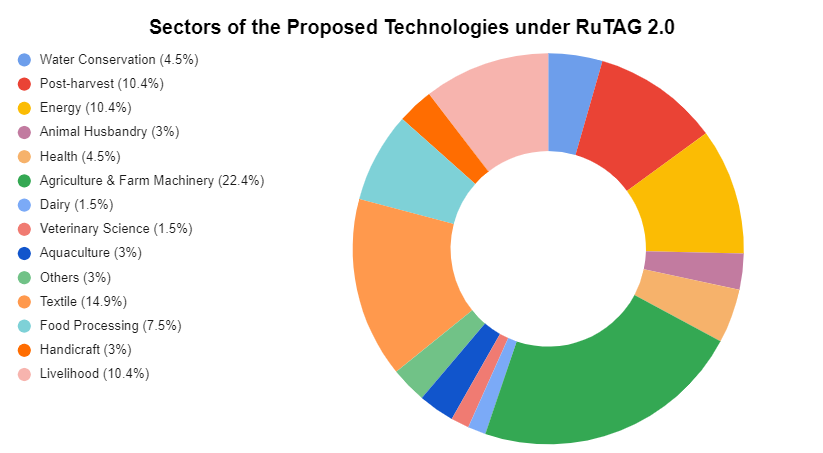
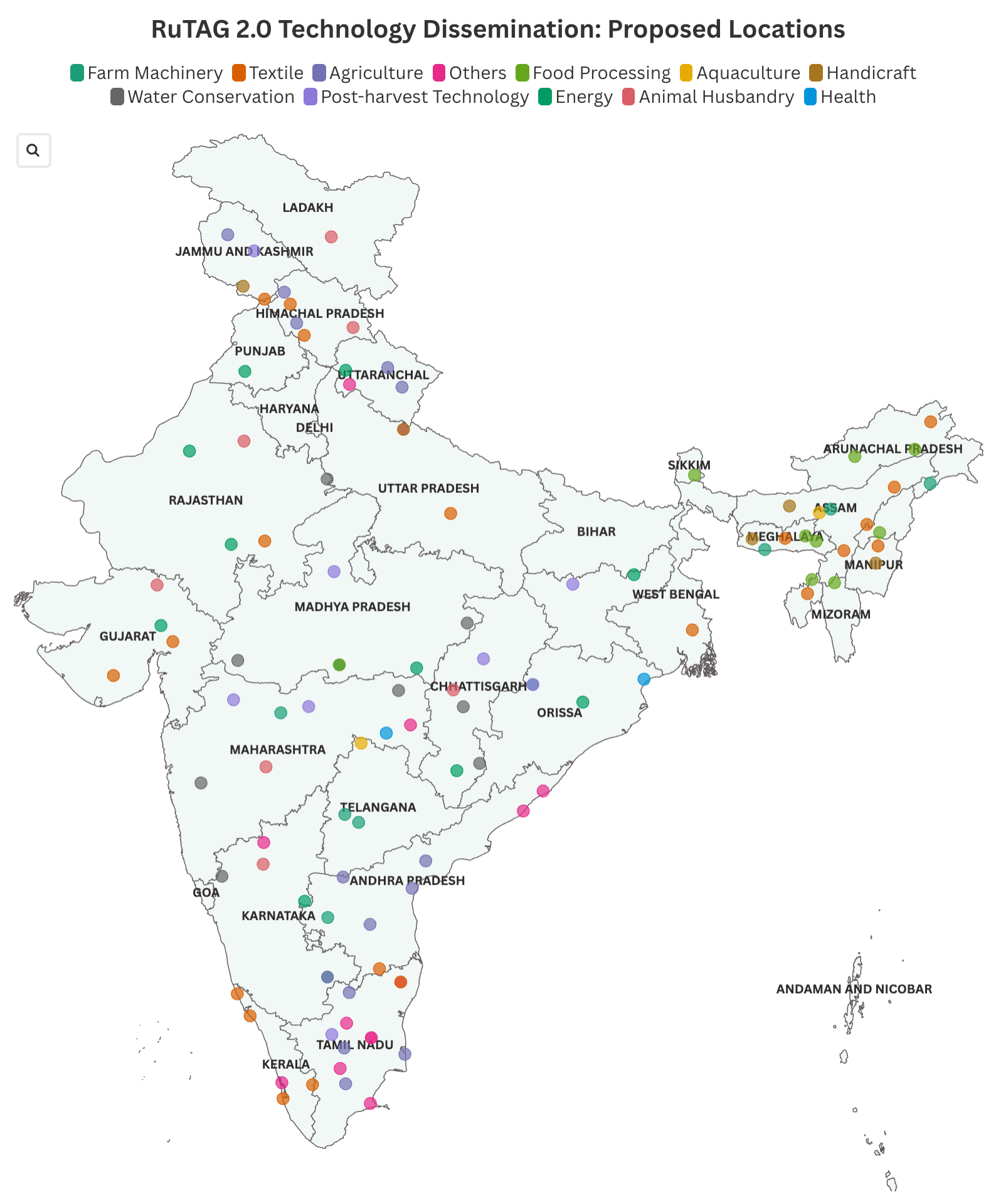
Latest Updates On RuTAG 2.0
5-6th December, 2024-The first Annual Review Meeting of RuTAG 2.0 Projects
23rd August 2024-First Project Review & Monitoring Committee (PRMC) Meeting held at ICAR-NAARM Hyderabad
April 25, 2025 - The Second PRMC meeting of the RuTAG 2.0 projects
13-14 November 2025 - Annual Review of RuTAG 2.0 Centres
2024-25 - Release of RuTAG 2.0 Annual Progress Report (2024–25)
Grassroots Innovation & Startup Exhibition
Inauguration of New Innovation Facilities at IIT Guwahati
RuTAG Stakeholders Meeting
An Initiative of the office of the Principal Scientific Adviser to the Government of India
   | Contact UsDr. Rakesh Kaur Adviser/Scientist ‘G’ RuTAG Program Head & Coordinator, (Adviser/Scientist 'G', Office of the PSA) Email: kaur[dot]rakesh [at] gov.in / rutag-project [at] psa.gov.in |