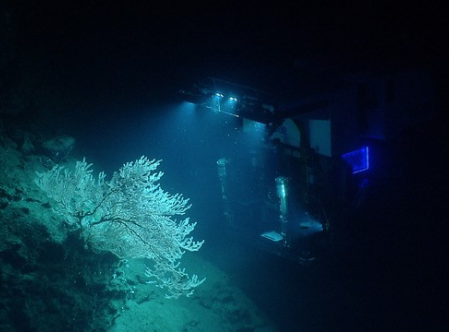
This mission will explore the deep oceans to improve our understanding of the blue frontier.



























"leadPartners": {
"normal": "Lead Partners",
"colored": null
},
"goals": {
"normal": "Sustainable Development Goals",
"colored": null
},
"newsHighlights": {
"normal": "Deep Ocean Mission News And Highlights",
"colored": null
},
"updates": {
"normal": "Deep Ocean Mission Updates",
"colored": null
},
"videoGallery": {
"normal": "Video Gallery",
"colored": null
},
"publications": {
"normal": "Publications & Reports",
"colored": null
},
"introduction": {
"normal": "Introduction",
"colored": null
}
}
The depth of the seas is a treasure trove for any country. Blessed with a long coastline of over 7500 km (1), the country draws numerous benefits from the seas. While the huge ports help us in vibrant trade, the blue economy, inclusive of fishing and other activities is extremely beneficial for India. In addition to the above, the depths of the seas have much more to offer. India’s Exclusive Economic Zone spreads over 2.2 million sq. km. and in the deep sea, lies “unexplored and unutilized”. Understanding the seas would also go a long way in mitigating the crisis of climate change.
The aim of the ‘Deep Ocean Exploration’ of the PM-STIAC is to scientifically explore the deep oceans towards improving our understanding of the blue frontier. The information from this mission will address issues arising from long-term changes in the ocean due to climate change. The focus areas cover the development of technologies for deep-sea exploration and exploitation of living (biodiversity) and non-living (minerals) resources; development of underwater vehicles and underwater robotics; development of ocean climate change advisory services; technological innovations and conservational methods for sustainable utilization of marine bio-resources; offshore based desalination techniques; and renewable energy generation.
Joining countries such as China, France, Germany, Japan, South Korea, and Russia, India has also taken significant steps in the deep ocean mission. In 2019, the government of India has initiated a ₹8,000-crore plan to explore the depths of the ocean (2) with multidimensional aims including the exploration of metals and minerals. Moreover, India has also been allotted a site of 75,000 sq. km. in the Central Indian Ocean Basin (CIOB) by the UN International Sea Bed Authority for the exploitation of polymetallic nodules (PMN). Just utilizing 10% of the PMN reserve available in the area, the country can meet its energy requirements for the next 100 years (3).